The Toyota Prius was doing its conscientious best, and Dana Guernsey wanted a race car. At Dartmouth, she worked on converting a student Formula car to hybrid power. The attraction was performance: could a cleaner machine also be a more exciting one? Environmental virtue had acquired a reputation for sensible shoes. Here was a chance to put it on a starting grid.
That student project offers a useful introduction to Guernsey, now co-founder and chief executive of Voltus. She has spent her career working where engineering meets incentives, searching for arrangements in which a useful environmental outcome also makes commercial sense. A business customer getting paid to adjust electricity use fits that preference rather neatly. So does a power system making better use of equipment it already owns.
By October 2026, her company had announced a $225 million financing round and an expanded agreement with Google to develop a gigawatt-scale virtual power plant. The scale has changed considerably since the Dartmouth workshop. The underlying curiosity remains recognisable: what could this system do if we organised it differently?
A racing education, with rules attached
Guernsey grew up in Queens, New York. At Dartmouth, she combined mechanical engineering with studio art, having imagined a future in architecture. There is a pleasing logic to that combination: calculate whether something will stand up, then consider whether anyone will enjoy looking at it. Electric vehicles eventually captured her attention, offering another meeting point between design, practical constraints and human enthusiasm.
Her racing project belonged to a wider Dartmouth effort with an unusually instructive complication. The students' work on hybrid powertrains ran into Formula SAE rules that excluded hybrid entries. The engineering school helped establish a separate competition. Formula Hybrid was formally founded in 2006; its first official competition followed in 2007 at New Hampshire Motor Speedway.
The resulting challenge asked teams to design, build and compete with hybrid or electric race cars, giving fuel efficiency a place alongside performance. Mechanical, electrical and computing disciplines had to cooperate. A car, unlike a committee, eventually has to move.
It would be too tidy to treat every later career choice as a consequence of that episode. Still, it supplies a revealing early encounter with the relationship between technical possibility and participation rules. A working machine needs somewhere to compete. Years later, that question would recur in electricity markets, where useful resources also need permission, measurement and a route to payment.
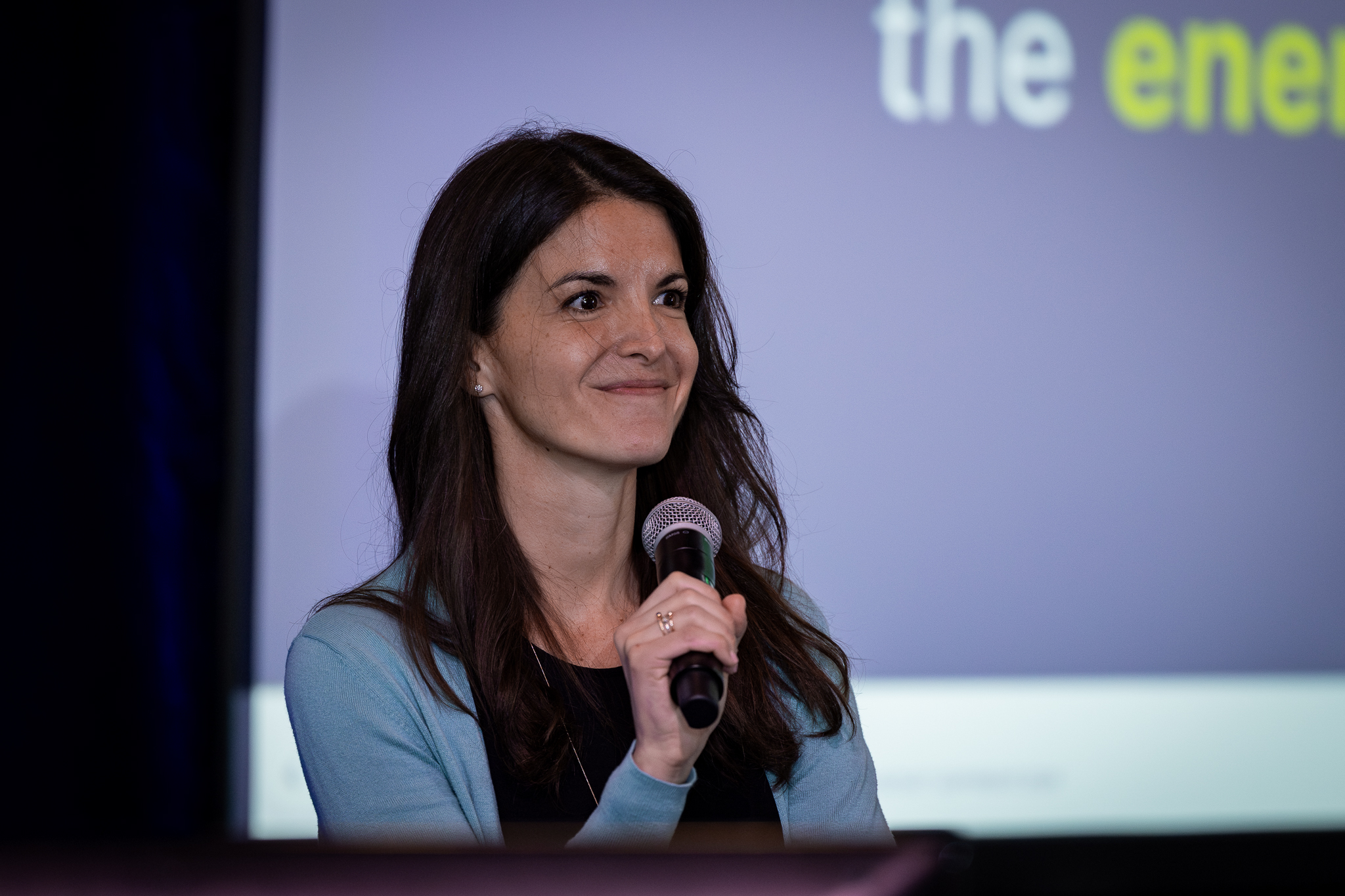
The appeal of paying people to use less
EnerNOC supplied her introduction to demand response. The proposition caught her imagination: customers could earn money by using less electricity when the system needed relief. She spent seven years there and came to lead its international energy markets group. What interested her was the business model as much as the machinery. Existing equipment could acquire another job, provided someone understood how to connect its capabilities to a market.
She subsequently worked at Ambri, the battery company developing long-duration grid storage, and at FirstFuel, where she was director of product marketing. These roles put her close to different parts of the same problem: storing energy, improving efficiency and making complicated offerings intelligible to customers. Her career accumulated a vocabulary that crossed the usual boundaries between hardware, software and commercial rules.
In 2014, Mass High Tech and the Boston Business Journal named her a Woman to Watch. At EnerNOC, she had responsibility for a demand response portfolio of nearly 10,000 megawatts spanning wholesale markets and utilities in North America, Europe, Asia and Australia. Those markets gave her plenty of opportunities to discover that electricity is universal while its paperwork is emphatically local.
Voltus publicly announced her arrival in October 2017 as vice president of market and business operations. Its announcement placed a familiar challenge at the centre of the job: complex markets should produce an understandable offer for the customer. The customer, after all, has a business to run. Learning a second profession in wholesale electricity is a fairly extravagant condition to attach to saving money.
A power plant scattered across other people's buildings
Guernsey became Voltus's chief product officer before taking over as CEO in January 2024, succeeding co-founder Gregg Dixon. Her work had included developing the platform connecting customers and partners to electricity markets, then widening the kinds of resources it could accommodate. At the transition, Voltus reported 5.8 gigawatts integrated across nine wholesale markets in the United States and Canada.
A virtual power plant makes more sense when the word virtual is relieved of its mystique. The equipment is real. Batteries, building controls and industrial processes sit at actual sites with actual operating limits. Software and market operations coordinate them so their combined response can become useful to a grid operator. The flexibility comes from what those sites can adjust, at an agreed time, while continuing to meet their own needs.
The delicate part is the fit. An adjustment that suits one facility may be unsuitable for another. A payment opportunity must justify the effort of participating. Voltus's role brings together equipment, customer requirements and the rules governing compensation. Guernsey's product background sits squarely in that junction, where a technical capability becomes an offer someone can accept.
- Customer flexibilityBatteries, cooling and adjustable processes
- Voltus coordinationCombine resources and respond to market needs
- Grid service + customer valueDemand relief, revenue and potential bill savings
A simplified illustration of the model; participation depends on the resource and market.
In December 2025, Voltus said its platform had been dispatched on each of the preceding 365 days. It reported 8.1 gigawatts under management and expected to deliver $240 million in customer earnings and savings that year. Its customer awards included a winery, a hotel, a glass manufacturer and a water authority. This is a rather varied cast for a power station, which is precisely the point.
Complexity earns its keep
Guernsey's account of building Voltus gives complexity an unusually hospitable reception. Different rules, changing customer requirements and evolving markets are part of the operating environment. A platform that can adapt has a reason to exist. The ambition she described in a 2025 conversation was concise:
“We wanted adaptability to be our superpower.”
Dana Guernsey
There is humour in her interviews as well as technical fluency. Recalling the Dartmouth hybrid project, she has joked about being ahead of Tesla's Roadster. The joke works because the career itself has involved patient work on systems that attract less attention than a sports car. An electricity market integration offers limited opportunities for a glamour shot. Its merits become clearer when a customer gets paid.
Her colleagues offer a more personal view. Former teammates describe analytical skill alongside calm leadership and mentorship. One recalled her help with becoming a first-time manager and her attention to individual development. Those recollections describe the less photogenic work of management: helping someone else think through a difficult decision, and making room for their next responsibility.
Guernsey has also described mentoring Dartmouth students through the engineering school's corporate collaboration council, as well as people she meets professionally. She credits mentors of her own, most of them men, and encourages women to recognise useful allies wherever they appear. Her account treats mentoring as a relationship that requires interest and sustained contact. Advice is rather easier to distribute than attention.
The AI boom comes looking for capacity
In 2026, the commercial setting around her changed visibly. At CERAWeek, Guernsey discussed a grid whose existing capacity is used unevenly and argued for making that infrastructure work harder. She predicted that large technology companies could become important stabilisers within five years, through demand management and storage deployment. That remains a forecast, and a useful expression of what she wants to build.
Voltus's June acquisition of Brightfield AI added battery project development capabilities and an experienced storage team. Bringing a battery to a commercial site involves evaluation, engineering and installation, well beyond displaying an attractive savings estimate. The acquisition addressed those practical steps. For Guernsey, who had earlier worked on storage commercialisation at Ambri, batteries were becoming a larger part of the business she now led.
By July, she described roughly 8.5 gigawatts under management. She also described a change in the conversation around flexible capacity: customers and grid participants increasingly wanted to know how much could be delivered and how soon. The company's Bring Your Own Capacity offering gave large electricity users a way to help finance additional distributed resources.
Voltus says it aims to grow its platform to 20 GW by 2030. The target describes its plans.
The October financing brought Generation Investment Management in as lead investor, with Activate Capital and Vitol as co-leads. Two weeks later, Google and Voltus announced the expansion of their PJM agreement to a gigawatt-scale virtual power plant, following an initial agreement in June. The model assembles flexible resources from homes and businesses, with participating customers receiving financial benefits. It is an agreement to develop capacity, with work still ahead.
Still interested in what the machine can do
Guernsey now lives in Boulder, Colorado. Away from work, she enjoys skiing, biking and hiking with her family. The early interest in movement appears to have survived a career in markets, although it would be presumptuous to give every bicycle ride an energy-sector metaphor.
What does connect the chapters is her attention to practical usefulness. A hybrid race car had to perform. A customer offer has to make financial sense. Flexible capacity has to arrive when it is needed. Her aspirations for a more affordable, reliable and lower-emissions grid depend on those ordinary tests, repeated across many sites.
The race car made the proposition visible: cleaner technology could be something people wanted. Voltus takes that proposition into less conspicuous surroundings, among cooling systems, factory schedules and batteries. Guernsey's work asks customers to see another possibility in familiar equipment. There may be an additional business hiding in the building. It would be a shame to leave it idle.