Dan Brillman could fly a military aircraft. Helping a friend find the right organization proved a different sort of navigation. After a deployment, while he was attending Columbia Business School, veterans he had served with began calling for assistance. He did what a willing friend with an internet connection might do: he searched Google. An MBA was evidently expected to come with a directory of useful answers. His did not.
The requests concerned the practical business of civilian life: work, somewhere to live, the next person to call. Brillman had encountered a problem with an awkward shape. Plenty of organizations wanted to help. Getting them to work together required another layer of effort, often supplied by the person who needed assistance in the first place. Good intentions had acquired rather a lot of administration.
That difficulty became the subject of a business-school paper, then a company. In 2013, Brillman co-founded Unite Us. He would spend twelve years as its chief executive. Along the way, an early product was discarded, a partnership endured, and a small venture became a national software business. The story is less tidy than an ascending line on a presentation slide, and more interesting for it.
An education with a flight plan
Brillman graduated from Yale in 2006 with a degree in political science. Finance and consulting followed. His route then took him into the Air Force Reserve, where he trained as a KC-10 pilot. These are substantial changes of setting: from studying institutions, to working inside businesses, to serving in a military organization where coordination carries a very immediate meaning.
He completed deployments in Iraq and Afghanistan and earned multiple air medals and bronze campaign stars. His subsequent assignments have included liaison work with the Defense Innovation Unit. He has continued serving as a reservist alongside his civilian career. The military chapter belongs in the middle of his story as well as at its beginning; it was never merely an interesting preface to a company biography.
In a cockpit, a useful answer needs to arrive where it is needed. The attraction of that principle extends well beyond aviation. A founder can have an elegant idea and still leave the next person wondering what happens now. Brillman’s later work would concentrate on that troublesome space between a request and a completed task.
He earned his Columbia MBA in 2012 and worked with Scout Ventures in New York. Venture capital placed him near people evaluating new businesses. His own idea had a less abstract starting point: people he knew were asking for help, and the process of helping them exposed the same difficulty again.
The useful accident at Columbia
Taylor Justice had been examining a similar difficulty from Philadelphia. An Army veteran, he had volunteered with a local veteran organization and seen needs spill beyond the help any one group could provide. Columbia’s military network connected him with Brillman in 2012. The introduction brought together two people who had already spent time on the problem before they spent time on each other’s business plans.
There is a particular advantage in that sequence. A prospective partner who recognizes the problem does not need every sentence translated. The conversation can move to what might be done, what has already failed, and what each person is prepared to undertake. Shared experience gives the first meeting somewhere useful to begin. The working relationship still has to be built.
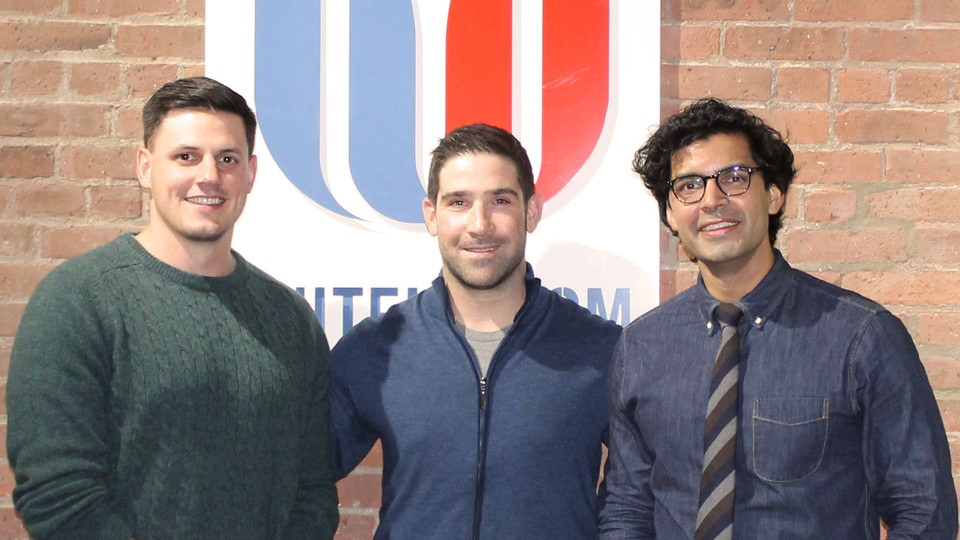
By 2017, the two founders were welcoming a Columbia podcast into their Lower Manhattan office. The photograph records an unceremonious chapter of the enterprise: colleagues standing in front of a company banner, the work already several years old. Business histories tend to prefer launch days and funding days. An ordinary day in the office is where much of the company actually happens.
Brillman’s partnership with Justice also offered room for different reactions. Justice has described Brillman as the more level-headed of the pair. That is a useful quality in a venture with ample opportunities for excitement. A business needs people who can register the urgency of a problem and still decide which part can sensibly be addressed this week.
A product is allowed to be wrong
The early version of Unite Us faced consumers. Brillman and his partners eventually shut that product down and moved to a business-to-business model. The problem survived the first answer. That distinction is easy to admire once a company has grown; it is harder to live through when the product being retired contains your own effort and judgment.
Changing the customer changes the work. Software for an organization must fit the people using it, the information they need, and the decisions they are authorized to make. A network of organizations adds another complication: each participant arrives with habits of its own. Agreement on a worthy purpose does not automatically produce agreement on Tuesday afternoon’s workflow.
Brillman described the first community network as taking about six months to launch. Much of that time involved sitting with partners and mapping the process. His account gives the enterprise a useful sense of proportion. The software mattered. So did the patient business of establishing what people would do with it, and how they would know the next organization had acted.
Consider the difference between passing along a telephone number and knowing whether the call achieved anything. The first action is easy to record. The second demands cooperation. Brillman’s founding question lived in that second part. It explains why conversations with organizations could be as consequential as decisions about the interface.
In 2021, Unite Us raised a $150 million Series C led by ICONIQ Growth, at a reported valuation above $1.6 billion. The amount makes a conspicuous marker in the company’s history. It also arrived eight years after the founding. The interval deserves as much attention as the number: there had been a great deal of listening, revision, and implementation before that announcement.
Series C financing led by ICONIQ Growth.
The fridge belongs in the story
A 2021 speaker biography supplied a less expensive measure of executive involvement. It described Brillman working alongside engineers on a Saturday, joking with colleagues on Slack, and stocking the office snack cabinet and fridge. The fridge is a welcome detail. Executive biographies generally reserve their attention for the money coming into the company, rather than the groceries.
Such anecdotes cannot tell us everything about a workplace. They can make a person visible inside it. Here is a founder whose documented routine included small jobs as well as consequential ones. The ordinary task offers colleagues a rather direct indication of whether somebody regards themselves as part of the working group.
The question grows more difficult as a company expands. People hired later cannot rely on having shared every early experience. Decisions travel through more layers. A leader has to find ways to hear what those layers contain. The practical test of an accessible chief executive is whether an employee’s useful information can still reach a decision.
In 2023, Unite Us received workplace recognition and described benefits including paid parental leave, flexible time off, and employee financial planning. Those are organizational choices, with budgets and policies attached. They give the discussion of culture something more substantial to rest on than an attractive sentence on an office wall.
“It is impossible to do everything by yourself.”
Dan Brillman
That admission is especially useful coming from a founder. A business begins with a small group making an unreasonable number of decisions. Growth requires other people to acquire genuine authority over parts of the work. The founder’s early usefulness can become a constraint if every answer must continue to pass through the same desk.
Twelve years, then a handover
On October 28, 2025, Unite Us announced that Justice would succeed Brillman as chief executive. Brillman was leaving the company for a new role. The announcement closed a twelve-year period in which the two had built together, with Justice taking responsibility for the next chapter of the organization they had helped establish.
Brillman subsequently moved into federal leadership. His current official biography also places him in Washington and Philadelphia with his wife and two children, while his Reserve service continues. The settings have changed over the years, but the combination of business, military service, and public institutions has remained unusually consistent.
A handover gives a founding story a useful ending without requiring the company itself to stop. There are colleagues to continue the work, a partner who knows how it began, and decisions that will now belong to others. Building something that can proceed beyond its first chief executive is a substantial part of building it at all.
Brillman’s career contains aircraft, investment rounds, and formal titles. Its most revealing beginning is still a friend making a call. He tried to help, found the process cumbersome, and kept asking what would make it work. Twelve years of company-building followed that question. Even with a much larger balance sheet, it remained a practical question: who needs to speak to whom, and what happens next?