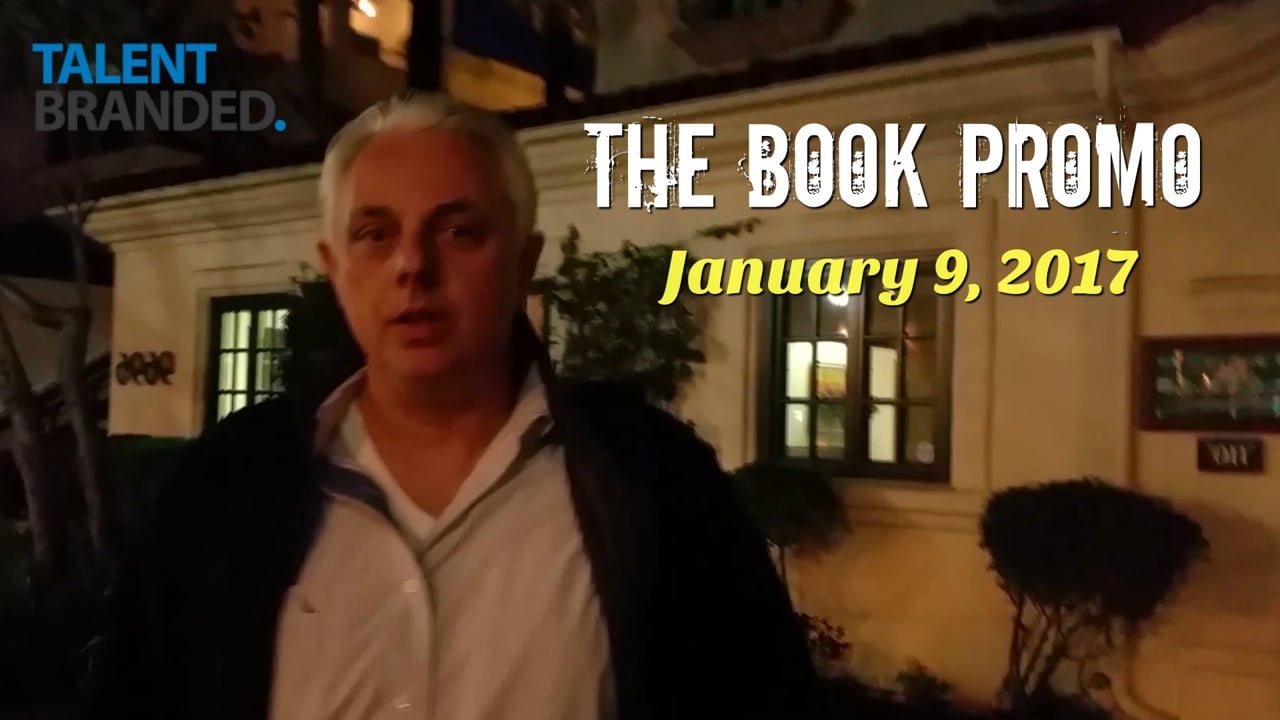
A book promotion has a date. In Damon Frank's case, one of those dates was January 9, 2017. There was a team at Talent Branded, social media material to put together, and a Facebook Live event for a new television show to support. The resulting behind-the-scenes video carried a wonderfully unromantic title: The Book Promo Shoot. Here was a small view of a career usually described in much larger nouns: talent, branding, entertainment.
The date is worth keeping. A brand sounds permanent; a promotion happens on a Monday. Somebody has to make the material, coordinate the people and get it in front of an audience while the occasion still matters. Frank was working in that gap between having a person worth watching and giving people a reason to watch now.
His career connects the co-founding of Venture IAB with television packaging, celebrity brand management and the founding of Talent Branded. The connecting question is practical: once someone has your attention, what can happen next? A programme, a product, a conversation, a purchase. Applause is pleasant. It is also rather difficult to put on an invoice.
The agency with several kinds of doors
Frank co-founded Venture IAB with Neil Stearns. The Los Angeles firm's own account places that partnership in 2006. Its business crossed talent representation, entertainment packaging, endorsements and marketing partnerships, bringing celebrities, experts, creators and brands into the same commercial conversation.
By 2014, Frank appeared as CEO, with Stearns as president. The agency had separate theatrical and commercial leadership, as well as youth representation. Those distinctions give the enterprise some shape. An actor pursuing a role and a brand pursuing an endorsement may both need an introduction, but the introduction is only the beginning of quite different assignments.
That range helps explain Frank's later movement into marketing. He came from a business in which the individual could be the starting point for several kinds of work. A recognizable personality might appear on screen, lend credibility to a partnership, or become associated with an offer beyond the programme itself. Each possibility required its own arrangement.
The useful thing about the CEO title is its historical precision. It places Frank inside an operating agency at a particular point in his career. The more interesting thread runs through the agency's mix of activities: representation alongside commercial development, and the effort to give talent somewhere useful to go.
The agency structure also puts several kinds of judgment under one roof. The person assessing a performance opportunity may be asking different questions from the person considering a marketing partnership. Read that way, Frank’s agency background supplies a useful setting for the later career: a place where a person’s appeal had to be understood in relation to an actual assignment.
A dog expert, a pawn shop, a hotel
Consider three of the programmes connected to Frank's entertainment work: The Dog Whisperer with Cesar Millan, Pawn Stars and Hotel Impossible. A dog expert, a pawn business and a hotel setting are very different starting materials. The titles themselves show how readily a particular kind of knowledge or workplace can become the centre of a viewing proposition.
Frank's credits include packaging work on Pawn Stars and brand and packaging work connected to The Dog Whisperer. His entertainment experience also includes Hotel Impossible. These are specific contributions within programmes made by many people. The packaging role is especially revealing because it sits between recognizing an interesting person or situation and assembling a proposition others can act on.
It is easy to talk about personality as if it travels unaided. Commercially, it needs a form: a programme, a campaign, an agreement. Frank's move across representation and brand work is interesting at precisely this level. The person remains important; the assignment changes around them.
He also served as brand manager for Christopher Knight Brands. That brings another question into view: what can recognition support beyond an appearance? The answer has to survive the ordinary demands of a customer. A familiar name may earn a glance. The offer still has to earn consideration.
The fifteen-minute question
In May 2017, Frank explained how service businesses could use a free consultation. His advice descended quickly from the idea to the mechanics: put the offer on the website, make the call to action clear, tell people how long the meeting will last, and decide what happens when they click.
He treated that conversation as a way to establish whether the prospective customer and the business suited each other. The distinction matters. A booking gives both sides a chance to discover whether there is a useful piece of work to do together. Simply collecting interest leaves that question unanswered.
There is something appealingly modest about specifying the duration. Fifteen minutes is an understandable request. An undefined invitation to discuss an undefined possibility is a small administrative fog. Give the conversation edges, and the prospective customer can decide whether to enter it.
This is an editorial reading of his advice: the little decisions are part of the offer. The button, the form and the stated time tell a visitor what sort of interaction to expect. They make a service easier to approach before the service itself has begun. Frank's example takes a broad promise about growth and gives it a place on a page, a next action and a slot in a calendar.
“Your expertise needs to be easy to understand.”
Damon Frank
When the agent starts explaining
Frank also made short marketing videos. One instalment of Marketing Minute, titled Be The Expert, dealt with building out the first two personas. Even that brief description points toward a particular habit: define the people involved before trying to persuade them.
The title offers a nice glimpse of the change in his public role. An agent works on somebody else's presentation. A teacher has to make his own explanation hold an audience. The material becomes a demonstration of the very problem under discussion: how to give someone a clear reason to listen.
That makes the book-promotion film an apt companion to the instructional clips. One shows a day's assignment; the other offers a small piece of advice. Together they let the viewer encounter the work at two scales, from a particular promotion to a repeatable question about customers.
There is a useful discipline in that pairing. A tidy piece of advice can seem effortless when separated from the people and deadlines required to apply it. The shoot puts the calendar back into the picture. The work has a date, the date arrives, and the explanation has to become something an audience can actually see.
A conceptual illustration of the career's recurring problem, rather than a published company process.
Pep and June join the business
There is another way to see Frank's interest in audiences and offers: watch him become the presenter. Home Deals with Damon covers household, garden, pet and office products. Its reviews and shopping pages connect the presentation to products available through retailers including Amazon and Walmart.
The dogs are named Pep and June. They have a place in his product selections, which is a welcome adjustment to the usual cast of business profiles. A dog has limited interest in a positioning statement. A chew toy, on the other hand, is a proposition worth investigating immediately.
In a March 2024 account of reviewing BetterBone, Pep, described as a Labrador-Great Dane mix, took the toy into another room before the review had properly started. Frank had to get the dog and her new possession back in front of the camera. The intended demonstration had acquired a participant with her own production schedule.
The anecdote makes a small but useful change of perspective. After work helping other personalities reach an audience, Frank is on the presenting side himself, with a household object to explain and a dog to retrieve. The review pages disclose that purchases through their links may generate affiliate commissions. The path from an audience's interest to a transaction is right there in the format.
What follows the introduction
Today, Frank's public business identity includes Talent Branded and a publication called Authority & Revenue. His career has moved through agencies, celebrity brands, instructional content and product presentation. The settings differ, yet the work repeatedly returns to the relation between being recognized and giving someone a reason to act.
That makes the Monday shoot a useful place to leave him. A promotion needs more than an interesting subject. It needs material prepared, people coordinated and an occasion made visible. Frank's story becomes clearest in those ordinary verbs. Represent. Package. Explain. Produce. Then see whether the person on the other side of the screen wants to take the next step.