Before Cy Scott made a career out of cleaning up cannabis data, he helped clean up the price of a used car. At Kelley Blue Book, he had crossed from engineering into product management and joined a major redesign of KBB.com. Off to the side, Scott and two colleagues worked on a valuation process to verify used cars. He later called it a little skunkworks project. It escaped the workshop, became a production feature, and earned the company its first patent.
The two colleagues were not incidental. Scott Vickers had known him since college. Brian Wansolich met them at Kelley Blue Book. Together, the three would go on to build two cannabis technology companies, a durable collaboration in a startup culture that sometimes treats co-founder relationships like airport Wi-Fi: essential, unstable, and liable to vanish at the worst moment.
Scott’s recurring subject is not cannabis so much as confusion. A used car has a value, but the truth needs a method. A dispensary has a shelf, but the products need a vocabulary. A retailer has thousands of transactions, but a receipt pile is not yet intelligence. His work has kept returning to the same practical question: how do you turn an unruly collection of facts into a decision someone can use?
The spreadsheet before the brand
Leafly began in 2010 with an experience familiar to anyone who has stared too long at an unfamiliar menu. Vickers encountered a bewildering range of cannabis strains at a dispensary. The founders understood the broad categories, but not the nuances. So they made a spreadsheet to track what they encountered and what they preferred. The seed of the company was not a pitch deck. It was three product people trying to remember what was what.
They reasoned that other people must be equally lost. A public guide could collect reviews, help users keep a journal, and return aggregated, anonymized knowledge to the next person standing before the same confusing shelf. The opportunity was informational, but the design mattered. Cannabis websites of the period often wore the category’s clichés like a uniform. Scott and his co-founders wanted something a person could open at work without performing a nervous browser-tab ballet.
Early posts on startup forums, including Hacker News, brought attention. Then the rush slowed. Scott’s memory of the curve is refreshingly uncinematic: growth became more linear. “It really takes time,” he said in 2015, gently puncturing the myth that every useful product arrives on a rocket. Leafly was bootstrapped. Conventional investors were wary of cannabis. The founders had traction, but traction in a category many investors would not touch was rather like holding a winning ticket for a lottery no bank wished to acknowledge.
“It really takes time.”Cy Scott on Leafly’s growth
Privateer Holdings acquired Leafly in 2012. Scott credited the alignment of the two teams and the backing that followed with helping the platform expand. Leafly later became a familiar consumer brand, but its deeper lesson for Scott was already visible: make an emerging market approachable, use design to lower the social temperature, and let organized information do the persuasive work.
Same trio, harder dataset
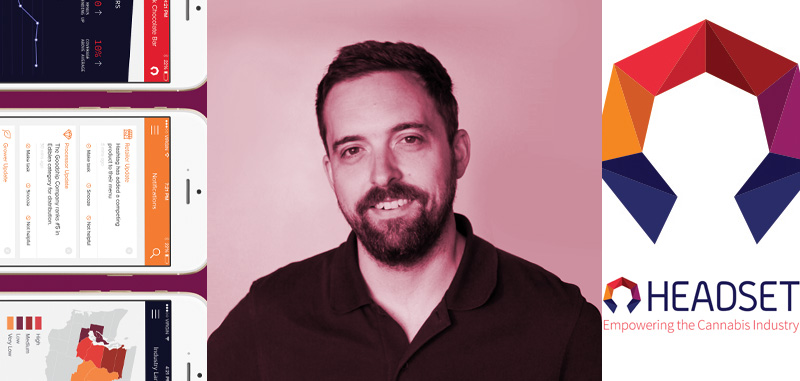
By 2015, Scott, Vickers, and Wansolich had left Leafly and started Headset. The user changed. The problem moved behind the counter. Cannabis businesses were selling in a fast-changing market with limited access to timely operational and market intelligence. The industry had enthusiasm, regulations, new brands, and an impressive supply of anecdotes. It did not have enough reliable ways to answer the plain questions that keep a retailer alive: what sold, at what price, after which promotion, to whom, and what should be reordered?
Headset’s answer was to connect directly to point-of-sale systems. A monthly report is a rearview mirror; a live integration is closer to a windscreen. The company could see baskets, inventory, prices, and the timing of sales. Loyalty programs added demographic and behavioral patterns. Direct feeds also exposed the untidy reality of retail records: different names, different categories, different habits at every shop.
That made normalization the unglamorous center of the product. Headset mapped retailer records back to a common product database, creating what Scott called a uniform language for brands, categories, and segments. Dashboards were only the visible furniture. The serious work happened underneath, where hundreds of versions of roughly the same thing had to agree long enough to become comparable.
Scott likes the phrase “analytics into action.” It is a useful distinction. A beautiful chart can still leave its reader marooned. Headset was designed to connect the display to a next move: judge the lift from a promotion, compare a pricing strategy, watch market share, or determine whether inventory deserves more shelf space. Data becomes valuable when it changes Tuesday’s order, not when it decorates Friday’s meeting.
In November 2023, Headset said it had processed $50 billion in retail measurement data since its founding, covering 970 million transactions and 2.8 billion distinct items. Scott described the ambition as more than aggregation: the company wanted to provide “a compass in an uncharted market.” The metaphor suits him. A compass is a modest instrument. It does not flatter the traveler or promise fine weather. It simply makes the next direction less foolish.
The company between the companies
The continuity of the founding team may be Scott’s particularly reusable advantage. He and Vickers met in college. All three worked together at Kelley Blue Book, then Leafly, then Headset. Their titles eventually divided the terrain neatly: chief executive, chief technology officer, chief design officer. More important, they carried shared context from one problem to the next. They knew how the others thought before the new company had a name.
Kelley Blue Book redesign, product work, and a patented valuation project.
Leafly launches from a spreadsheet-sized consumer problem.
The original trio starts Headset for retail market intelligence.
Headset reports $50 billion in processed retail measurement data.
Scott continues market analysis, podcasting, and conference presentations.
There is another company threaded through the story, one that never issued stock. In 2014 Scott founded and co-organized the Seattle-area Cannabis Tech Meetup to connect entrepreneurs with technology developers. Chapters spread to Denver and San Francisco. The meetup made explicit what his businesses had already demonstrated: a young industry advances faster when people from established technical disciplines can see its unsolved problems up close.
Scott’s technical curiosity did not freeze when his job title acquired the word chief. His public coursework includes deep learning, computational thinking with Python, and model thinking. He also co-hosts The High-Rise with investor Emily Paxhia, a show that mixes market data with the often eccentric procession of policy and business news surrounding cannabis. The pairing is apt. He is animated wherever a noisy headline can be made to answer to a number.
Even the childhood anecdote fits. A podcast profile recounts that Scott sold Jolly Ranchers on the school bus in fifth grade, using the proceeds to play video games at his family’s store. Demand, distribution, reinvestment in technology: the business model was pocket-sized, but structurally sound. One imagines the margins were excellent, provided nobody performed due diligence on the dental consequences.
A market learning to see itself
Headset’s current direction extends the same logic. In 2026 the company described becoming AI-native, while insisting that any artificial intelligence strategy is only as useful as the data beneath it. The claim is less fashionable than it sounds. Models may be new; bad inputs remain vintage. Headset has also added AI-generated retail scenarios and tools for understanding competitive position, customer loyalty, and cross-shopping. The surface changes. The old normalization problem keeps reporting for duty.
Scott has remained a public interpreter of the market, writing analyses, speaking at conferences, and using current sales patterns to test broad claims. In 2026, his schedule included presentations on New Jersey and Ohio, with a Colorado market session announced for September. Headset’s public work increasingly resembles a live newspaper for operators: prices move, categories gain or lose share, holidays distort baskets, and mature markets reveal what younger ones may face next.
“Our vision was never just about data aggregation; it was about providing a compass in an uncharted market.”Cy Scott, 2023
The result is a career with an unusually clean through-line. Scott did not leave engineering behind when he entered product, or abandon product when he became a CEO. He kept moving one level outward. Verify the value. Organize the shelf. Read the market. Each project made a complicated system legible to a larger audience.
Cannabis supplied the volatility, but the craft is portable. Find a category where everyone has data and nobody quite shares a language. Resist the urge to confuse information with insight. Put the answer near the decision. Keep collaborators who can survive more than one company. Allow growth to be linear when linear is honest.
Scott’s companies began with people peering at choices they could not confidently compare. Leafly helped the shopper. Headset helps the operator. Between them sits one patient product principle: a market becomes more mature when its participants can describe what is happening without guessing. The useful founder does not always invent the world. Sometimes he hands it a clearer pair of glasses.