A university can be a neighbor and still need someone to introduce it. In February 2015, Cristal Gary took a job with precisely that complication built in. She was leaving the Illinois deputy governor’s office for the University of Chicago, where part of her assignment was to strengthen relationships with the South Side around the campus. The distance on a map was small. The institutional distance was the work.
Her appointment paired a vice presidency with a senior advisory role in civic engagement. One position put her inside an organization; the other asked her to think about its connection to the city. It was an apt arrangement for a career that has repeatedly crossed the line between making decisions and working with the people affected by them.
Gary is now president and CEO of Meridian’s Illinois business, a position she took in July 2023. But the corporate title is only one entrance to her story. Another is a giving circle on Chicago’s South Side. Another is a government budget office. Taken together, they make a more interesting portrait than a list of promotions: an executive whose work has moved among institutions while returning, repeatedly, to the question of their relationship with a place.
The choice before the job titles
The educational route began at Ohio State, where Gary completed an undergraduate degree in molecular genetics in 1998. In 2001, she earned a master’s degree in public policy from the University of Chicago’s Harris School. The shift put a different set of questions at the center of her professional life.
In an interview published under the name Cristal Thomas, she described noticing how government funding influenced the direction of academic research. She chose a policy master’s rather than the genetics doctorate she had considered. Her interest in policy came before her involvement in electoral politics. That sequence matters in a career easily mistaken, from the titles alone, for a conventional political apprenticeship.
“I really started off interested in policy”
Cristal Gary, interviewed as Cristal Thomas
There is a useful distinction here between being attracted to public office and being interested in what public institutions do. Gary’s account places her in the second conversation. The work began with decisions about resources, priorities and the machinery that turns an intention into a program.
A résumé with several scales
Her early career included a policy analyst position at the federal Office of Management and Budget. State roles followed in Illinois and Ohio, along with a regional directorship in the federal government. By February 2011, she was serving as an Illinois deputy governor under Pat Quinn. She remained in that office until early 2015.
The chronology moves between levels of government, and each level changes the size of the assignment. A federal office, a state administration and a neighborhood organization all make choices about resources. They differ considerably in how those choices travel to the people waiting for them. The organizational chart is tidy; the journey through it can take considerably more explanation.
Undergraduate degree
Public policy master’s
Deputy governor
University and civic work
President and CEO
A contemporary account of her Ohio executive role described coordination across six state agencies. That is an administrative detail worth pausing over. Coordination is a modest word for an assignment involving separate chains of responsibility. It asks people to make something coherent out of organizations that were not necessarily designed to move together.
The university chapter brought a different geography. Gary would work with civic engagement vice president Derek Douglas, with responsibilities extending into South Side neighborhoods. The institution was familiar: she had earned her graduate degree there. The assignment was new. An alumna was returning with years of government experience and a job that required looking outward from the campus.
Six chairs, several institutions
A photograph from May 4, 2023, places Gary at the far right of a six-person panel at The Metropolitan. The audience sits at round breakfast tables. A screen invites questions. Onstage, separate organizations have temporarily been arranged into a single conversation.
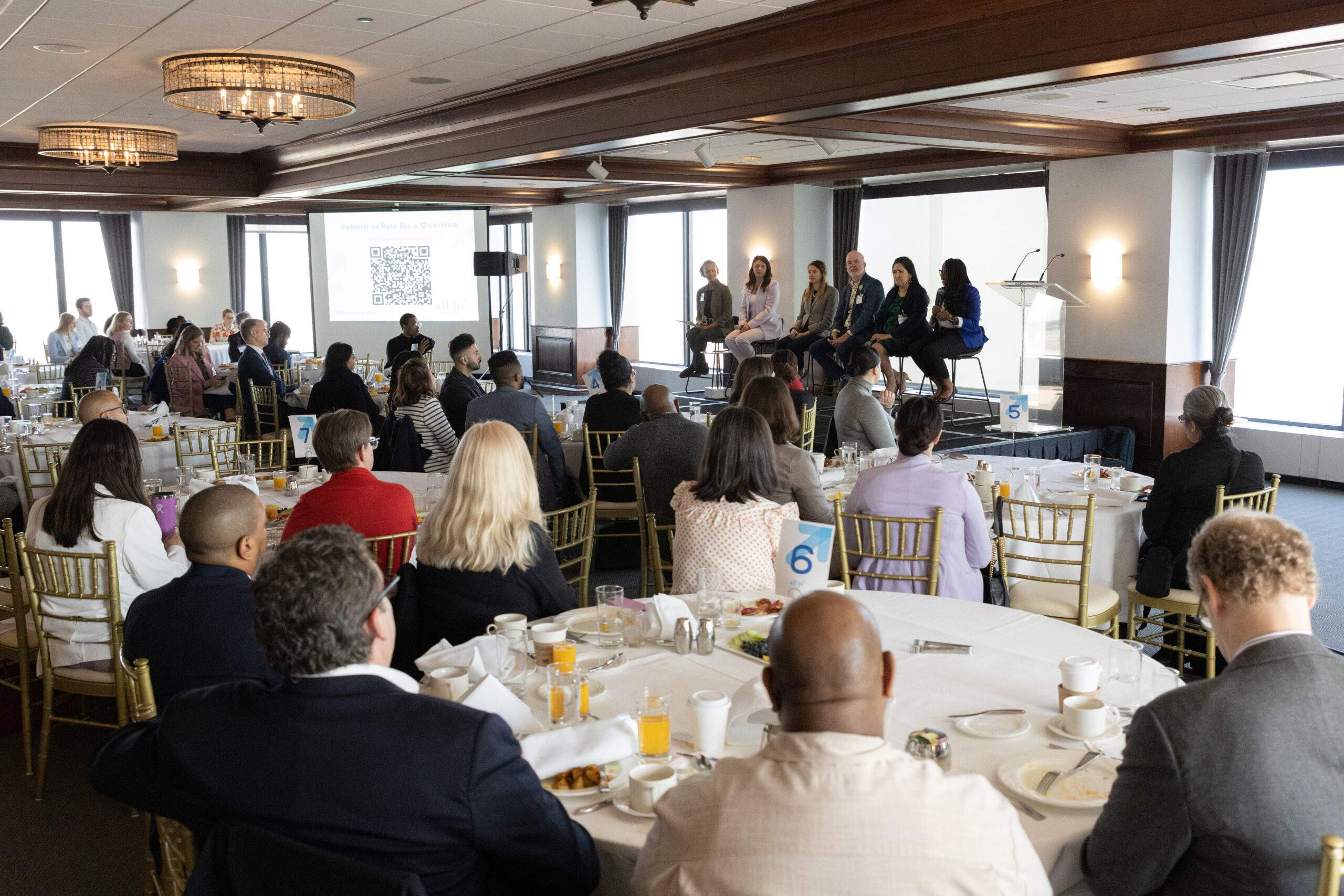
Gary was then chief advocacy officer at Ascension Illinois. The other participants included Dan Fulwiler, Samantha Olds Frey, Michele Smith, Luvia Quiñones and Stephanie Willding. Their titles represented distinct responsibilities. Bringing them together made those different perspectives visible in one room.
The image provides a useful interruption to the solitary executive portrait. Leadership is often photographed as a person facing a camera. Here it looks more like a person facing other people, with an audience entitled to ask questions. The scene is ordinary in the best sense: chairs, microphones, coffee, an agenda. Institutional cooperation needs furniture, too.
Earlier, Gary had worked as a principal at Leavitt Partners. A 2018 professional symposium scheduled her to explain federal policy developments and their implications for the following year. The task was another form of translation: take what is happening in government and help people outside it understand what might follow. The career had crossed into consulting, carrying its public-policy experience with it.
The circle beside the organization chart
Gary’s civic work adds another shape to the picture. Chicago Foundation for Women lists her among seven founding members of its South Side Giving Circle, alongside Felicia Davis, Jessyca Dudley, Phaedra M. Leslie, Melody M. Miller, Nicole Reed and Nicole Robinson. The foundation’s 2018 leadership record also places her in the circle’s founding group.
The circle focuses on the economic, social and political power of Black women and girls connected to the South Side and South Suburbs. Its record includes more than $500,000 awarded since 2018. For fiscal 2025, it lists $61,000 in grants to organizations including 773 Dance Project, Black Girls Dance and Kemtiyu Arts & Media. Those are collective results, belonging to the circle and its participants.
Awarded by the South Side Giving Circle since 2018, including grants and leadership awards.
The founding discussions reached beyond choosing recipients. In a 2019 interview, fellow founder Jessyca Dudley explained that the group considered what a meaningful grant would look like for smaller organizations. They also considered accepting applications through a telephone conversation, so that the mechanics of applying would not decide who could be heard.
That is a revealing detail in Gary’s wider story. The formal application is one of institutional life’s familiar front doors. It can be an invitation, and it can be a test of whether an applicant already understands the building. Considering another route changes the relationship before a grant is awarded.
Dudley described a process involving nominations, brief applications and site visits. The group called its members Queenmakers. The name has more personality than a committee acronym, and the work had an equally specific intention: invest in local leadership and build relationships beyond the transaction of issuing a check.
Gary’s place among the founders brings her into that shared experiment. It also prevents the corporate résumé from swallowing the civic one. A large employer and a giving circle are different settings for deciding how resources move. Both belong in a portrait of someone whose career has crossed public, private and community institutions.
July 2023, and the work around the title
Meridian announced Gary’s appointment effective July 31, 2023. She arrived from Ascension Illinois with more than two decades of professional experience. The announcement named her consulting, university and state-government background, gathering several chapters into the explanation for a single hiring decision.
Other roles continue the civic thread. CommunityHealth lists her as secretary of its board of directors. Her public professional profile records membership in the Economic Club of Chicago beginning in January 2024. Later that year, the Chicagoland Chamber of Commerce included her in its recognition of Crain’s Notable Black Leaders.
These affiliations put the CEO title among other responsibilities. A board secretary belongs to an organization’s governance. A giving-circle founder belongs to a collective undertaking. An executive belongs to an institution with its own obligations. None of those descriptions is a complete biography, but together they keep the portrait from becoming a business card with extra paragraphs.
In April 2026, Gary appeared with Chicago Fire Foundation executive director Jessica Yavitz in a television conversation about the P.L.A.Y.S. school soccer program. The program had grown from eight public schools at its 2013 start to 70 schools and more than 1,600 students. Meridian was in its fourth year as presenting sponsor. The history belongs to the program; Gary’s part in that moment was to help explain the partnership.
The scene supplies another view of the same career: an executive discussing an initiative with a local partner, several years into a relationship. From the deputy governor’s office to a breakfast panel to a giving circle, Gary’s story keeps returning to institutions meeting one another. The people at the table change. So does the scale. The practical question remains close at hand: how will a decision made here reach the neighborhood outside?