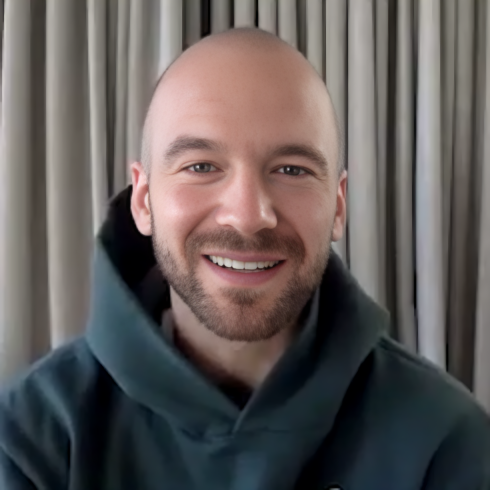
Researched Into a Corner, Then Out of It
A professor at the University of Illinois once told Sean Evans he should become a weatherman. That was 2008. Evans graduated with a broadcast journalism degree and went to work as a copywriter for the Chicago tourism board instead. It was a perfectly sensible career - just not the one that led anywhere interesting.
What changed things was an assignment nobody was chasing: celebrity interviews for Complex Magazine, working out of New Orleans. His first was with 2 Chainz. Evans was nervous enough to over-prepare five minutes of questions. Complex liked what he did well enough to offer him a full-time role. He quit the copywriter job, packed for New York City, and did not look back at the tourism board.
At Complex, Evans found his groove in a specific kind of on-screen interaction - one where research was not decorative but structural. Where the question showed more than the answer. And then, in 2015, he and executive producer Chris Schonberger pitched a format so counterintuitively dumb that it had to work: sit celebrities across a table from progressively spicier chicken wings and just ask them things. Call it Hot Ones.
Celebrity is so unobtainable by definition, you know. But what's more common man than dying on hot sauce?- Sean Evans
The Format That Became a Cultural Franchise
The wings are not a gimmick. They are a mechanism. As the heat escalates across all ten sauces - from a mild opener to something approaching pure punishment - the usual celebrity defenses collapse. PR polish does not survive a Carolina Reaper. What's left is something more interesting: a real person, sweating, caught mid-thought, and genuinely surprised by a question about something they said in 2007.
Evans' research process is deliberately lean. The team is exactly three people - Evans himself, his brother Gavin, and Schonberger. No army of producers mining Reddit. Just obsessive, targeted preparation that routinely produces questions celebrities describe as ones nobody has ever asked them. Gordon Ramsay walked in expecting a food fight and left visibly rattled by the interview itself. Jennifer Lawrence cried. Paul Rudd generated an internet meme so durable it still circulates years later: "Look at us. Who would have thought? Not me."
Bill Murray stayed for three bowls of ice cream after his taping and spent an hour talking college basketball with Evans. That detail captures something important - the show functions as much as a genuinely enjoyable hang as it does an interview format.
The Acquisition
In December 2024, First We Feast - the production home of Hot Ones - was sold by BuzzFeed to an investment group for $82.5 million. Evans was not just a beneficiary. He was a buyer, joining Chris Schonberger, Mythical Entertainment, Crooked Media, and Soros Fund Management in the ownership group. A host who co-created the show now co-owns the company. The copywriter from the Chicago tourism board now holds equity in one of the most-watched interview formats on the internet.
Where It Came From
Evans grew up in Evanston, Illinois - the kind of suburb where the Chicago Bears were a serious household religion. His father, Michael, was responsible for two formative habits: he served "hot-ass salsa" at every game and refused to make it milder, and he recorded David Letterman's late-night show to watch with Sean on Saturdays. The Letterman sessions had a specific ritual: Evans would make his father pause every time the audience laughed, just so he could explain the joke. That is a child studying comedy structure. Not just enjoying it.
Crystal Lake Central High School, class of 2004, where Evans played football and baseball. Then Champaign for four years of broadcast journalism, under professors who apparently saw meteorology as his ceiling. Evans took careful note of the interviewers he actually wanted to emulate - Howard Stern's depth, Letterman's wit, Adam Carolla's energy. He built a personal catalog of what made interview television worth watching, then spent the better part of a decade figuring out how to make it himself.
The Spice Is Personal
Evans has eaten the Carolina Reaper pepper - which averages over 1.5 million Scoville Heat Units - twice. The second time was on a horse carriage through Central Park. He described the experience as his "entire body shutting down." He still showed up to host the next episode.
Off camera, he does not order chicken wings. This is not a contradiction - it tracks for someone who has spent years eating them under duress, with cameras rolling and celebrities watching. But his appreciation for hot sauce culture is genuine. The show inspired a branded line of sauces that found commercial shelf space far outside YouTube fandom.
There is also the taco matter. Evans eats tacos from the top down through the center, producing what he calls a "meat tube" that he finishes separately. He argues it is cleaner. This is not a system the general public has adopted.
Recognition, On His Own Terms
In 2021, Evans was nominated for a Daytime Emmy Award for Outstanding Entertainment Talk Show Host - the first YouTube-native host to land there. He had already won a Shorty, a Lovie, and a Webby. In 2022, Apple TV+ cast him in Loot. Saturday Night Live wrote a sketch around the format he created. He appeared on The Tonight Show, Kimmel, and Colbert - three programs that represent the traditional television establishment Hot Ones was quietly undermining since 2015.
In 2025, TIME magazine named Evans to its inaugural TIME100 Creators list. Not a list of people who happen to have large audiences. A list of people who changed the creative landscape. Then in 2026, the University of Illinois - where he was once pointed toward the weather segment - invited him back to give the commencement address.
You don't need to know what happens next. You just need to be ready for the heat.- Sean Evans, University of Illinois Commencement Address, May 2026
That line landed in a stadium in Champaign and also read like the thesis of his entire career - a decade-long argument that the best preparation for an uncertain outcome is genuine curiosity, willingness to sit with discomfort, and the patience to ask one more question after the previous one just destroyed a famous person's composure.
Most interviews should fail. His mostly don't.
Evans has said, in one of his more candid moments: "Most interviews - like 90 percent of them - should fail when you really think about it. All of that artifice to get something real, to get a real natural reaction to something... To get an actual, real human moment, which maybe sounds bizarre, but I think that's the truth."
The show he wants to make is something warmer than that - the TGIF feeling, he has called it, a Friday night comfort-food kind of television where everybody ends up laughing and a little sweaty. That combination of intellectual rigor and genuine warmth is hard to fake, and hard to systematize, and essentially impossible to copy at scale. Nobody has successfully cloned Hot Ones in a decade of trying.
Sean Evans has a co-owner stake in the only interview format that has ever made a sitting action star tap out, a Michelin-starred chef weep, and a former president pause mid-sentence because the sauce hit differently than expected. From copywriting for Chicago tourism to holding equity in a media brand that is watched by tens of millions of people per month. The wings were just the delivery mechanism.