BREAKING: CREW Carbon closes $25M Series A ~10 wastewater plants live across US & Europe $33M in carbon offtakes via Frontier Buyers: Google · JPMorgan · Stripe · Autodesk Born at Yale, built in Connecticut CO2 stored as bicarbonate for ~10,000 years BREAKING: CREW Carbon closes $25M Series A ~10 wastewater plants live across US & Europe $33M in carbon offtakes via Frontier Buyers: Google · JPMorgan · Stripe · Autodesk Born at Yale, built in Connecticut CO2 stored as bicarbonate for ~10,000 years
YesPress Profile · Climate Tech

CREW Carbon

The Yale spinout that taught the sewage plant a new trick: pull carbon out of the sky and bill the city less for it.

$25M
Series A (2026)
~10
Plants live
$33M
Offtakes signed
2022
Founded
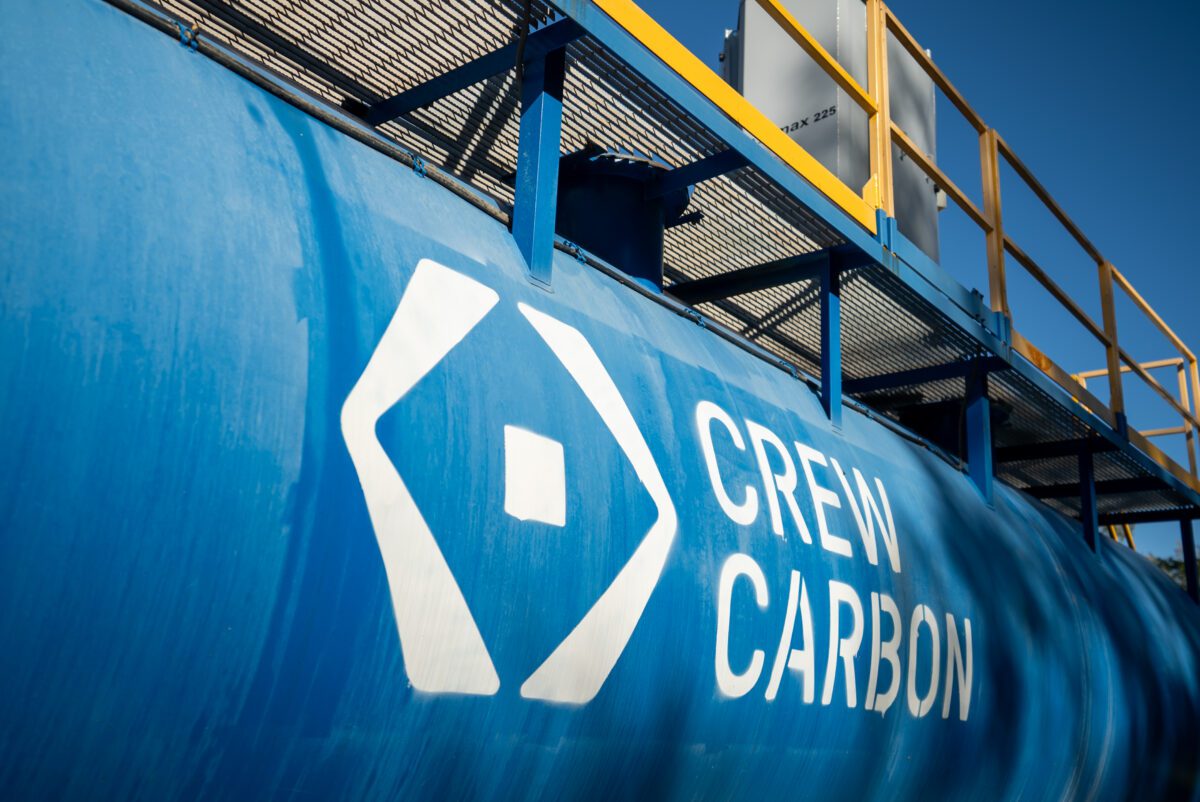
A CREW Carbon mineral-dosing system installed at a wastewater treatment facility

CREW CARBON, IN THE WILD - where the climate fight smells faintly of a treatment plant and looks like industrial plumbing. That tank is doing geology on fast-forward.

Dispatch from Hamden, CT

A rock, a pipe, and a quietly radical idea

Somewhere in Connecticut, wastewater is flowing through a tank that has no business being interesting. CREW Carbon made it interesting anyway.

The water arrives the way it always has: used, treated, on its way back to a river. But before it leaves, CREW doses it with finely ground alkaline minerals. The minerals do what minerals have done for hundreds of millions of years - they react with dissolved CO2 and lock it into stable bicarbonate. The difference is the clock. In nature this weathering takes millennia. CREW compresses it into the time the water spends in the tank.

The result is two things from one act. The plant runs better - steadier pH, easier nutrient removal, lower operating costs. And the carbon is gone, permanently, measured on the way in and counted on the way out. CREW sells the first benefit to the utility and the second to companies like Google and JPMorgan Chase. Same tank. Two customers. One of them is the atmosphere.

"Crew's water technology is driving jaw-dropping results for wastewater customers - and precise measurement of permanent carbon removal is highly differentiated."- Tom Ferguson, Partner, Burnt Island Ventures

Carbon removal had a measurement problem

Everyone agrees the world needs to pull carbon back out of the air. The disagreement is over whether anyone can prove they did. Plant a forest and it might burn. Spread minerals across an open field or the open ocean and the carbon they capture drifts off into a system far too big to audit. Buyers were being asked to pay for removals that nobody could fully verify - an awkward foundation for a market measured in billions.

Enhanced weathering was the promising chemistry stuck inside that awkwardness. The science was sound; the accounting was a fog. If you can't say exactly how much carbon you removed, you can't sell it with a straight face. And a climate solution you can't sell, charmingly, tends not to scale.

"You can't bank a removal you can't measure. The whole market runs on the receipt, not the promise."- The verification problem, in one sentence

Meanwhile, an entire industry of wastewater plants was sitting in plain sight: tens of thousands of facilities, already buying chemicals to manage pH, already metering their flows, already enclosed in pipes you can put a sensor on. The infrastructure for measurable weathering existed. Nobody had thought to run the reaction there.
The Founders' Bet

Two scientists, one closed system

CREW was spun out of Yale in 2022 by Dr. Joachim Katchinoff, a biogeochemist who had spent more than a decade studying how the planet naturally stores carbon, and Prof. Noah Planavsky, an earth scientist whose research underpins the chemistry. Their bet was specific and a little contrarian: stop fighting the measurement problem in the wild, and move the entire reaction indoors.

Inside a wastewater plant, a weathering reaction stops being a leap of faith. The water comes in through one pipe and leaves through another. Put instruments on both ends, model the chemistry in between, and you get something the open-ocean and open-field approaches struggle to produce: a number you can defend. The closed system isn't a constraint. It's the whole pitch.

"Crew is positioned to become a category-defining leader in water and climate - its patented technology addresses the wastewater industry's mounting challenges."- From CREW Carbon's Series A announcement

The founders also understood something about adoption that pure climate plays often miss. A utility manager does not wake up wanting to save the planet on a tight municipal budget. They wake up wanting cleaner effluent and lower costs. CREW leads with that. The carbon removal rides along, which is exactly how you get conservative public infrastructure to try something new.

One dose, two payoffs

CREW's system retrofits into a plant's existing process. It doses strategically sourced alkaline minerals to optimize alkalinity and pH, then measures and models the carbon that gets locked away as bicarbonate. No new plant. No moonshot hardware. Just chemistry placed where it can finally be counted.

Process Intensification

Mineral dosing stabilizes pH, boosts alkalinity, and improves nutrient removal - so the plant runs better and cheaper while staying compliant.

Permanent Removal

Dissolved CO2 is converted into stable bicarbonate that stays put for roughly 10,000 years. Sold as durable, verified carbon credits.

Closed-System M&V

Inlet and outlet monitoring plus biogeochemical modeling deliver precise, auditable carbon accounting - the part rivals can't easily copy.

"Add a rock. The plant runs smoother, the city pays less, and the carbon goes away for ten thousand years. The trick is proving that last part."- How CREW's tech works, minus the jargon

From thesis to ten plants

2022

Spun out of Yale

Katchinoff and Planavsky turn years of biogeochemistry research into a company in Hamden, Connecticut.

OCT 2024

$5.3M Seed

Round led by Counteract, with Connecticut Innovations and others, funds first deployments and the measurement stack.

2025

Scaling & offtakes

Deployments expand toward ten facilities across the US and Europe; corporate buyers and ~$33M in offtake agreements line up via Frontier.

MAY 2026

$25M Series A

Oversubscribed round led by Burnt Island Ventures - $19M equity plus $6M non-dilutive - to scale across the water sector.

The Proof

The receipts, itemized

Climate startups are easy to admire and hard to verify. CREW's argument is that the numbers do the talking. Roughly ten facilities are running its process across two continents. Corporate buyers have committed about $33 million to its removals through Frontier, the advance-market-commitment vehicle backed by some of the most demanding carbon buyers on earth. And the Series A was oversubscribed.

Funding & commitments, by the numbers

USD, approximate · sources: ESG Today, FinSMEs, company disclosures
Seed (2024)
$5.3M
Series A equity
$19M
Series A total
$25M
Carbon offtakes
$33M
"The cheapest carbon removal might be hiding in your city's sewer budget. CREW found it."- The unglamorous economics of climate

The customer list reads like a who's-who of buyers who hate being wrong: Google, JPMorgan Chase, Autodesk, Stripe, Shopify, Salesforce, Workday, Watershed and H&M Group on the carbon side; utilities like the Hampton Roads Sanitation District on the water side. The investor roster - Burnt Island Ventures, AP Ventures, Sony Innovation Fund, Builders Vision, Idemitsu Ventures and New York Ventures - leans toward people who price climate risk for a living.

Carbon buyers

Google · JPMorgan Chase · Autodesk · Stripe · Shopify · Salesforce · Workday · Watershed · H&M Group, largely via Frontier.

Water & science partners

Hampton Roads Sanitation District · Yale · Pacific Northwest National Laboratory · Carbon Removal Alliance · Carbon to Sea Initiative.

Turning water infrastructure into climate infrastructure

CREW's stated aim is modest in tone and large in consequence: help wastewater plants perform better and cost less while permanently removing CO2. The longer game is to make every treatment facility a verifiable carbon-removal engine. There are tens of thousands of these plants. Most of them already buy the chemicals, already meter the flows, already sit enclosed in pipes. The hard infrastructure is built. CREW is supplying the missing chemistry and the receipts.

"CREW sells two things from one tank: cleaner water and permanent CO2 removal. The genius is that the utility only has to want the first one."- Why the model spreads

It is, admittedly, an unglamorous place to save the world. There are no rockets and no rainforests - just industrial plumbing doing geology on a deadline. But unglamorous and measurable beats inspiring and unverifiable, especially when there is money on both sides of the meter.

Why It Matters Tomorrow

Back to the tank

Return to that wastewater plant in Connecticut. Nothing about it looks like the future. The water still arrives used and leaves clean. The smell has not improved. From the road, it is the least photogenic climate solution you could invent.

But the carbon that left in that water is not coming back. It is bicarbonate now, and it will still be bicarbonate when everyone reading this is gone.

That is the quiet bet CREW Carbon is making - that the most durable way to fix the climate is not to build something new and heroic, but to add one missing step to something the world already runs by the thousands. A rock, a pipe, and a number you can actually trust. The plant looks exactly the same. The atmosphere does not.

#carbon-removal#enhanced-weathering#wastewater #climate-tech#yale-spinout#permanent-storage
✦ ✦ ✦