In 2022, a former Olympic boxer with a thriving YouTube channel needed money for merchandise and a growing team. Tony Jeffries had an audience of more than a million subscribers. He also had the familiar small-business problem of paying for tomorrow's growth with today's cash. Creative Juice gave him $120,000. In return, he said it would receive 30% of his channel's YouTube ad income for two years. The bargain is unusually easy to picture: a check arrives now; a slice of future advertising revenue leaves later.
It is also a useful way to understand Creative Juice. The San Francisco fintech did not make videos, sell ads or manage talent. It made a proposition to people who did: your channel is a business, and its earnings can be organized, measured and financed like one. The company offered business banking, invoicing, bookkeeping and advances, then added individually negotiated funding deals called Juice Funds. Its customers ranged from creators looking for a proper account to established YouTubers buying equipment, hiring staff or building merchandise.
- Creative Juice built banking and business tools around irregular creator income.
- Its $2 million funding test with MrBeast led to a $50 million capital pool announced in 2022.
- Creators traded a negotiated share of revenue for cash upfront; Jeffries' public deal shows the arithmetic.
- Venture databases record a Rho acquisition in July 2024, with terms undisclosed.
The problem had a camera attached
Sima Gandhi had worked at Plaid, American Express and the U.S. Treasury. Ezra Cooperstein came from the other side of the counter: he was president of Night, the management company associated with major digital creators. Their combination mattered. One understood how financial institutions categorize risk; the other knew what a creator's business looked like before an underwriter saw its statements. The founders began building in 2020, and Creative Juice's public launch followed in 2021.
A channel's accounts can look unruly even when the underlying business is sound. Advertising pays on a platform schedule. Sponsors may pay later. Merchandise requires cash before a sale. Editors and managers expect payment on a human schedule. Gandhi's complaint was that conventional tools made creators stitch together banking, spreadsheets, payment apps and accounting software, while conventional lenders often had no comfortable category for the resulting income.

The first answer was administrative: a business account, a debit card, invoices, payment splits and a view of money arriving from different places. That was useful, but it did not buy a studio or pay an editor before the next platform payout. Then came an unusually public prompt. In December 2020, MrBeast wondered aloud about investing in influencers. Creative Juice and the creator tested a $2 million fund. The experiment pushed the company from helping creators see their finances toward helping them finance their plans.
Those three numbers tell different stories. The first was a test. The second was a pool of capital available for creator deals, backed through a financing arrangement - it was not $50 million of sales, or $50 million invested in Creative Juice. The third was the reported sum of a $5 million seed round and a $15 million Series A led by Acrew Capital. Confusing the pool with the company's own funding would make the story sound larger and less intelligible than it is.
A contract with a clock on it
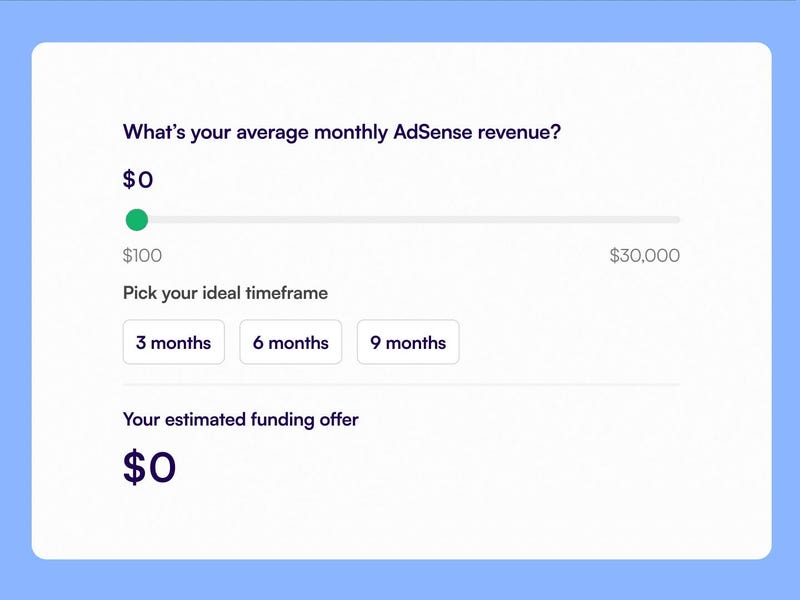
Juice Funds offered selected creators money today for an agreed share of specified future revenue over a limited term. Earlier arrangements could run from roughly six months to three years. Later products included shorter three, six and nine-month options tied to earnings from existing YouTube videos. There was no universal public price list: the share, period and eligible income were contract terms. Jeffries' $120,000 for 30% of AdSense revenue over two years is an example, not a menu price.
The cost is a portion of future receipts, which can prove expensive if the channel grows quickly. The upside for a creator is that a fixed-term revenue deal can preserve ownership and creative control. The risk for Creative Juice is that views, ad rates and creator output can move sharply; the company screened historical and projected income, engagement and the creator's plan. This model fits best where earnings are established enough to inspect and the proposed use of cash has a plausible return. A brand-new channel with no revenue history gives an underwriter little to work with; a creator expecting explosive growth should calculate what a revenue share could cost at the high end, not only the low end.
More than a check
Creative Juice sat between several familiar options. A bank could supply an account or conventional credit but might struggle to read creator income. Karat Financial offered products such as cards for creators. Spotter and Jellysmack made deals around video catalogs. Creative Juice tried to assemble account, operations and capital in one place, with help from people who knew the creator business. Funded creators could get access to accountants, money managers and industry experts including Cooperstein and YouTube strategist Paddy Galloway.
The company kept extending that proposition. AdSense advances addressed the awkward wait for a monthly YouTube payout. Juice Funds Refresh and Reserve gave creators more funding choices. In 2023, Juice Club added bookkeeping, tax-related tools, contractor payments, expert support and a community. Gandhi said the company heard from creators who felt alone running a business that the world still treated as a pastime. The more ambitious idea was that financial literacy and cash could reinforce each other: the books make the business legible, then capital helps it grow.
There were attempts to widen who received that help. Creative Juice's Black Creator Incubator committed $25,000 across five creators, along with education and mentorship. Spotify named the company among partners bringing creator videos to its platform in 2023. The partnership was a reminder that a creator's finances do not end at the edge of one app; a channel can become a podcast, a store, a sponsorship business and a small employer in the space of a few years.
“Creators are the next generation of small and medium-sized businesses in America.”Sima Gandhi, co-founder
The ledger after the applause
Creative Juice was named among Fast Company's innovative companies in 2023. Later that year, The Information reported that Rho was in talks to buy it. CB Insights records the acquisition in July 2024; no price was disclosed. The available record does not establish how every original product fared after the deal. What it does preserve is a useful business argument: if you want to serve a new kind of customer, start by understanding how that customer actually gets paid.
That lesson is copyable without copying the contract. Put all the revenue streams in one view. Map the delay between earning and receiving money. Test a small, clearly priced advance against an existing stream before promising a full financial universe. Then ask the uncomfortable question Jeffries' deal makes impossible to ignore: if this works wonderfully, how much of tomorrow have I sold today? The camera may be new. The arithmetic is old.