The first thing beatBread asks for is not a demo, a backstage pass or the phone number of somebody important. It asks for an artist name or Spotify ID. A few seconds later, the platform can show an estimate of how much the music might support as an advance. This is finance dressed in the plain clothes of a search box - a fitting entrance for a company trying to pry money loose from the rest of the record deal.
Founded in 2020 by Peter Sinclair and data scientist John Haller, beatBread advances cash to independent artists, songwriters, labels and other rights holders. In return, it receives an agreed portion of selected future music revenue. The company says this is not a loan: there is no interest meter, personal-credit inquiry or late penalty. Nor is it a label. It does not own the masters under its standard advance structures, choose the single, hire the publicist or insist on a favored distributor.
That narrowness is the product. A conventional record deal often bundles capital with distribution, marketing, services and years of control. beatBread pulls out the capital and prices it separately. Artists can choose which works are included, whether new music joins the package, how much monthly income flows through before recoupment and how long the economic arrangement lasts. The knobs are visible. The consequences still belong to the person turning them.
The deal is a set of sliders
The basic journey is brisk. beatBread gathers public performance data, then asks the applicant to upload distributor reports. Its underwriting system - historically called chordCashAI - estimates future earnings from streaming, social and revenue signals. The artist reviews confirmed offers, adjusts the structure, signs and connects the relevant distributor. The company says a large share of the advance is commonly paid within a week after contracting and final arrangements.
From streams to spendable money
Advances advertised on the current site range from $1,000 to more than $10 million. That span explains the audience: a working artist with a modest but steady catalog can enter the same front door as an independent label financing acquisitions or a distributor funding its roster. The FAQ says artists with roughly 10,000 to 10 million monthly listeners are most likely to qualify, while stressing that there is no hard line. Genre is not the filter. Predictable economics are.
What it costs - really
There is a small, wonderfully specific number in beatBread's FAQ: $278 plus 2.8 percent of the advance to source and administer each deal. The charge is repaid from future revenue rather than collected upfront. On a $100,000 advance, that formula equals $3,078.
An advance is not free because it is not called a loan. The artist is selling or assigning a temporary slice of cash flow, and money now is worth more than money later. A larger advance may require more repertoire, a higher recoupment share or a longer arrangement. If the catalog underperforms, beatBread says it does not increase the balance or add penalties; collection continues until the agreed amount is recouped. If a major-label offer arrives mid-term, the standard contract includes a formula-based buyout clause.
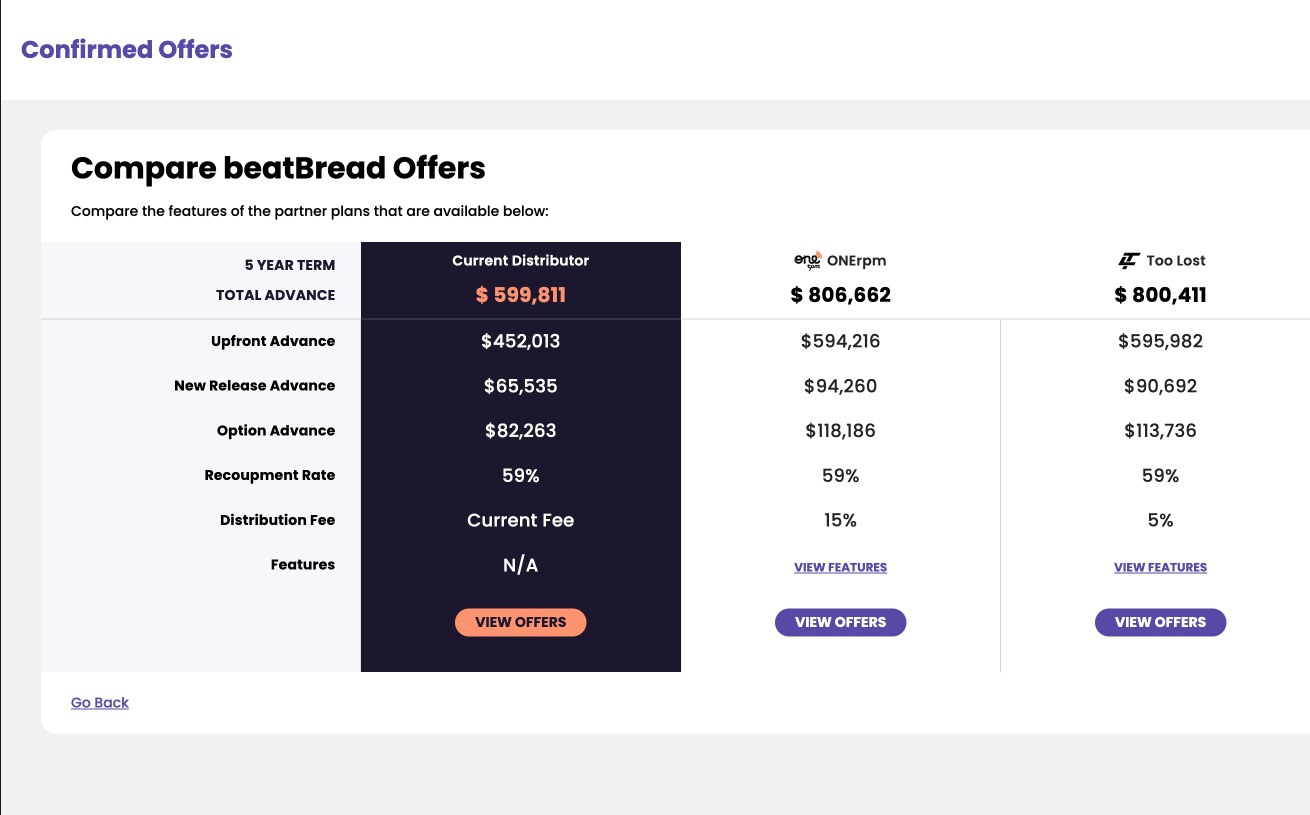
The best product decision beatBread made may be admitting that its own offer is not always the best one.Its comparison layer can point a client to outside capital
The Funding Network turns underwriting into a marketplace. Qualifying clients can compare capital from beatBread, distributors and other finance partners. The Deal Comparison Tool puts the advance beside the less glamorous columns: distribution fee, effective recoupment rate, term and projected cash position. One customer testimonial on beatBread's site says he ultimately took a network partner's money, not beatBread's. Losing the transaction can win trust in the platform.
What failed first
The origin story contains a useful bit of founder abrasion. Sinclair, who came to music after startup roles and an executive stint at Universal Music, had the market thesis and access to data. He did not yet have the technical engine. In a recorded company interview, he said he went through three data scientists before finding Haller. That is less a charming meet-cute than a reminder: in a financing business, the model is not a feature someone can bolt on after lunch. Investors must believe it prices risk, and artists must believe it prices them fairly.
The second correction arrived through customers. beatBread began with a rather cinematic idea of independence: artists escaping onerous label economics and keeping control. After nearly 500 advances, the company wrote that it had underestimated how pragmatic those artists were. Most were not waving an ideological flag. They were comparing funding, services, reach and flexibility. Some used independent capital to build leverage, then signed shorter, more favorable label arrangements.
That observation changed the product's direction. Funding became less a declaration of independence and more an instrument for optionality. It also revealed a second customer. Independent labels were trapped by a similar bundle: distributor advances could arrive with non-portable technology and weak negotiating leverage. beatBread added label financing, comparison tools and, with OpenPlay, catalog infrastructure that could make switching distribution partners less painful.
Market map / More control moves right
Funding is not artist development
beatBread's restraint creates a sharp boundary. The company says it does not provide promotion. It does not tell artists how to spend the advance. Surveyed customers have used money for producers, studio time, collaborations, touring, videos and living costs. That freedom is valuable when a creator already has a plan, a capable team and evidence that another dollar can produce useful growth.
It can be dangerous when capital is mistaken for strategy. A viral month is not a durable business. Streaming revenue can decay, collaborators have splits, release schedules slip and marketing spend can disappear without moving a listener. An artist who needs audience development, creative coaching or operational discipline may be better served by a hands-on partner - even if that partner takes more economics. A creator who can comfortably self-fund may prefer to keep every near-term royalty.
Conditions that fit
- Measurable, reasonably stable royalty history
- A specific use for capital and a team able to execute
- A strong reason to preserve masters and partner choice
- Comfort modeling several revenue scenarios
Conditions that break it
- Little data or a brief, unexplained streaming spike
- A need for development and services, not just cash
- No tolerance for reduced monthly royalty flow
- Terms chosen by advance size alone
The company after its founder
In August 2025, days after beatBread announced $124 million in new credit and equity capital, Sinclair died after a short illness. He was 50. The loss made the company's fifth year both its largest and its hardest. Colleagues described his belief in artist independence as the principle behind their decisions.
Former CD Baby chief executive Tracy Maddux became interim CEO that November. By December, beatBread said it had deployed more than $100 million across 1,700 agreements in 42 countries, tied to catalogs with 67.6 billion lifetime streams. In March 2026 it added three fractional leaders: former CD Baby operator Christine Barnum in financial operations, Michael Poole as CFO, and former Spotify machine-learning engineer Jameson Toole as a board adviser. The mix - music operations, structured finance and underwriting technology - reads like a deliberate attempt to institutionalize what had been a founder-led thesis.
The market around it is getting crowded. Labels and distributors have improved their advance products. Royalty financiers, catalog buyers and marketplaces chase the same cash flows from different angles. New funds can offer enormous checks. beatBread's defensible position is not merely money; money is famously undifferentiated. It is the combination of underwriting, configurable terms, embedded distribution partners and a comparison layer that gives the client more than one door.
What another founder can steal
- Find an expensive bundle customers tolerate because one component is essential.
- Unbundle that component and make its tradeoffs configurable.
- Turn opaque negotiation terms into an interface people can compare.
- Let partners embed the product where customers already work.
- Be willing to show a competitor's offer when trust is worth more than one transaction.
That playbook travels beyond music to any market where access to capital comes stapled to control. It works only if the underlying revenue can be observed, the risk can be modeled and customers understand what they are exchanging. beatBread has made tomorrow's royalties feel as adjustable as a software subscription. The grown-up move is to remember that the sliders control real years, real songs and real cash.