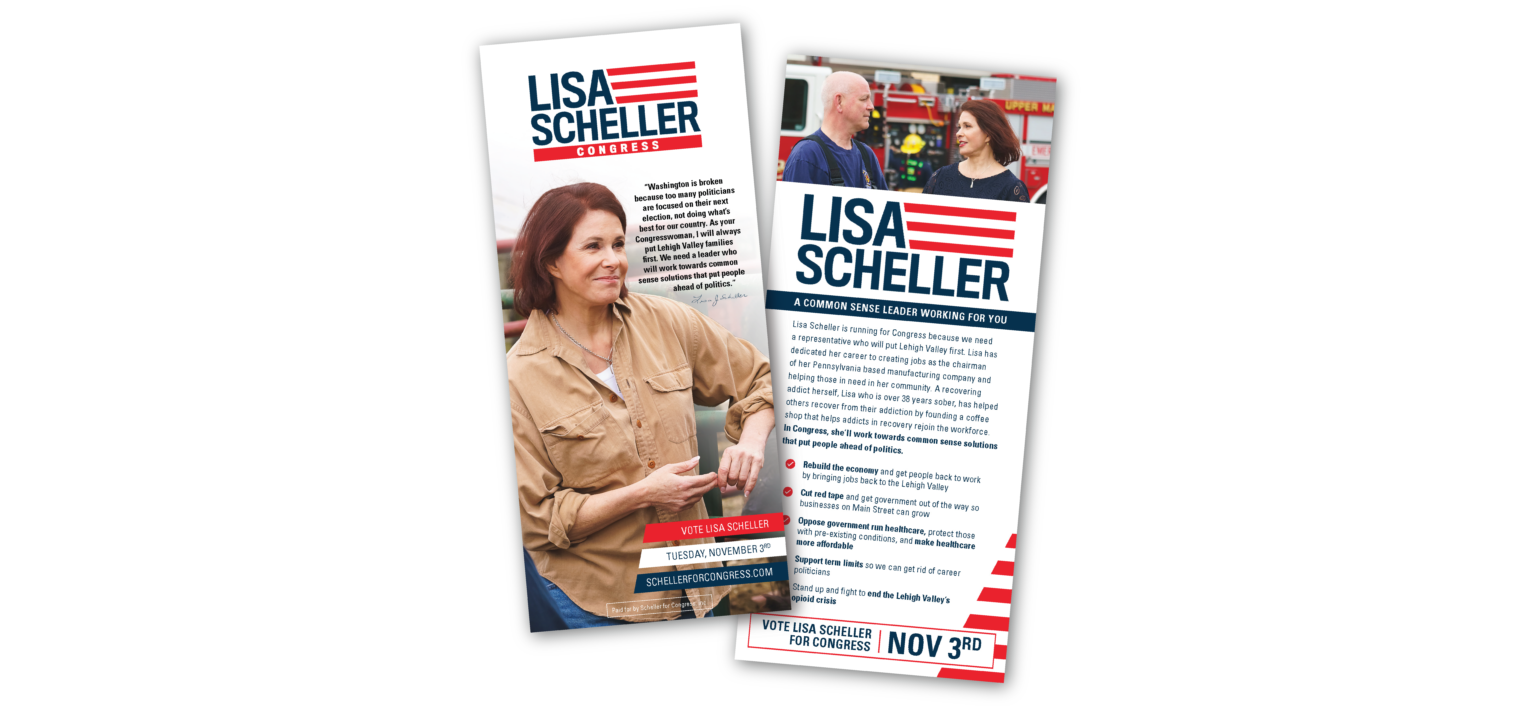
The most unforgiving product deadline in America falls on a Tuesday in November. Miss it by a day and the product does not become less valuable. It becomes litter. This is the peculiar industrial fact behind Creative Direct, a political consulting company in Richmond, Virginia, whose best-known work is the object voters carry from the mailbox to the kitchen counter: the campaign mailer.
Ray Allen and Ron Butler founded the firm in January 1997. They were political operatives before they were agency builders. Butler had worked as political director for the Republican Party of Virginia and as a field director for the Republican National Committee. Allen had managed campaigns and political field operations. Their proposition was narrow and practical: make better Republican direct mail, then make sure it arrived.
Nearly three decades later, the proposition is wider but the deadline remains. Creative Direct says it has served clients in more than 40 states. It works for candidates, campaign committees, PACs, causes and some corporate public-affairs clients. Its team page runs from former chiefs of staff and party operatives to designers, production managers and digital buyers. The company is private, with a staff in the low dozens. This is not a Madison Avenue holding company. It is closer to an election workshop with a national delivery map.

The product is not the paper
A mail piece is easy to underestimate because it is easy to hold. The work behind it is mostly invisible. Someone selects the voters. Someone decides what those voters fear, want or need to remember. Someone writes the argument, chooses the photograph, checks the disclaimer, buys the paper, reserves the press, sorts the addresses and calculates when the postal system must receive the job. Then someone has to answer the campaign manager at 11:47 p.m.
Creative Direct packages that chain. Its direct-mail service begins with strategy and a mail plan, then moves through copy and customized design by an in-house creative team. For production, the company relies on long-standing relationships with printers and mail shops around the country. It is a revealing division of labor: keep political judgment close; distribute physical capacity.
The audience system goes beyond age and ZIP code. The company says it uses voting history, consumer data, political leaning and support for particular issues to find the people most likely to react. That selection determines the creative. A positive piece introduces. A contrast piece places two records side by side. A social-pressure piece reminds a voter that participation is public record. Issue advocacy turns a policy dispute into something a household can see.

“They are not a direct mail mill. They give a personal touch and attention to all their clients.”George Nassar, Public Opinion Strategies
Digital did not kill the mailbox
The obvious story of political communication is replacement: television replaces the whistle-stop; social media replaces television; the phone replaces paper. Creative Direct has built around a different idea - reinforcement. A voter sees a message in the mailbox, then encounters its colors in a connected-TV spot and its sentence in a text. Familiarity begins to masquerade as importance.
The firm now places digital advertising and says the buying is performed in-house. It offers connected TV, texts, automated calls, ringless voicemail, surveys, campaign collateral, websites, branding and video. Its mail-to-text programs are the clearest statement of the model: the physical piece is not a lonely artifact but the first or second beat in a sequence.
states served, according to the company.
The scale comes less from owning presses everywhere than from relationships with printers and mail shops across the country.
This also explains where Creative Direct sits in the market. A local printer can put ink on paper. A specialist digital shop can buy impressions. A campaign can hire freelance designers. Creative Direct sells the coordination among them, plus the political judgment to decide what should be said. Its competitors are full-service partisan agencies such as Big Dog Strategies, FP1 Strategies, Convergence Media and The Strategy Group, not merely the shop that runs the press.
What urgency costs
There is no public price list, and a single invoice may contain strategy, creative, production, postage or media. Campaign-finance records do, however, make the scale legible. An Alaska disclosure from October 2022 listed $315,434 in paid expenditures, including several direct-mail payments to Creative Direct. Aggregated federal and state records also show individual disbursements ranging from modest web and logo work to a $1.06 million payment described as direct-mail services and SMS advertising.
Three pieces of an Alaska mail bill
Selected disclosed payments, October 2022. These are campaign expenditures, not Creative Direct's rate card.
The important unit is not the sheet of paper. It is the reachable voter. Costs rise with the size of the universe, the number and format of contacts, postage, geography, turnaround and the ambition of the media plan. A beautiful piece sent to the wrong list is expensive decoration. A perfectly targeted piece that lands on Wednesday morning is a postmortem.
The proof arrives on election night
Creative Direct's public record is partisan and specific. A company post-election deck says it and the polling firm co/efficient worked on all three Virginia statewide races and more than 20 House of Delegates contests in 2021. Republicans won the governorship, lieutenant governorship and attorney general's office, and retook the House majority. The firm served as a strategic adviser to the House Republican Caucus.
In 2024, staff member CJ Grover managed direct mail and texting for Donald Trump's presidential campaign, according to his company biography. Campaigns & Elections later gave Creative Direct its 2025 Reed Award for best mail piece for a Republican presidential campaign. The award attaches to one piece. The capability behind it - targeting, message, design, production and follow-up - is the durable part.
The company has also widened its map. In late 2022, Creative Direct and affiliated LINK Public Affairs announced an Atlanta office to serve Georgia clients. Senior adviser Jay Walker joined the following month while continuing his Creative Direct practice. By 2026, the Richmond operation was recruiting an in-house video editor. A firm founded around the printed page was hiring someone to cut footage for political advertising. This is not a conversion away from mail. It is a recognition that the same argument must now travel in several containers.
Four things worth stealing
Keep strategy, copy, design and buying near the people who know the client and the audience.
Use regional production partners when speed and geography matter more than owning every machine.
Let mail, digital, video and text carry one recognizable argument instead of four unrelated clever ideas.
Start from the immovable deadline, then reserve production, approvals and delivery time before polishing the concept.
This model is not universal. It depends on an identifiable audience, usable data, a concrete message, enough money to buy repetition and enough lead time to produce it. It loses force when the voter universe is poorly defined, the list is stale, the creative channels disagree or the campaign changes its mind after the presses run. Direct mail also offers weak feedback compared with a clickstream. You cannot rewrite a postcard already moving through Ohio.
But politics rewards commitment. The vote is binary, the date is fixed and the audience can often be named household by household. Under those conditions, paper has an unfashionable advantage: it occupies space. It waits on the counter. It can be passed to a spouse. It can survive a dead phone battery. Creative Direct's wager is that this old object becomes more useful, not less, when data decides where it goes and digital media makes it echo.
A campaign mailer is a small rectangle carrying a large logistical promise: this argument, to this voter, before this Tuesday.