The first Connor Waslo business had no price list. He was a child with a lemonade stand on a busy corner, looking for summer money and letting customers decide what a cup was worth. Pricing power, meet the honor system. Years later, after he had learned the adult vocabulary for experiments like this, Waslo would trace his appetite for building companies back to that table.
His route from lemonade to Caddy, the personal AI company he now runs in New York, is not a neat procession of increasingly grand ideas. It is a history of making things, noticing the actual problem and changing direction before pride hardens into strategy. The pivots are the plot. The willingness to discard working software may be the defining skill he carried from a Phoenix adolescence through Vanderbilt, Loom, Atlassian and Y Combinator.
Caddy's current proposition sounds almost impolite by the standards of modern software: it would like less of your attention. It lives in a text thread, watches connected streams such as email and calendars, and helps with the loose ends that pile up between intention and completion. When something matters, it can nudge. When nothing matters, silence is the feature.
A founder before the résumé
Waslo expected to study medicine until a summer job before his final year of high school rearranged the plan. He thought he was joining an established tutoring company for an ordinary sales job. Instead, he landed inside a young startup, where its CEO took him under his wing. Waslo began seeking out Phoenix founders and small-business owners simply to ask how they thought. He did not always know what the question was. He knew they had seen something he had not.
By August 2017 he had started GoCode, first imagined as a mobile app for learning programming. He taught himself app development and filled the spare corners of his days with code. A 2018 post records the rhythm: college visit, programming; free period, programming; driving, wisely, only thinking about programming. He wrote of entrepreneurship consuming every ounce of effort, then added the distinction that made the effort tolerable: it was his idea and he wanted to see how far it could go.
The release frightened him. The app had swallowed months, but Waslo had barely considered how anyone would find it. GoCode moved from lessons toward project-based certification, while its young founder learned the rude difference between a thing that can be built and a thing that people will adopt. He also kept teaching. Public records of his early work include a Boys & Girls Club program and an after-school club where third graders learned Python. For all the talk of failing fast, his preferred medium was doing.
“Cutting scope is uncomfortable, but it made our product so much more focused.”Connor Waslo on removing Caddy's dictation feature
The engineer who kept borrowing the product job
At Vanderbilt, Waslo studied computer science and worked across sales, consulting, software and small ventures. Scalar, a company he co-founded in 2020, gave him experience managing distributed development teams. In 2021 he joined Loom as a software-engineering intern. The job title did not contain him for long.
He asked to write product requirements. He sought ownership beyond the usual intern boundary. Loom let him take it, and the ladder that followed was unusually compressed: engineering intern, engineer, product manager, senior product manager. His remit came to include growth, billing, monetization, pricing and Loom's AI work. When Atlassian acquired Loom, he continued as a senior product manager into July 2025.
That progression matters because Caddy is a founder's company built with the reflexes of both an engineer and a product manager. The engineer knows the seductive pleasure of making a mechanism work. The product manager has to ask whether the mechanism belongs. At Loom, Waslo saw a product with distribution and product-market fit. A new feature could be attached to a moving vehicle. Starting Caddy meant standing in the road with parts.
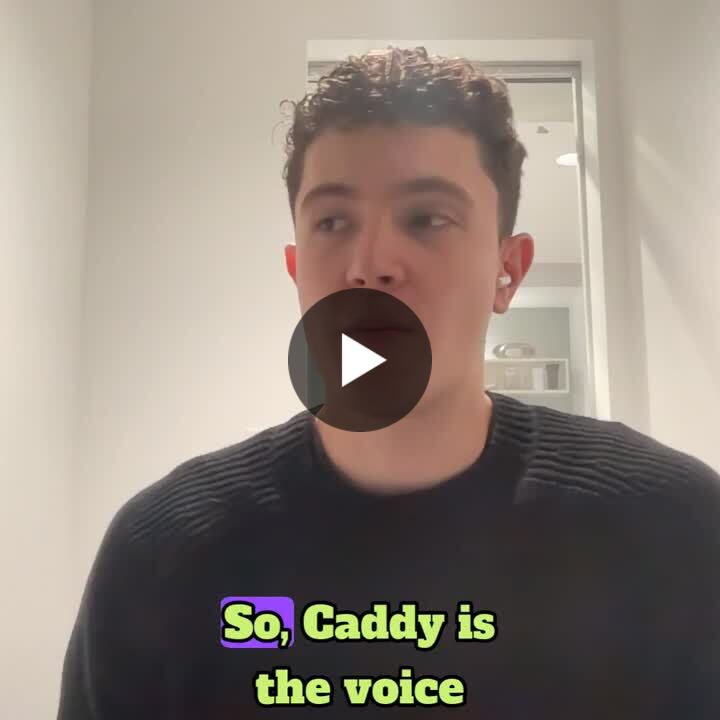
Pivot hell, with a four-hour automotive era
Waslo and designer Rajiv Sancheti had worked closely at Loom. They shared a frustration: ideas lived in people's heads while the work required to express them was scattered across documents and apps. They both left their jobs intent on starting something together, then promptly wandered away from the familiar problem. Go-to-market tooling came first. During what Waslo cheerfully called “pivot hell,” they cycled through an AI quality-assurance engineer and, for roughly four hours, automotive agents. Expertise eventually prevailed over novelty. They returned to the annoyance they actually understood.
The first Caddy emerged as a desktop voice interface. Hold the function key, say what you want, and the software could use APIs to create a Linear ticket, attach a screenshot and post the link in Slack without seizing control of the screen. It also offered dictation that could put clean text at the cursor in under a second. The demo was legible. The craft was real. Users still had a larger complaint.
Typing faster did not send the follow-up promised after a meeting. It did not turn notes into tickets or remember the file someone said they would send. So Waslo and Sancheti removed dictation. The decision narrowed the story from getting words into software to getting work finished. A feature can be good and still be guilty of solving the smaller problem.
The visible request may be faster input. The durable pain is often everything the user must still do next.
Working code is not sacred. When removal clarifies the roadmap and the user's description, subtraction is progress.
A text thread lowers the adoption cost because conversation is already part of the day.
An assistant that interrupts carelessly spends trust faster than it can earn it back.
The Rut gets an axis
Caddy entered Y Combinator's Fall 2025 batch weeks after Waslo left Atlassian. He and Sancheti moved temporarily from New York to San Francisco, where Demo Day imposed an argument with the calendar. The batch compressed decisions that had previously drifted. Ideas had to be validated or killed quickly. Caddy's founders scrapped months of work about a week after arriving.
On an office whiteboard, they drew a line tracking how they felt each day. It went everywhere. They annotated the causes, named one long low stretch “The Rut,” and later labeled an upswing with the sort of pep talk that does not fit on tasteful stationery. Turning mood into a graph made bad days discussable, then faintly ridiculous. They could point to the dip and laugh. Eventually, as the line stayed above the axis and the work became fun again, they retired the board.
Software with the manners of a good friend
Caddy now lives in messages. The shift answers an adoption problem Waslo understands intimately: his phone's home screen, he says, is a graveyard of apps that were exciting for a week. A new interface demands a new ritual. Texting arrives with the ritual installed.
The ambition has expanded even as the surface became simpler. Caddy can watch connected work, remember context and help handle tasks through conversation. Waslo argues for a horizontal assistant rather than a cupboard of narrow agents. Ten tools may each know one fragment of a person; one assistant that understands the pattern across those fragments could become more useful. The defense is not the novelty of any single workflow. It is reliability and trust.
Trust creates a peculiar product metric: things that do not happen. The unimportant email produces no ping. The on-time flight remains silent. The issue that resolves itself never asks for a tap. Waslo has said he would rather Caddy text once a week and be right than ten times a day and be ignored. In an economy that counts attention as revenue, restraint can look almost subversive.
“We'd rather text you once a week and be right than ten times a day and get ignored.”Connor Waslo on the cost of crying wolf
The company kept in good company
The Caddy office is not governed entirely by sober theories of human-computer interaction. The team plays Kinda Hard Golf every day and totals the scores through Friday. The winner earns an “override” to choose lunch during the following week. The loser has to post on LinkedIn. Waslo reads the ritual as evidence of a competitive culture that reaches beyond the browser game. It is also a pleasantly absurd way to distribute both sandwiches and content marketing.
His more serious principle is about the people playing. Asked in 2025 what he would put on a billboard, Waslo did not offer a product slogan. He said the people you choose to work with are central to the undertaking. Loom had shown him the pleasure of colleagues who were strong at their jobs and good to spend time with. Caddy made the condition non-negotiable. Startup days can run deep into the night; fondness is operational infrastructure.
The thought connects the chapters. A tutoring-company mentor redirected his teenage curiosity. Phoenix founders answered questions before he knew how to phrase them. Loom colleagues let an intern borrow responsibility. Sancheti became the collaborator with whom he could survive a graph called The Rut. For a founder building software meant to understand people, Waslo's durable advantage may be how often he has chosen to learn through them.
The lemonade stand had no fixed price because a child was experimenting. Caddy has no conventional app interface because its founders kept experimenting long enough to question the premise. Between the two sits a career of code written, roles crossed, features removed and plans revised. The line does not travel straight. It does, however, keep moving.