Consider the last hundred yards of a hospital visit. The driver has negotiated the motorway, found the campus and parked. The appointment is upstairs, somewhere beyond a junction of corridors whose names make perfect sense to the people who work there. Medicine has arrived at the age of precision. The visitor is still asking which lift to take.
- Connexient sells hospitals maps, indoor navigation and the services that keep them usable.
- MediNav follows the journey from parking to appointment and back to the car.
- By November 2019, it reported 90+ hospital sites under contract and 90 million square feet mapped.
- Everbridge bought it in 2020; HID acquired it in 2023.
The appointment before the appointment
That final stretch is Connexient’s territory. Founded in 2012 by Mark Green and Joe Motta, the company brought together two kinds of knowledge: enterprise software and hospital wayfinding. Motta had spent years building GDS, a business in graphic design, architectural signage and healthcare navigation. Green brought software sales and management experience. They knew the building as well as the screen.
MediNav launched in January 2015. In May, the National Institutes of Health selected it for a Clinical Center complex covering 3.5 million square feet and more than 5,000 rooms. Those numbers explain the opportunity better than any fashionable talk of disruption. A hospital can be a small town with a roof. Its residents understand the streets; its visitors have other things on their minds.
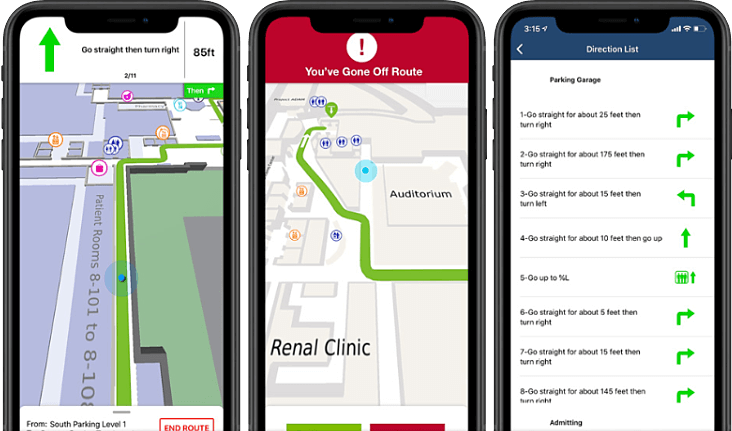
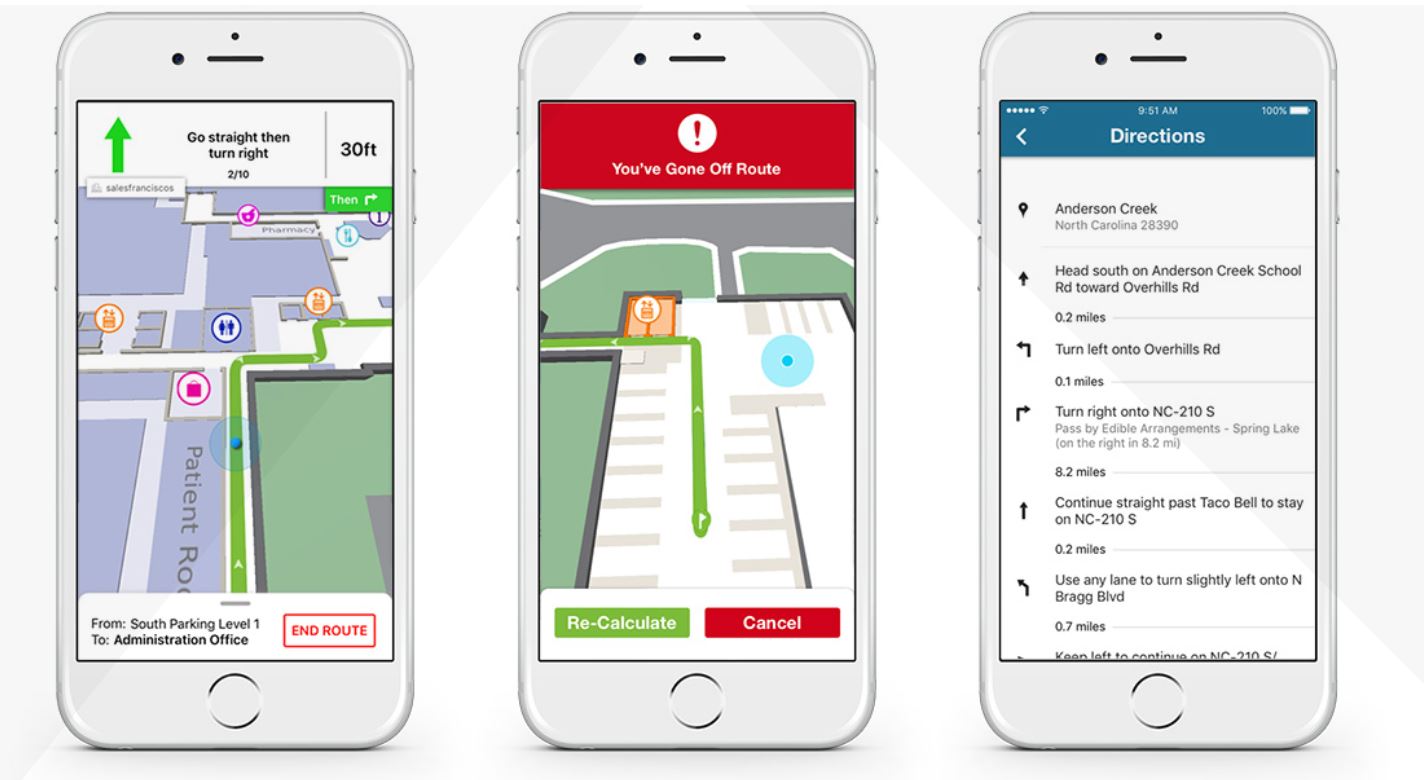
The product supplies searchable destinations, indoor maps and turn-by-turn guidance. Voice prompts, visual landmarks and off-route notifications help translate a plan into movement. Parking Planner points people toward parking suited to their destination. Find My Car helps them reverse the journey. The latter is wonderfully unglamorous. After a difficult appointment, remembering the garage level is hardly a reasonable test of character.
The blue dot needs a factory
“Indoor GPS” is a useful nickname, provided nobody mistakes it for the machinery. Connexient’s indoor positioning combines Bluetooth Low Energy infrastructure with handset sensor fusion. Maps, routing and application software turn that position into instructions. The dot is the visible result of a system installed and maintained behind it.
Connexient also offered web maps, kiosks and digital signage. This mattered because a hospital’s audience includes people who will never download its app. Mobile SDKs and web APIs let navigation appear inside existing applications. The commercial offer combined a SaaS platform with mapping, deployment and integration services. Hospitals were buying an operating capability, with continuing work attached.
Demand exposed a weakness in that work. Engineering partner Kepler Team describes disconnected digital tools, long implementation periods and a backlog of projects. Its response was a unified content management system, clearer development priorities, better code quality and automated software delivery. Kepler reports a roughly 50% productivity improvement, without publishing the measurement method. The account is a reminder that selling more maps can create a map-production problem.
“MediNav isn’t necessarily changing the world”Mark Green, July 2019 interview
Sell the journey, share the infrastructure
Rush selected MediNav in 2018, then launched Indoor Directions within My Rush in September 2019. UCI Health announced a MyChart-related integration that July. The reasoning is easy to follow: a patient already consulting appointment information should be able to move toward the appointment. An extra app introduces an extra decision at precisely the moment the hospital hopes to remove decisions.
At Memorial Sloan Kettering’s Westchester facility, the branded MSKcompass app let visitors search departments, providers and clinics, find check-in desks and use a meet-up feature. It followed the phone’s language preferences. A pharmacy, a café and a family member become destinations in the same system. The useful unit is the visit, with all its errands.
- 01Choose
parking - 02Navigate
indoors - 03Find the
appointment - 04Return to
the car
Competitors included Gozio Health and LogicJunction; kiosks and conventional signs remained alternatives. Connexient’s positioning rested on healthcare expertise, delivery across several screens and integration into enterprise software. These were buying reasons, rather than proof that rivals could not navigate a corridor.
There was another way to make the economics attractive. In September 2019, Connexient and Intelligent Locations announced a common Bluetooth beacon infrastructure for wayfinding and real-time location services at four Cone Health hospitals. The same installation could support patient guidance and operational uses such as asset tracking. The copyable idea is specific: look for another department that needs the infrastructure you are asking a customer to fund.
Two buyers saw more than directions
In January 2018, an investment announcement with Riverside Acceleration Capital described 28 healthcare networks and more than 60 million square feet covered. By November 2019, Connexient reported over 90 hospital sites under contract and more than 90 million square feet mapped. Networks and hospital sites are different measures. Both announcements describe a growing footprint; neither supplies a controlled measure of fewer missed appointments.
Everbridge bought Connexient on February 7, 2020, for $20.2 million in base consideration. The deal included a possible $6 million payment tied to revenue targets; its annual filing says the threshold was not met. Everbridge’s stated rationale was to add customers and technology to its critical event management offering. During COVID-19, its materials described routing people away from restricted areas and updating locations as hospital arrangements changed.
The ownership story continued. HID acquired Connexient in 2023, with ASSA ABLOY’s annual report recording consolidation in March. HID subsequently described it as part of a broader location-services portfolio. The progression suggests why buyers valued the map: once a building is navigable, its location data can serve several operational purposes.
A map is a promise that needs maintenance
For a hospital considering this approach, the practical lesson is to budget for the whole system: positioning infrastructure, accurate maps, integration and upkeep. Moving a clinic or closing a corridor changes the promise the software makes. Compatible phones and properly installed infrastructure matter for live navigation; other visitors still need usable signs, web directions or kiosks.
Start with the journey people actually struggle to complete. Test the parking entrance, the floor change and the return trip. Give someone responsibility for updates. Connexient’s opportunity lived in those ordinary details. A hospital visit already contains enough uncertainty. The route to the right room ought to be one of the things a patient can take for granted.