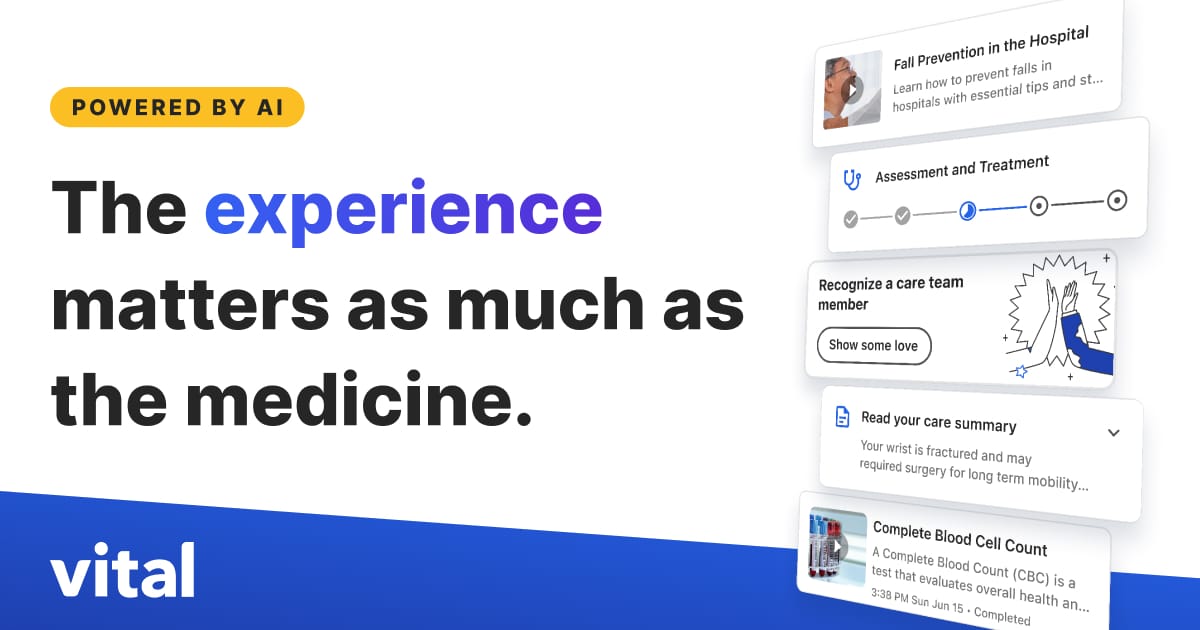
It is 11:40 on a Tuesday night and a waiting room full of strangers is doing the one thing hospitals are worst at managing: not knowing. Not knowing how long. Not knowing what the blood test meant. Not knowing whether to stay or go home. Vital is the small piece of software trying to answer all three before anyone gives up and leaves.
Vital is a digital health company that puts a consumer-grade app between a patient and the machinery of a hospital. It reads from the electronic health record, predicts how long the wait will be, translates the radiology report out of Latin, and texts you what to do after you go home. None of that sounds revolutionary until you remember that almost no hospital does it well.
The company is roughly 65 people, headquartered on paper in Delaware and run mostly remotely. It is used by more than 100 hospitals and somewhere between 20 and 30 health systems - names like CommonSpirit, HCA, Mercy, Dignity Health and Emory. Together they push more than five million patients a year through Vital's screens. For a company most people have never heard of, that is a lot of the scariest nights of strangers' lives.
01 / The ProblemThe metric nobody puts on a poster
There is a number hospitals track and rarely advertise: patients who walked in, sat down, waited, and then left without being seen. In a busy emergency department it can run into double digits. Every one of those people is a clinical risk and a billing loss, and most of them left for the same boring reason - nobody told them anything.
The information existed the whole time. It was sitting in the EHR, in the lab system, in the nurse's head. It just never reached the person in chair 14. The patient experience, such as it was, consisted of a clipboard, a vending machine, and the occasional update delivered with the warmth of a parking ticket.
Healthcare's answer to this was the patient portal: a login, a password reset, and a PDF written for lawyers. Technically it shared information. Practically, it shared the feeling of being kept out. That gap - between data that exists and data a frightened person can use - is the tension the whole company is built around.
The wait
Patients leave when time feels infinite. Vital makes it finite with a predicted number.
The jargon
"Acute myocardial infarction" helps no one at 2am. Plain English does.
The handoff
Discharge is where care quietly falls apart. Vital keeps texting after you leave.
02 / The BetA fintech founder walks into an ER
Aaron Patzer had already done this trick once. He built Mint.com, the app that made your bank accounts legible, and sold it to Intuit for around $170 million. Personal finance was a category drowning in jargon and dread. He drained both out of it with clean design and a bias toward the user. Then he went looking for the next category that treated its own customers like an afterthought.
He found it in the emergency department, with help from Dr. Justin Schrager, an emergency physician who had spent years watching the information gap up close. Their bet was almost insultingly simple: the thing that worked for money would work for medicine. Take the data the institution already has, make it beautiful, hand it to the person who needs it, and stop pretending that "complicated" is the same as "serious."
The bet had an obvious objection. Hospitals are not banks; they are slower, more regulated, and allergic to anything that adds work for nurses. Vital's answer was to make the software earn its keep on both sides of the desk - patients get clarity, staff get tasks taken off their plate. A tool that only delighted patients would have died in a procurement meeting. One that also quieted a nurse's pager had a chance.
MilestonesHow Vital got from idea to 100 hospitals
Aaron Patzer and Dr. Justin Schrager start Vital to rebuild the ER patient experience.
First Round and others back the Mint founder's second act in healthcare.
Threshold Ventures joins as the software lands in real emergency departments.
Transformation Capital leads, pushing total funding past $40M.
Vital crosses a million people on its care-experience platform - then launches a free LLM-powered medical translator.
Named an Emerging Solutions winner as the hospital roster passes 100.
03 / The ProductSoftware that reads the chart for you
Vital is not one app but a small family of them, each pointed at a different room. Vital Emergency (the old ERAdvisor) lives in the waiting room and the bay - it predicts wait times, explains test results as they come back, and nudges people toward follow-up and medication. Vital Inpatient (CareAdvisor) keeps admitted patients and their families oriented between the brief, blurry moments when a doctor actually appears. There are tailored versions for urgent care and a safety-focused product, Vital Guard, aimed at the incidental findings that slip through the cracks.
The connective tissue is the EHR integration. Vital plugs into systems like Epic and Cerner through FHIR and HL7, which is the unglamorous engineering that makes the magic possible: the app is not asking you to re-enter anything, it is reading your actual chart and turning it into sentences.
That last product is the one that made people outside healthcare look up. In 2023 Vital released a free, public Doctor-to-Patient Translator that uses large language models to rewrite imaging results, lab values, physician notes and discharge summaries into plain language. It runs in a browser, needs no account, and sits on Microsoft's HIPAA- and HITRUST-compliant cloud. It was both a useful gift and a very good demo of the thing Vital sells.
04 / The ProofNumbers a skeptic can hold
Mission statements are cheap. The case for Vital is easier to make in counts: hospitals signed, patients reached, dollars raised. Here is the scale, drawn from the company's own disclosures and press.
Vital, by the numbers
The Series B - $24.7 million led by Transformation Capital, with Threshold Ventures and strategic health-system investors - was less a vote of confidence in an idea than in traction that already existed. Emory Healthcare served as an early development partner, the kind of relationship that shapes a product instead of just buying it. The awards (KLAS Top 20 Emerging Solutions, a Pinnacle Diamond) are the industry's polite way of saying this is real.
05 / The MissionClarity as a clinical intervention
Strip away the funding and the integrations and Vital is making one argument: that understanding what is happening to you is not a luxury layered on top of care. It is part of the care. A patient who knows why they are waiting is calmer, more likely to stay, more likely to follow the discharge plan, less likely to bounce back through the door a week later.
That is also where the business and the mission stop fighting each other. The same clarity that lowers a patient's blood pressure raises a hospital's HCAHPS scores and trims the costly churn of people who leave or return. Vital does not have to choose between being good and being sold. Which is convenient, because healthcare is a graveyard of products that picked one.
06 / TomorrowWhy this gets bigger
The arrival of capable language models did not invent Vital's idea, but it sharpened it. Translating a dense clinical note used to require a clinician's time; now it can happen in a second, for free, in a browser. Every improvement in those models makes Vital's core promise - take what the institution knows and hand it to the patient in words they can use - cheaper and better at the same time.
The competition is real: digital front-door players, patient-engagement vendors, and the EHR giants themselves with MyChart and its cousins. Vital's edge is a founder who has already turned dread into a clean interface once, and a wedge - the emergency department - that the big platforms treat as an afterthought. Whether that is enough to outrun Epic is the open question of the next few years.
Back in that waiting room at 11:40 on a Tuesday, the difference Vital is chasing is small and enormous at once. The patient in chair 14 looks at a screen and sees a number: about forty minutes. A line that explains the blood test came back normal. A note about what to do if the pain returns. Nobody got cured by software. But for the first time all night, someone is not in the dark - and they don't get up and leave.