The internet is fast. Buying the line that delivers it to an office can be comically slow. A company asks for connectivity at 47 addresses. Someone hunts through carrier portals, someone else checks a fiber map, suppliers email spreadsheets, and a salesperson waits for prices that may describe the wrong building. By the time the quote is assembled, the buyer may have moved on. Connectbase exists because founder Ben Edmond spent more than two decades in fiber and networking watching this contradiction chew up time and margin.
Founded in Massachusetts in 2015 as Connected2Fiber, the company began with an unglamorous observation: location context belonged in nearly every commercial decision a network operator made. Which building is actually on the route? Who occupies it? Which supplier can reach it? Is the service on-net, near-net or an expensive construction project in disguise? A mailing address alone cannot answer those questions. Connectbase's wedge was to make the location trustworthy, then hang the market around it.

A market organized around the building
Today its Connected World platform is part location database, part workflow engine and part B2B marketplace. Seller Cloud lets providers publish serviceability, manage buildings and rate cards, price routes and distribute quotes. Buyer Cloud helps carriers and enterprise teams find suppliers, compare coverage and automate off-net procurement. Partners Cloud and Linkbase handle introductions and permissioned data sharing. Circuit Inventory Manager tracks physical and commercial assets. APIs push the whole apparatus into CRMs, quote portals and operating systems where employees already work.
That combination is the point. A generic GIS can draw the route. A CPQ product can calculate a configured price. A CRM can remember the account. None automatically knows which provider serves a specific rooftop, what it is allowed to reveal to a particular buyer, or whether yesterday's rate card still deserves belief. Connectbase tries to supply the telecom-specific connective tissue between those tools.
The users are the people stuck between a customer address and a deliverable circuit: wholesale sales teams, carrier-relations groups, fiber operators, managed service providers, technology advisors, data centers and enterprise network buyers. Publicly named customers and ecosystem members include Cox Communications, Granite, Frontier, Uniti, Aureon, Orange Wholesale, Viasat, Eurofiber and Console Connect. Connectbase says more than 400 buyers and sellers use the system and that it profiles more than 2 billion locations.
“Everything starts with a quote, ideally in real time.”Ben Edmond, founder and CEO
What failed first was the data
Telecom veterans love a spreadsheet because it is portable, familiar and wonderfully unopinionated. Those are also its crimes. A provider sends thousands of “lit” and “near-net” buildings to partners. Addresses use different abbreviations. Coordinates point to a parcel instead of the entrance. Routes change. A seller updates its own file but not the copy living in twelve inboxes. Automation placed on top of that mess does not fix it; it distributes the mistake with greater enthusiasm.
One customer, OPTK Networks, told Connectbase that its detailed near-net building lists had been less than 50 percent accurate before the platform. Connectbase's response was more specific than dropping pins on a map. Its near-net analysis calculates public right-of-way distance from an access point, the private path across a parcel and the route into the building footprint. That distinction matters when a sales opportunity becomes a construction bill.
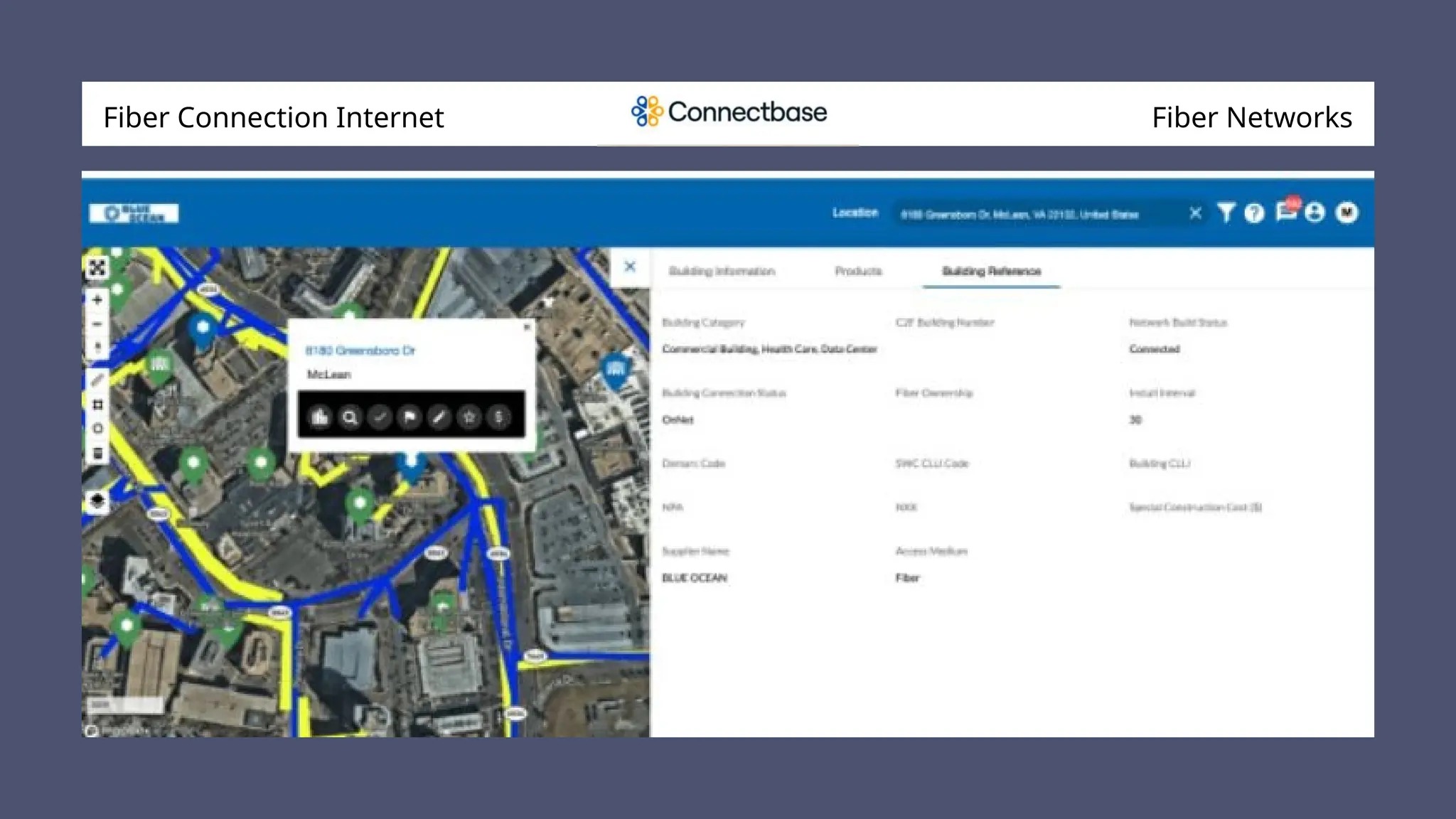
The other early failure was time. Off-net quotes require a provider to buy the last mile from somebody else, which historically meant emails, negotiations and manual checks. Connectbase says its automation can turn days into minutes. In one published solution overview, Cox Communications reported reducing time-to-quote by more than 50 percent within a year. The company's 2025 materials claim customers have seen 70 percent faster quote cycles and up to 80 percent less manual quoting labor. Those are vendor-reported outcomes, not a universal warranty, but they identify the valuable unit: fewer hours between an address and a credible offer.
The transaction Connectbase wants to compress
A data tool discovers it is a marketplace
Edmond's change of mind was gradual and visible in the name. Connected2Fiber sounded like a useful database for network reach. The 2022 rebrand to Connectbase advertised a larger idea: one base where the connectivity market could meet. The company did not abandon location intelligence. It used location as the identity layer for a two-sided network. Sellers want to be found at profitable buildings; buyers want fast, reliable supply; each additional participant makes the other side more useful.
Then came the acquisitions. London-based LastMileXchange brought global access pricing and a network of hundreds of vendors in 2023. MasterStream, acquired later that year, added telecom-focused CPQ and channel demand; it was processing roughly 500,000 quotes a month at the time. Network Capacity Solutions added data-center and circuit inventory in 2024. Cloud Age added invoice automation and spend intelligence in 2025, including billing formats from more than 1,700 providers. The product story stretched from “where can I buy?” to “what did I buy, what was I billed, and was it profitable?”
Product surface added over time - conceptual breadth
Funding financed the march. Public rounds include $8 million in Series A funding in 2018, $5.3 million in 2019, $12 million in Series B funding in 2021 and a $21 million Series C led by DigitalBridge Ventures in 2022. Silicon Valley Bank supplied a $16 million debt facility in 2023. Equality Asset Management made an undisclosed strategic investment alongside the Cloud Age acquisition in December 2025. No valuation has been announced.
What it costs - in money and homework
Connectbase sells enterprise SaaS with custom pricing; there is no public dollar menu. Linkbase is included with eligible Buyer or Seller CPQ packages at no additional charge, but that is one component, not a free version of the platform. The meaningful cost is broader than the contract. A buyer must clean and map its building lists, load products and rate cards, decide which partners can see which data, connect a CRM or portal, and persuade sales and procurement teams to change habits. Connectbase says most customers go live in four to six weeks. A complicated multinational estate can reasonably demand more homework.
The software promise
One location model, faster supplier discovery, reusable prices, automated quote formats and a growing buyer-seller network.
The implementation reality
Normalize addresses, reconcile coverage, govern permissions, integrate systems and assign humans to keep the data alive.
That makes Connectbase different from a horizontal software purchase. The marketplace is only as good as participating supply. A stale price in a beautiful API is still stale. A provider that refuses to expose serviceability forces the buyer back to email. Mutual approval in Linkbase protects commercial data, but it also means the network cannot simply scrape its way to completeness. Trust has to be earned company by company.
The copyable playbook
There is a clean vertical SaaS lesson hiding inside all those route maps. Connectbase did not begin by digitizing the entire telecom industry. It picked the object everyone argued about - the serviceable location - and made that object useful to a revenue workflow. From there, it expanded along the transaction. Founders hunting for their own version should look for an industry where a shared noun is still trapped in incompatible files.
- Normalize before you automate. The valuable foundation is a stable record that multiple systems and companies can recognize.
- Attach the data to an expensive clock. Quote speed, fallout and construction mistakes make clean location data economically visible.
- Start with one side, earn the other. Useful seller records attract buyers; visible demand gives sellers a reason to maintain those records.
- Expand along the workflow. Discovery led to pricing, quoting, inventory and spend rather than a random bundle of features.
- Treat permission as product. In B2B markets, who may see the data is part of the data model.
When the model does not work
A global connectivity marketplace is unnecessary for a small buyer with one office, one trusted carrier and three quotes a year. The software pays off when quote volume, supplier complexity or geographic reach is high enough to amortize setup. It also struggles when providers cannot keep coverage and pricing current, when a region lacks participating supply, or when internal systems cannot accept the APIs and identifiers. In those conditions, a capable broker with a phone may beat an immaculate dashboard.
The company also sits in a market with substitutes rather than one perfect rival. A buyer can assemble ArcGIS, Salesforce CPQ, FiberLocator or GeoTel, provider portals and its own operations team. That stack may fit a company with unusual processes and strong developers. Connectbase wins when the prebuilt telecom data model and provider ecosystem save more than customization would. It loses when control matters more than network access, or when the organization is unwilling to standardize around somebody else's location truth.
The moat is not the map. It is the agreement that this is the building, this is the service, and this is the price.
Connectbase's next ambition reaches beyond circuits. In 2025 it announced planned GPU-as-a-Service commerce, imagining compute capacity sold through the same federated fabric as connectivity. The logic is understandable: an AI workload needs both GPUs and the network around them. The risk is equally clear. Every new asset class introduces new suppliers, specifications and failure modes. The company will have to prove that its location-and-quote grammar travels without becoming generic marketplace soup.
For now, its sharper achievement is making a stubborn back-office problem legible. A circuit is physical infrastructure, but the deal surrounding it is data: addresses, routes, products, permissions, prices and promises. Connectbase has spent a decade trying to get those fields to agree before the customer loses patience. In a business measured in milliseconds, shaving days from the sales process is a wonderfully grounded idea.