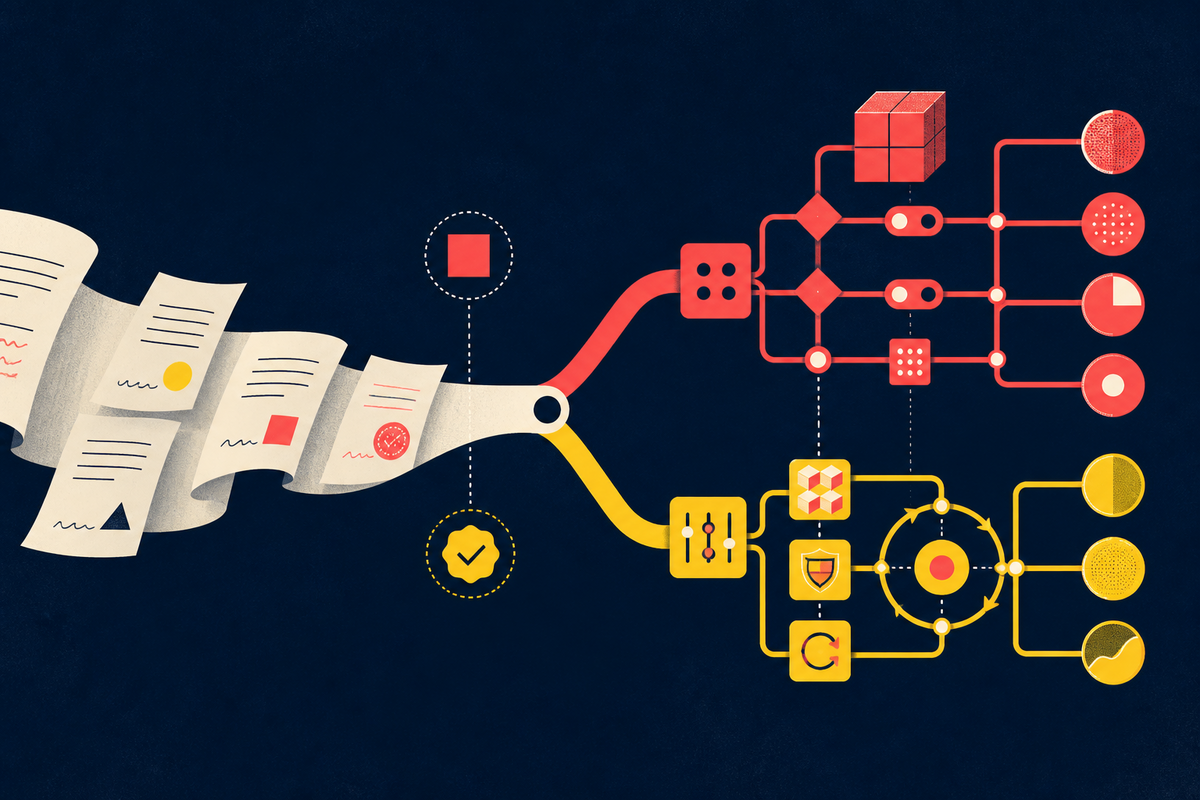
A sales rep opens a CRM opportunity, assembles a quote, routes it for approval, sends a polished proposal and waits for a signature. From ten feet away, PandaDoc and DealHub appear to do this same job. Both pull data into buyer-facing material. Both touch approvals, contracts and e-signatures. Both can show up in the same search results, procurement decks and software demos. So the shortlist looks sensible. The mistake comes later, when a team treats the final PDF as proof that the machinery behind it must also be the same.
It is not. PandaDoc grew around the document as the unit of work: create it, edit it, route it, send it, sign it, track it and retrieve the completed file. Its developer documentation describes a lifecycle that begins with a template, uploaded file or public URL and continues through preparation, delivery and signing. DealHub begins closer to the commercial decision: configure the right products, apply the right pricebook, control discounts, collect approvals and carry the transaction through contracts, subscriptions and billing. Its CPQ materials emphasize guided configuration, adaptive pricing, bundles, renewals, co-terms and amendments.
That sounds like a tidy category distinction. It would also be out of date. PandaDoc now sells CPQ capabilities. DealHub generates documents, supports contract workflows and offers built-in e-signature. The products have expanded toward each other because customers do not experience a clean boundary between a quote’s logic and its presentation. A price has to appear somewhere. A contract has to inherit approved terms. A signature has to update another system. The overlap is not a buyer’s misunderstanding; it is the market responding to the same handoff.
The quote is where content and calculation meet. A shared output does not imply a shared operating model.YesPress analysis
Start with the object each system protects
PandaDoc protects the integrity and movement of the document. Its workflow pages focus on reusable templates, smart fields, editing, version tracking, approvals, reminders, signatures, storage and engagement data. That makes intuitive sense for teams whose recurring pain sounds like this: proposals are off-brand, legal language is copied from old files, recipients are chased manually, documents disappear into email threads, or product data has to be retyped before sending.
The platform’s CPQ add-on pushes upstream. PandaDoc says it can apply real-time pricing rules, guided selling and threshold-based approvals, then combine CRM details, product configurations and prices inside a designed quote. Its product page says the add-on can work standalone and is most deeply integrated with HubSpot and Salesforce. This matters: dismissing PandaDoc as a decorative proposal tool would miss the product it sells now.
DealHub protects the integrity of the commercial transaction. Its CPQ layer treats product structure, pricing methods, discount guardrails and approval policy as governed logic. A rep can be guided toward a valid configuration; the system can support fixed, tiered and usage-based prices; and the same commercial record can handle a new sale, expansion, renewal or amendment. The adjacent products extend that record into contract collaboration, a buyer-facing DealRoom, subscription management and billing.
Document first
Templates, content, editing, routing, signatures, tracking and completed files are the work to standardize.
Logic first
Products, pricing models, bundles, discount policy, renewals and billing handoffs are the work to govern.
DealHub does not stop at arithmetic. Its DealRoom is a customer-facing site that can centralize proposals, contracts, files, chat, mutual action plans and signatures. Its contract product includes templates, clauses, redlining, version comparisons and approval flows. In other words, calling DealHub “the pricing one” is useful only as a starting orientation. It is a wider quote-to-revenue platform whose document experience is downstream of the governed deal.
Why the feature matrix keeps lying to you
Put both vendors into a spreadsheet and the rows begin to collapse: document generation, CRM integration, approvals, quotes, contracts, e-signatures, analytics. A check mark records presence, not depth, design or ownership. It does not tell you whether a pricing administrator can safely change a rule without a developer. It does not show whether a sales manager can rebuild a proposal without breaking a subscription calculation. It certainly does not reveal how a signed amendment becomes the next invoice.
Authoring: Who owns templates, clauses, content and the final buyer experience?
Policy: Who owns products, pricebooks, bundles, discounts and approvals?
Change: Who can alter the system safely when the offer evolves?
Record: Which system remains authoritative after the customer signs?
The better unit of comparison is an exception. Ordinary deals flatter every product. Give each vendor a new-business quote with standard products and an approved discount, and both demonstrations may feel fast. Instead, test a co-termed expansion priced differently by region, with one nonstandard clause, a finance approval, two signers and a billing change. Then watch where data is re-entered, where policy leaves the system and which administrator has to intervene.
This exercise also identifies the real buyer. A sales enablement lead concerned with approved content may value an editor that ordinary users can control. Legal may care about clauses, redlines and audit trails. RevOps may care about product dependencies, discount leakage and the ability to maintain rules without joining an engineering queue. Finance may care about proration, invoice schedules and what the signed terms do next. “We need better quotes” is often four projects compressed into one sentence.
A practical way to choose
Begin with PandaDoc when most of the value is created after the commercial terms are known. If the recurring task is turning stable data into many kinds of polished, reusable and signable documents, PandaDoc’s document-first model is legible. The same logic applies beyond sales: onboarding forms, HR documents, statements of work and agreements all benefit from a generalized document workflow. Its API can also embed creation and signing in another product, making it relevant when the document experience itself must become part of an application.
Begin with DealHub when the expensive risk happens before the quote is rendered. Complex catalogs, product dependencies, several pricing models, regional rules, partner quoting, discretionary discounts, recurring revenue and frequent subscription changes create a governance problem. DealHub’s product model is designed to turn that policy into a repeatable seller path, then carry the approved result into contracts and the buyer experience.
“Begin with” is deliberate. A company may still use both, or connect one of them to an incumbent CRM, e-signature provider, billing platform or contract repository. Architecture matters more than suite loyalty. If DealHub owns configuration and pricing while PandaDoc owns a broader document estate, define the handoff and the authoritative fields. If PandaDoc CPQ covers the required rules, adding a second commercial platform could create unnecessary administration. Consolidation is valuable only when the remaining system can carry the difficult work.
- Map the current path. Mark every copy-paste, spreadsheet, approval message, document edit and post-signature update.
- Name the costly failure. Formatting delay, wrong price, invalid bundle, approval leakage and billing mismatch require different fixes.
- Demo two deals. Use one common transaction and one exception that has already caused trouble.
- Test the administrator. Ask the future owner to change a template, a price rule and an approval path during evaluation.
- Trace the signed data. Decide what becomes authoritative in the CRM, contract store, subscription record and billing system.
The shortlist was a clue
PandaDoc and DealHub appear together because the quote is an awkward border object. To the buyer, it is a document. To sales, it is a conversation. To RevOps, it is the result of configuration and pricing policy. To legal, it may become a contract. To finance, it is a promise that must eventually match an invoice. Each vendor has expanded across that border from a different home base.
The choice becomes less confusing once the team stops asking which product “does quoting.” Both do. Ask where complexity originates, which system should own it and who will maintain that system after launch. The answer may point to PandaDoc, DealHub or a deliberate combination. More importantly, it replaces a category debate with an operating decision. That is the reason to keep both on a shortlist long enough to test the work that a polished demo usually leaves out.
Questions buyers keep asking
Are PandaDoc and DealHub direct competitors?
They compete across quotes, proposals, approvals, contracts and signatures. PandaDoc remains centered on document workflows; DealHub remains centered on CPQ and quote-to-revenue governance.
Does PandaDoc offer CPQ?
Yes. PandaDoc offers pricing rules, guided selling, quote creation and approval workflows through a paid CPQ add-on for Enterprise plans.
Can DealHub create and sign documents?
Yes. DealHub offers document generation, contract workflows, a buyer-facing DealRoom and built-in e-signature. It also integrates with DocuSign.
Which one fits a document-heavy workflow?
PandaDoc is the more natural starting point when templates, editing, routing, signatures, tracking and API-driven document completion are the main work.
Which one fits complex pricing operations?
DealHub is the more natural starting point when products, bundles, pricebooks, discount policy, renewals, amendments and billing handoffs create the main risk.