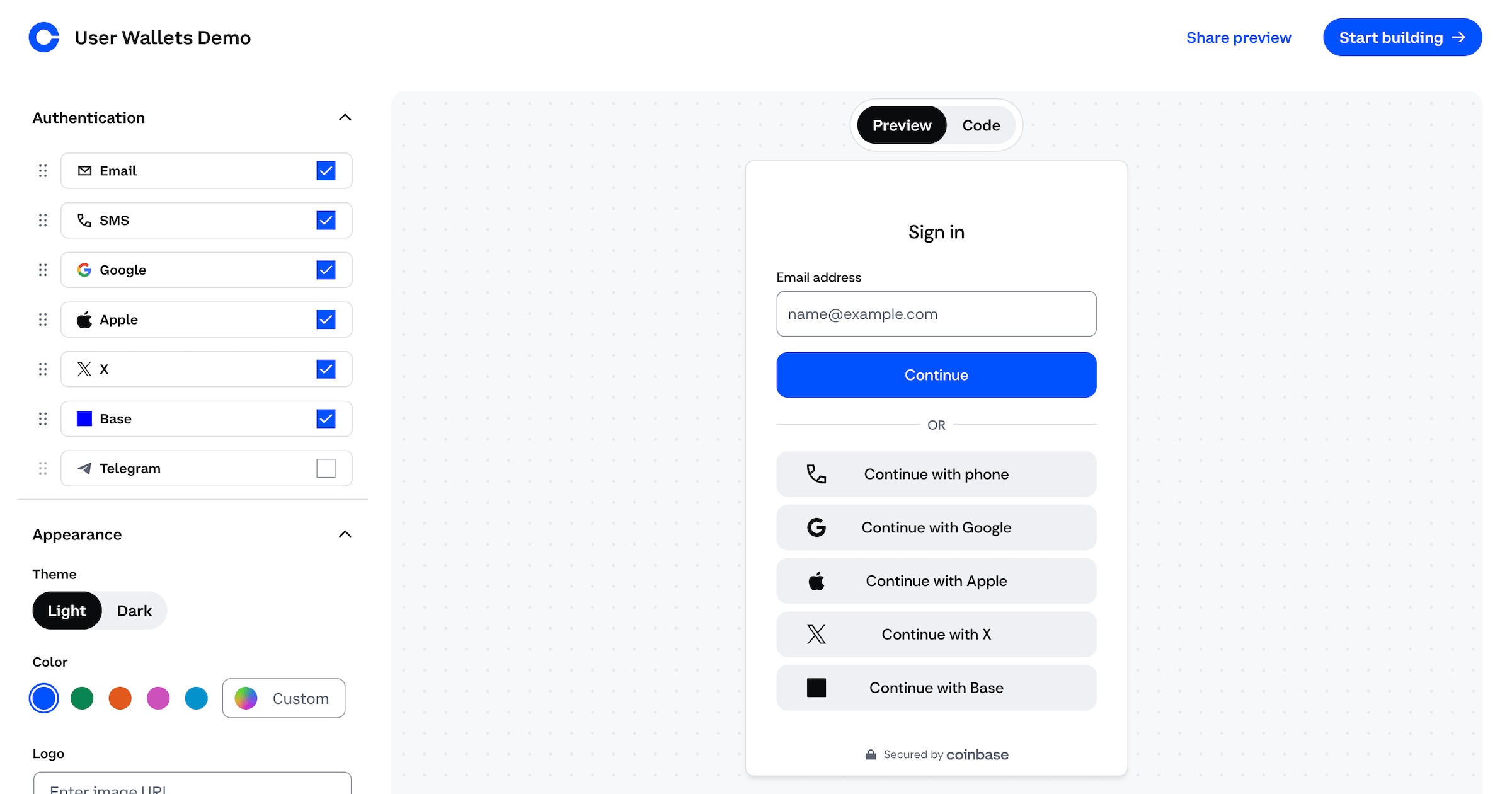
Consider the email address. It is an unremarkable thing to type into a box, which is precisely why it matters. In Coinbase Developer Platform’s wallet demo, that familiar act sits where crypto applications once asked newcomers to acquire a wallet, understand a recovery phrase and work out how to fund it. The interesting engineering is happening behind the screen. The visitor gets to remain a visitor.
- CDP packages Coinbase infrastructure for developers, banks, brokerages and payment firms.
- Embedded Wallets serve people; Server Wallets serve programmable systems and agents.
- Its appeal is fewer handoffs between wallets, funding, payments and trading.
First, retire the initiation ceremony
A developer wants someone to buy something, receive money or use an application. Crypto has often inserted a small technical education before any of those activities. Each additional instruction is another invitation to leave. CDP’s proposition is to make more of that work a service the developer integrates, rather than a sequence the customer must perform.
The platform brings together APIs, software development kits and hosted services across wallets, payments, trading and stablecoins. A team can use individual components or combine them. Its customers range from application builders to financial institutions. The common problem is the same: adding crypto functionality requires several systems to cooperate, and somebody must take responsibility for the joins.
“Building onchain is hard. We make it easy.”Coinbase Developer Platform
This is Coinbase’s infrastructure business. Its significance comes from the machinery behind the familiar exchange: key management, custody, compliance and financial connections. CDP makes that machinery available to other builders. There is a pleasing commercial symmetry here. Coinbase can be the application a person opens, or the infrastructure inside an application that person already prefers.
Two wallets, two kinds of customer
Embedded Wallets put a wallet inside the developer’s application. Email, SMS and social authentication make the entrance familiar; customization lets the builder own the presentation. Coinbase describes the default as self-custody. Private keys are handled within trusted execution environments, an architecture intended to isolate sensitive operations. The promise is convenience without turning every app developer into a custodian.
Server Wallets solve a different problem. Software needs to create wallets and authorize actions through an API. A trading bot cannot keep fetching a person to approve every routine step. Developers can apply allowlists, transaction limits and other policy controls. The wallet becomes a controlled instrument of the program. EVM networks and Solana extend the available terrain, with coverage depending on the particular product.
The distinction matters more than the product names suggest. One system needs authentication that people understand. The other needs permissions a machine can obey. Both need security, but their daily choreography is different. Treating them as separate design problems gives a builder a useful place to begin.
The first trouble appeared between chains
FereAI provides an instructive example. Its early CDP integration supported deposits and basic agent trading. As its product developed, wallet management across chains became confusing, funding and trading flows became fragmented, and moving capital flexibly required more integration work. The original arrangement had served the initial job. Expansion exposed its seams.
FereAI upgraded to Server Wallets, provisioning programmable wallets for users and agents and simplifying funding flows. Coinbase’s August 2025 case study reports fivefold growth in agent transaction throughput and 90% faster onboarding for new trading flows and chain integrations. Those are customer case-study results, rather than a forecast for the next team. Their useful lesson is narrower: growth can make the connections between components the problem.
Questflow had another coordination problem. Its agents needed wallets and a way to pay one another without repeatedly summoning humans. It combined Server Wallets with x402, an HTTP-native payment protocol. Coinbase reports more than 130,000 autonomous microtransactions by August 2025. Payments became part of the workflow, rather than an errand outside it.
Count the operations, then count the money
Infrastructure has a wonderfully sobering property: eventually, somebody receives an invoice. At Embedded Wallets’ October 2025 general availability announcement, Coinbase offered 5,000 free wallet operations monthly. Its indexed pricing listed $0.005 per operation beyond the allowance. That historical rate illustrates the model; a production budget needs current terms and the actual operations its workflow consumes.
A wallet operation is not synonymous with a successful payment. Creation, signing, broadcasting and policy evaluation can contribute work to a flow. Using the historical rate, 20,000 billable-category operations with 5,000 free would produce $75 in wallet charges. Network fees and other services are separate considerations. A cheap unit becomes meaningful only after you count the units.
Excludes network and other service fees
The machinery earns its place
CDP has competition at several layers. Privy offers embedded and agent wallets. Alchemy supplies blockchain infrastructure, data and transaction tooling. A team can also assemble separate providers. CDP’s distinctive argument is the breadth of Coinbase’s stack: fewer separate arrangements across financial functions, with infrastructure already used within Coinbase itself. Its retail DEX experience uses CDP Embedded Wallets.
The institutional direction became clearer in 2026. Coinbase joined Solana Developer Platform as a wallet infrastructure partner in March. In September, its expanded Citi collaboration connected fiat account infrastructure with stablecoin services and payment acceptance. These arrangements address a practical obstacle: businesses need money to move between conventional accounts and digital assets, not merely between impressive diagrams.
The boundaries deserve design attention. Coinbase distinguishes immediately accessible self-custody APIs from custodial APIs requiring verified business onboarding. Product availability varies by jurisdiction. A team whose required chain, geography or control model does not fit will need another arrangement. Convenient signing also cannot rescue a poor trading strategy or an unwanted application.
What should a reader copy? Begin with a familiar entrance, give automated spending explicit rules, and test an entire money journey, including funding and withdrawal. Then measure completion and cost. The email box is a good reminder of what infrastructure is for: allowing the person using the product to think about something else.