BREAKING   Coherence Neuro raises $10M seed to advance closed-loop cancer neurotech +   First-in-human trials targeted for 2026 +   Flagship device SOMA: implant + wearable + app +   Co-led by Artesian and Topology Ventures +   Founded by Cambridge neuroengineers Woodington & Jenkins BREAKING   Coherence Neuro raises $10M seed to advance closed-loop cancer neurotech +   First-in-human trials targeted for 2026 +   Flagship device SOMA: implant + wearable + app +   Co-led by Artesian and Topology Ventures +   Founded by Cambridge neuroengineers Woodington & Jenkins
Company Profile  /  Neurotechnology  /  San Francisco, California

Coherence Neuro

// Cancer therapy that learns

A San Francisco medical-device company that treats cancer less like a war and more like a signal it can read - and answer - in real time.

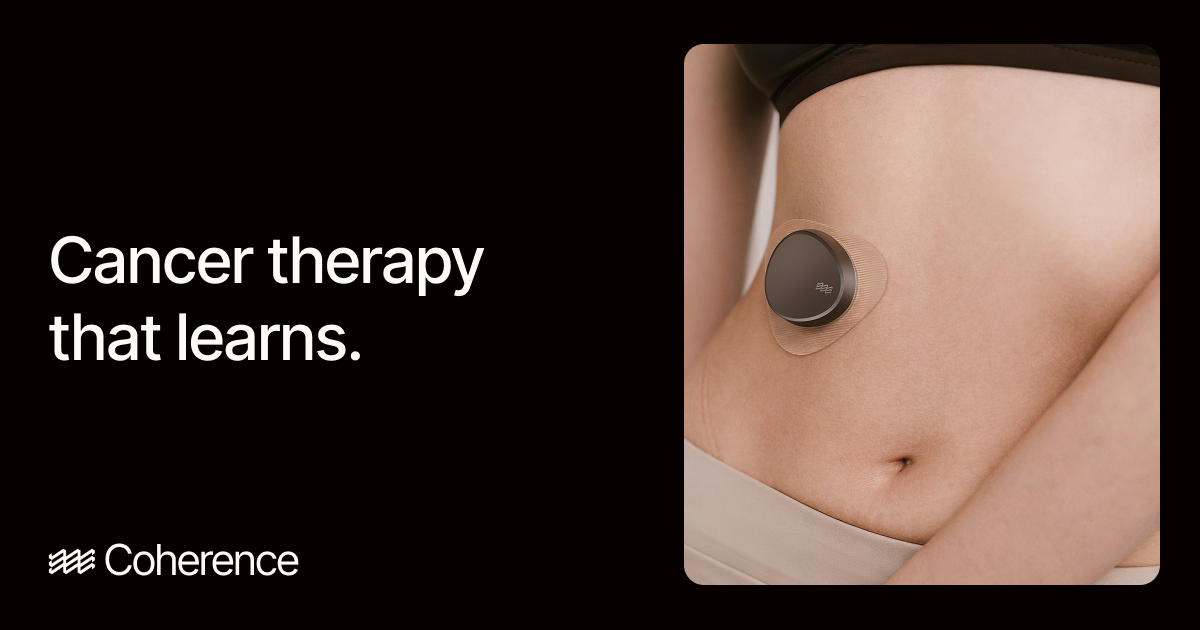
Coherence Neuro - Cancer therapy that learns, with the SOMA wearable device worn on the abdomen
The whole pitch in three words and one small disc. A wearable sits on the skin the way a wristwatch does - unremarkable until you know it is quietly reading and answering the body's electrical signals. The company's own promise, printed plainly: cancer therapy that learns.
$10M
Seed Round
2022
Founded
26
Employees
2026
First-in-Human

A Control Problem Wearing a Lab Coat

Here is a sentence that should not work as a business plan: what if cancer is a signal-processing problem? Most oncology treats a tumor as something to cut out, burn down, or poison into retreat. Coherence Neuro, a 26-person company in San Francisco, proposes a stranger idea - that the body runs on electrical signals, that disease shows up in those signals, and that if you can read the signals accurately enough, you can answer back. Treat the tumor, in other words, the way an engineer treats a system-state error: measure, adjust, measure again.

This is the sort of claim that is either the future of medicine or a very expensive misreading of biology, and the honest answer today is that nobody knows which. What is knowable is that serious people have decided it is worth finding out. In November 2025 the company closed a $10 million seed round co-led by Artesian and Topology Ventures, with Blackbird, Possible Ventures, and a roster of others joining. That is not a lot of money to cure cancer. It is a reasonable amount to run your first human trial and learn quickly, which is the more disciplined - and more telling - ambition.

The founders, Ben Woodington and Elise Jenkins, met at the University of Cambridge studying neuroengineering and neuro-oncology, two fields that do not usually share a hallway. Most people in that situation write a paper. They started a company. The bet they are making is essentially that the tools which learned to quiet a Parkinsonian tremor - neuromodulation, closed-loop stimulation, adaptive electrical feedback - can be pointed at oncology. Whether tumors will cooperate the way tremors did is the entire question, and it is a real one.

"We are leading a revolution in cancer treatment, transforming it from a brutal battle into a continuously monitored and seamlessly managed condition."

- Coherence Neuro

Notice the framing. The word "battle" is doing a lot of quiet work in how we talk about cancer - patients "fight," they "beat it," they "lose." Coherence wants to replace the metaphor entirely. Not a war with a decisive victory, but a condition kept in stasis, monitored around the clock, adjusted continuously. It is the difference between a fire brigade and a thermostat. Whether the biology permits a thermostat is unproven. But as a reframing of the problem, it is unusually clean, and clean framing is often how hard problems first become tractable.
Meet SOMA

SOMA is the flagship - and, the company says, the first in a planned suite of cancer-management devices. It is not one gadget but three parts working as a loop: a wireless implant that listens and stimulates, a wearable that patients keep on the skin, and a phone app that ties it together. The name is a nice double joke: soma is Greek for "body," and also the name for the cell body of a neuron. The device is meant to disappear into daily life, which is a design goal as much as an engineering one.

01 / SENSE

Read

Decode the body's electrical signals in real time via the implant.

02 / DECIDE

Learn

An AI backend interprets the signals and chooses a response.

03 / ACT

Stimulate

Deliver adaptive, precisely tuned stimulation to modulate activity.

04 / REPEAT

Adjust

Measure the effect and correct - continuously, 24/7.

The interesting part is the fourth box. Most medical devices deliver a fixed dose or a fixed pulse; SOMA is designed as a closed loop, meaning it watches its own effect and revises. Add the data backend and you get something rare in medtech - a network effect. Every device deployed, in theory, teaches the next one. That is the kind of moat software companies take for granted and hardware companies almost never get.

The Implant

A wireless neural interface that decodes bioelectronic signals and delivers targeted stimulation from inside the body.

The Wearable

A discreet on-skin device - the small disc in the hero image - that patients keep on through ordinary daily life.

The App

The patient-facing layer for continuous monitoring, tying implant and wearable into one managed system.

Follow the Capital

Coherence has raised roughly $13.5M in total, anchored by the November 2025 seed. The round was co-led by Artesian and Topology Ventures - a mix worth reading closely: pre-clinical bioelectronics is a long, capital-hungry road, and the investors here are writing conviction checks on a thesis, not a revenue line.

Seed (Nov 2025)
$10.0M
Prior funding
$3.46M
Total raised
$13.46M
Artesian ★ lead Topology Ventures ★ lead Blackbird Possible Ventures XEIA Venture Partners Jumpspace Ventures Divergent Capital SmartGateVC Spacewalk VC Matt Krisiloff Linhao Zhang Tim Shi

"This is one of the most ambitious technical efforts we have seen at Blackbird, turning decades of neuroscience into a new way to fight cancer."

- Michael Tolo, General Partner, Blackbird

The Founders

BW

Ben Woodington

Co-Founder & CEO

A neuroengineer by training who met his co-founder at Cambridge. He leads the company's push from academic research into the clinic - and the first human trial ahead.

EJ

Elise Jenkins

Co-Founder

Co-founded Coherence out of shared research in neuroengineering and neuro-oncology, the two disciplines the company is trying to fuse into a single device.

The origin is almost suspiciously tidy - two researchers, one field each side of a hard problem, one shared conviction. It is the kind of story investors like because it is legible. The harder, less legible work - the trials, the regulators, the biology that may not cooperate - is all still ahead of them.

What Happens Next

2022

Founded

Ben Woodington and Elise Jenkins launch Coherence Neuro out of research begun at the University of Cambridge.

NOV 2025

$10M Seed Round

Co-led by Artesian and Topology Ventures to advance the closed-loop system toward the clinic.

2026

First-in-Human Trials

The pivotal next step - moving SOMA from bench and pre-clinical work into its first human study.

Things That Amuse & Inform

Pass It Along

Quick facts: Coherence Neuro

Coherence Neuro is a San Francisco medical-device company building closed-loop neurotechnology to treat cancer as a continuously monitored condition rather than a reactive battle. Founded in 2022 by University of Cambridge researchers Ben Woodington and Elise Jenkins, the company decodes the body's electrical signals in real time and delivers adaptive, AI-tuned stimulation through its flagship SOMA system - a wireless implant, wearable, and mobile app working together. Backed by a $10M seed round led by Artesian and Topology Ventures, Coherence aims to begin first-in-human trials in 2026.

Founded
2022
Headquarters
San Francisco, United States
Founders
Ben Woodington (Co-Founder & CEO), Elise Jenkins (Co-Founder)
Team size
26 employees
Products
SOMA, Digital neural interfaces, AI-enabled data backend
Notable
Closed a $10M seed round in November 2025 co-led by Artesian and Topology Ventures, Raised $13.46M in total funding to date, Developed SOMA, a closed-loop implant-wearable-app system for cancer management

Last updated: