In September 2014, a company called CloudBees told some of its customers to leave. Its application hosting service, RUN@cloud, would close. Customers had until the end of December to move their applications elsewhere. For a business with “cloud” in its name, abandoning a place to run software was a curious decision.
- CloudBees helps large companies build, test, release, and govern software.
- Its commercial foundation is Jenkins; its newer bet is Unify, a shared control plane across existing tools.
- The useful buying question: how much waiting and maintenance can it remove?
The cloud it walked away from
CloudBees had been incorporated in 2010, co-founded by Sacha Labourey and François Déchery. Application hosting was one opportunity. Jenkins, the open-source automation server, was another. Jenkins could build and test software whenever developers changed it. CloudBees offered the extra management and support that large organizations wanted around that engine.
By the 2014 announcement, Jenkins had more than 85,000 active installations globally. CloudBees expected annual recurring revenue from its continuous delivery products to quadruple that year. The company concentrated its resources on Jenkins. The hosting product was the thing it sacrificed to follow demand.

That decision explains much of the company today. Its expertise lives in the distance between a developer finishing a change and a customer safely using it. In a large company, that distance contains test queues, permissions, aging machines, release approvals, and a surprising amount of detective work.
The expensive part was the waiting
Consider the Salesforce business technology team described in a CloudBees customer study. Its infrastructure was more than five years old. Changes could take a month. Static Jenkins agents, the workers that execute jobs, needed continual maintenance while consuming resources even when their capacity was unnecessary.
“You’d basically have to work through 100 different steps to make it work right.”Venkat Kothapalli, Salesforce DevOps engineer
The team moved to CloudBees CI on Amazon Elastic Kubernetes Service and codified its platform configuration. On-demand agents replaced the static approach. According to the customer study, the team no longer maintained 35 to 40 static agents. Platform upgrades that had involved four people and three weeks of manual testing became work one administrator completed in two to three hours.
Four people testing manually → one administrator after the migration. A customer result, not a universal forecast.
The improvement combined a commercial product, cloud infrastructure, configuration as code, and changes in operating practice. Giving the license all the credit would miss the lesson. The team changed how work happened. Software helped make that change repeatable.
One view of a crowded workshop
CloudBees CI remains its Jenkins-based enterprise offering. Release orchestration coordinates deployments across applications and environments. Feature management lets teams expose a capability gradually rather than make every deployment an immediate launch. Security, compliance, and analytics address the questions that follow: who approved this, what was tested, and what actually shipped?
Unify, announced in May 2025, connects these concerns across existing toolchains. Jenkins and GitHub Actions can remain in place. CloudBees wants to supply the shared visibility and controls around them. That matters to companies whose development systems reflect years of acquisitions, team preferences, and infrastructure decisions.
GitHub Actions
Policy + evidence
Alternatives include GitLab, GitHub Actions, Harness, CircleCI, and operating open-source Jenkins yourself. The comparison depends on the job. A repository automation tool and a platform governing releases across an enterprise solve overlapping problems. A competitor in one buying decision can become an integration in another.
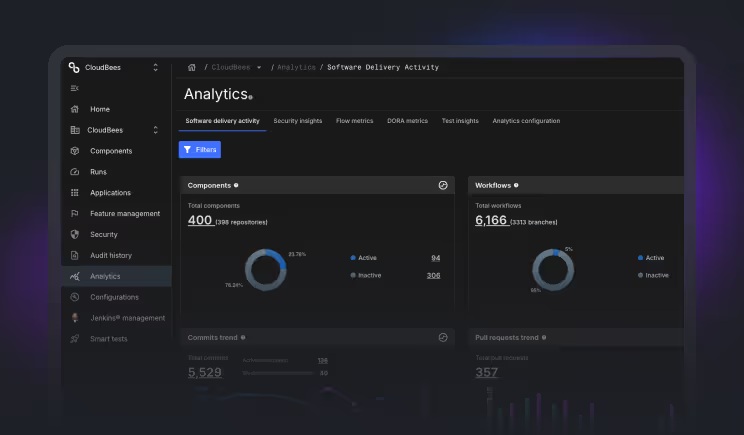
The customers reflect that complexity. CloudBees names organizations including Adobe, Bosch, Visa, HSBC, and Salesforce. In March 2025 it reported more than 500 large-company customers, more than 500,000 developer users, profitability, and annual recurring revenue above $150 million. Those are dated company figures; recurring revenue measures the subscription business rather than recognized annual sales.
A pilot beats a promise
For a small team with a straightforward pipeline, a broad governance layer may offer little extra value. The stronger fit is an organization where different groups must share evidence and coordinate releases. Its advantage depends on connecting those groups successfully, which makes integration quality part of the product evaluation.
CloudBees makes money through commercial software subscriptions and associated support and services. Its current Unify pricing page asks buyers for a custom quote. A useful budget therefore includes integration work, infrastructure, staff time, and the subscription. The free open-source alternative still needs someone to operate it.
There is a practical way to investigate the value. Pick one repository with a painful feedback loop. Measure test duration, reruns, administrator effort, and the time developers spend waiting. Make one change, then compare. Expanding a measured improvement is easier to defend than buying a platform on the strength of a demonstration.
Smart Tests offers a specific experiment. Built on technology from Launchable, acquired in 2024, it selects relevant tests and helps analyze failures. Its onboarding documentation recommends observation mode alongside normal CI runs to establish a confidence curve. That gives teams evidence about the relationship between saved test time and detected failures.
The conditions matter. Its documented requirements include internet access, compatible tooling, binary test results, and tests without inter-test dependencies. A suite whose tests depend on their execution order needs attention first. Faster selection also cannot supply clear ownership or repair an approval process nobody understands.
More code, more gatekeeping
In December 2021, CloudBees announced $150 million in equity at a $1 billion pre-money valuation, alongside a $95 million debt facility. That financing helped fund a business now confronting another shift: code produced by AI agents still has to be tested, secured, and released.
Moritz Plassnig, the Codeship co-founder whose company CloudBees acquired in 2018, became CEO in June 2026. An October Denver office announcement added a hiring hub. The strategic question underneath both developments is familiar from 2014: where does the work get stuck? CloudBees is betting enterprises will pay to make the answer visible before the next change reaches production.