A shirt is a surprisingly good test of a software company. Photograph it, ask an app what cleaning will cost, and an ordinary errand becomes a chain of decisions. Somebody must identify the garment. Somebody must collect payment. A cleaner and a driver need instructions that agree. The customer wants a clean shirt, preferably without learning anything about software architecture.
- Build it: custom web and mobile apps, from discovery to release.
- Extend it: dedicated engineers for an existing product team.
- Budget for it: small-app guidance starts around $50,000.
Cleveroad works in that gap between the simple request and the complicated delivery. Its customers include first-time founders and established software businesses. What they buy is engineering capacity, but also a way to turn a business process into something people can use. The revealing details sit behind the screen.
01 / The shirt gets a vote
Consider SnapWash, a laundry marketplace built for a founder without an engineering team. Cleveroad delivered customer and driver mobile apps, a retailer interface and an administration panel. Four applications had to behave like one service.
According to Cleveroad’s case study, the original specialist vision service struggled with real garment photos. The team changed models during development. An early selection had survived planning; it did not survive the laundry. That distinction matters whenever a prediction determines what somebody pays.
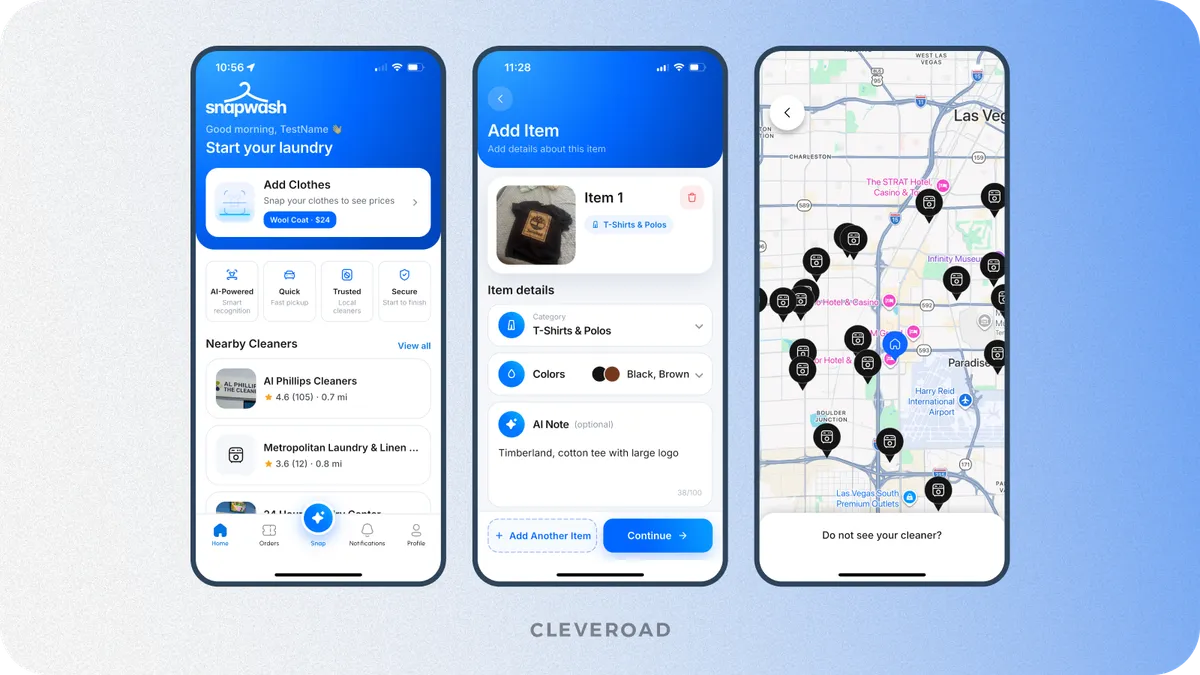
The support assistant has a useful boundary: it reads order information but cannot change an order. Unresolved issues go to a person. The portable lesson is to test the risky assumption with ordinary inputs and give an assistant only the permissions its job requires.
Each handoff needs the same version of events.
02 / The queue before the release
At Proprio Cloud Solutions, the troublesome object was a release. The Michigan company builds NetSuite-connected software for contract furniture dealers. Manual regression checks across three customer environments consumed three working days per release, according to Cleveroad’s account. More features meant more checking.
Cleveroad introduced automated Playwright tests and used Claude Code across delivery roles, with people reviewing generated work. It also contributed to Orion platform releases and a field-service mobile MVP. The reported sprint-output improvement was 30–40%, measured against earlier story-point totals.
“The speed difference was real. We tracked it.”
Luke Abbott, Proprio CTO and co-founder, in Cleveroad’s published case study
Treat that number as a result from one engagement. Story points belong to a team’s own estimating system; they are not a universal unit of productivity. The more useful question for another buyer is concrete: where does work wait before a customer can use it?
03 / Sometimes the product already exists
Piceasoft needed a different arrangement. The Finnish company makes software for the mobile-device lifecycle, including trade-in, diagnostics and erasure. Its own history describes an international business serving operators, retailers and other device businesses. Existing products meant existing customers, and existing customers make experimentation less forgiving.
Cleveroad’s engagement account describes a search for senior JavaScript and React developers who could also contribute to C# backend work. It says candidates were presented within a day and engineers joined within ten days. A month of onboarding followed. Joining quickly and understanding a system are separate accomplishments.
There is a lesson in that unglamorous month. A developer can know the programming language and still need to learn why a particular customer record, permission or exception exists. Asking about that learning process may tell a buyer more than asking how soon a résumé can arrive.
This is the dedicated-team side of the business: contribute inside somebody else’s software, processes and priorities. For buyers, the distinction changes the brief. A new founder needs help deciding what to build. An established team may need a particular skill, good documentation and fewer surprises at the next release.
04 / The bill belongs in the conversation
Cleveroad’s FAQ gives unusually practical starting points. An app with four or five key features is roughly $50,000–$100,000; six to nine features, $100,000–$200,000; larger projects start at $200,000. Sign-in and static content do not count toward those feature bands. These are planning estimates, not invoices for the projects above.
The company sells project delivery, time-and-material work and additional team capacity. It explicitly declines equity-only partnerships. Buyers are paying for services, rather than buying a subscription to one Cleveroad product. Its scope includes interface design, mobile and web engineering, quality assurance, cloud operations and consulting.
The comparison with alternatives should start there. Could an existing software package do the job? Could an internal team own it? Does the business need an entire delivery team or one missing specialist? Custom development makes more sense when the workflow warrants its cost and somebody can keep making product decisions.
The FAQ’s time-and-material process offers a useful buying discipline: review a demo and sprint reports, give feedback, then estimate requested changes. That gives a buyer repeated chances to adjust the work. It also requires attention. A customer who cannot review decisions will struggle to get much value from short feedback cycles.
05 / Look past the proposal
There is also work a prospective customer can inspect. Cleveroad publishes open-source Android and Flutter components. SlidingTutorial handles animated onboarding; FanLayoutManager arranges items like fan blades. Small interface problems, solved in public, offer a different view from a portfolio presentation.
Public code lets technical buyers ask their own questions: how is the component documented, what license applies, and does it fit the application they are building? A library cannot establish how a whole project will go. It does provide something concrete to examine before the sales call.
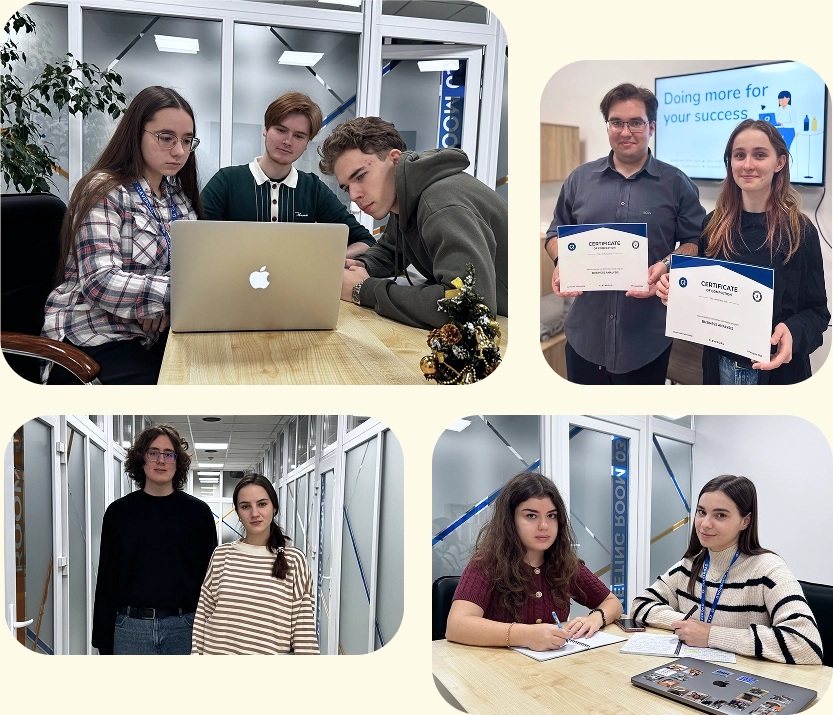
Its company page describes traineeships and community education. Its website also lists ISO quality and information-security credentials and AWS partnership status. Those are useful purchasing signals; buyers still need a specific scope, named responsibilities and a way to judge progress.
The habit worth borrowing is modest. Write down the handoffs. Test the assumption most likely to embarrass the product. Make changes visible. A clean shirt is a small outcome. Getting every person and system to agree on how it gets home is substantial work.