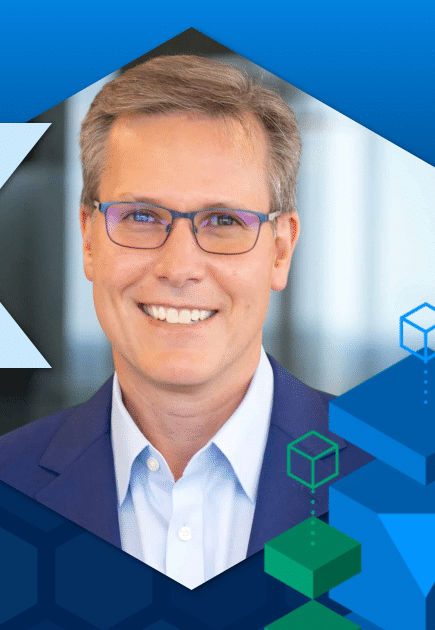
In a hospital operating room, most of us count minutes. Clay Ritchey counted machines. His daughter was in surgery, and as the procedure unfolded he recognized four separate technologies moving around her - four systems he had helped bring into the world over a career spent building healthcare software. It was, he has said, one of the most fulfilling moments of his professional life. It was also the clearest answer to a question he gets asked often: why healthcare, and why identity, and why for this long.
Ritchey did not set out to become a fixture in health technology. He grew up in rural south-central Pennsylvania, tucked into the folds of the Appalachian Mountains, the son of two teachers. That household ran on curiosity and the expectation that a hard problem was something you sat with until it gave way. Competitive athletics filled the rest of his childhood and taught him a second lesson that has followed him into boardrooms - what he describes as swagger, a quiet confidence that shows up without needing to announce itself.
He studied electrical engineering at Penn State and graduated with Highest Distinction, then added an MBA from Harvard Business School. The pairing is telling. Ritchey is comfortable in the wiring diagram and the business plan, and his career has lived in the space between them - taking genuinely technical products and turning them into companies that grow.
Verato's unique referential identity matching technology is a critical linchpin in the healthcare digital transformation journey.
Clay Ritchey, on joining Verato as CEOThe problem he keeps coming back to
Ask Ritchey what Verato does and he will start with something disarmingly basic. Healthcare organizations, he argues, often do not reliably know who their patients are. The same person shows up as three records in one system and a fourth somewhere else. A marketing database and a clinical chart describe the same human being but never quite agree. Every duplicate, every mismatch, every "we don't have you in our system" is a small failure of identity - and those small failures add up to worse care, higher cost, and patients who slip through the cracks.
Verato's answer is referential identity matching: instead of comparing records only against each other, the technology checks them against a deep, continuously updated reference database of identities. Ritchey is careful about how that data gets used. He warns against letting looser consumer and marketing data contaminate the clinical picture.
The problem with consumer data and identity is that it's often thinner information than you have for your clinical data. What you don't want to do is pollute your clinical match by using less trustworthy data.
Clay RitcheyHe is not shy about grading his own industry. Where other executives soften their language, Ritchey tends to say the quiet part plainly - that healthcare has been slow, even resistant, to invest in the kind of modern identity technology that other sectors adopted long ago. It is a striking position for the head of a company whose fortunes depend on that adoption, and it is part of why his interviews travel.
From Evariant to Verato
Before Verato, Ritchey ran Evariant, a healthcare CRM and big-data analytics company. Under his leadership it moved through hypergrowth and, in 2020, into a merger with Healthgrades. Earlier stops filled out the resume of an operator who has seen the industry from several angles: Chief Marketing Officer at Imprivata, CEO of the Maryland company Equinox Healthcare, and Vice President of Marketing and Strategy at Hill-Rom IT Solutions.
None of it happened by accident, and Ritchey is quick to credit the person who opened the first door. David Kennedy of Serent Capital handed him his first shot at being a CEO - a high-stakes bet on an unproven leader that, three healthcare companies later, has aged well. In 2021 Ritchey took over at Verato, succeeding the company's earlier CEO and stepping into a business positioned squarely on the identity problem he had circled for years.
How he works
Ritchey's instinct is to get close to the problem. The story he tells on himself is about spending days on a hospital floor simply watching nurses do their jobs - not to audit them, but to understand the friction in their day well enough that a product could remove it. That immersion, he says, produced innovations that a conference room never would have surfaced.
His operating philosophy compresses into three rules he repeats without irony: do the right thing, be trustworthy, and embrace diversity of perspective and background. It is a deliberately simple code, and simple codes tend to survive contact with a growing company better than clever ones do. When he reaches for inspiration on the big decisions, he reaches for Theodore Roosevelt - the passage about daring mighty things and winning glorious triumphs rather than ranking with the timid spirits who neither enjoy nor suffer much.
If they don't know who is who, they can't engage consumers, retain them, and acquire them in a more frictionless way.
Clay Ritchey, on why identity comes firstThe bet he is making
The healthcare industry spends most of its oxygen these days talking about artificial intelligence. Ritchey does not disagree that it matters - he just insists on a prerequisite. Layer all the intelligence you want on top of a patient record, he argues, and it is worthless if the record belongs to the wrong person. Get identity right first, and everything built on top of it gets more trustworthy. That is the wager underneath Verato, and underneath a career that keeps returning to the same unglamorous foundation.
It is also, in a quiet way, personal. The engineer who once counted four of his own technologies working in his daughter's operating room has never really left that room. He is still trying to make sure that when any patient walks through any door in the system, the people meeting them actually know who they are.