Elizabeth and Taylor arrived as gifts from a husband to his wife. Given Claudia Castillo Ross’s career in fashion and luxury, you might reasonably picture something in velvet boxes. They were Black Angus cattle. At Ross Ranch, the names suited a place where the farm animals get a little show business and the hosts have put considerable thought into dinner.
Ross and her husband, Keith, built their wine project together. The ranch now gives her a different setting from the magazine offices and San Francisco events associated with Cross Marketing, the public relations agency she founded. Yet the interests overlap: an eye for presentation, a reason to gather, and the pleasure of making a place feel personal.
The cattle are an entertaining introduction. The longer story runs through publishing, nonprofit work, a jewelry business, a garage winery and, eventually, a California valley. Ross has spent much of that time helping other people tell their stories. Her own has acquired a fair number of settings.
A publicist with a saleswoman’s memory
Before Cross Marketing, there were Harper’s Bazaar and Marie Claire. Ross worked on the commercial side of fashion publishing, experience that gave her a particular concern when she moved into publicity: whether attention helped a client sell something. An attractive photograph was welcome. So was a customer.
That background helps explain the agency she built in San Francisco. Cross Marketing, also branded Cross Marketing & Design, brings together public relations, marketing and design. Its work has connected retailers, hospitality businesses and nonprofit organizations with audiences and events. The company’s home city supplies a familiar intersection of commerce, culture and fundraising.
Ross could enjoy fashion’s pleasures while remaining blunt about its employment conditions. Asked what aspiring publicists needed, she answered: “It’s a four-letter word, darling…it’s called WORK.” The capital letters belong to her. The joke lands because it comes from someone well acquainted with the dresses and the deadlines.
She also took marketing and design into a classroom at the Fashion Institute of Design & Merchandising. Invitations to speak at UC Berkeley and the University of San Francisco extended that teaching role. It is one thing to arrange an introduction; explaining the judgment behind it requires slowing down a process that, at an event, can look deceptively effortless.
Publishing → Public relations → Her own products
A career moving between explaining a brand and taking responsibility for one.The invitations came with a payroll
The business also had a harder education. Ross recalled having ten employees in December 2008, as the recession unsettled clients and work began disappearing. She wanted to keep the staff employed and used her reserves to meet payroll. After roughly ten months, she reduced the team and began again with an assistant, rebuilding more selectively and charging higher fees.
It is a revealing episode in a career so often photographed at parties. An agency can be full of relationships and still run short of money. Ross’s account gives the founder’s side of the picture: obligations to employees, shrinking demand and a decision that could no longer wait. The smaller business required different terms.
She also described entrepreneurship as a way to control her schedule while raising a family. The work remained substantial; ownership offered a say in when it happened. Flexibility and responsibility arrived together. Neither the events nor the family photographs convey all the calculations involved in keeping that arrangement going.
When the room has a cause
Philanthropy became part of that working life early. Ross has described discovering an opening for her publicity skills through the San Francisco Ballet Auxiliary. People knew she worked in fashion magazines and expected that she could help attract coverage. She treated the assignment as a story she needed to sell.
The connection between retail and social responsibility subsequently became an explicit part of Cross Marketing’s approach. In her founder’s note, Ross describes an interest in businesses and community partnerships that carry a social purpose. That supplies a practical reason for bringing together people who might otherwise move through separate circles.
Raphael House gave her a much longer commitment. She has volunteered, helped with fundraising events and served as board chair. The organization now lists her as Chair Emerita. She moved to emeritus status in November 2011, a useful reminder that a gala photograph captures only a fraction of an ongoing institutional relationship.
Her work there also involved thinking about who would support the organization next. In a 2021 conversation, she discussed helping reshape its marketing to appeal to younger donors. The challenge was familiar to a publicist: communicate the purpose clearly enough that a new audience wants to take part. Here, the consequences extended beyond a commercial client.
“As an entrepreneur, I look to create.”
Claudia Castillo Ross · 2014
The title at Raphael House carries a different kind of weight from an agency job title. It points to continuity: the events end, but the organization keeps working. For Ross, the relationship stretches across changes in her own businesses and address. It also gives the philanthropy in her professional biography a specific place and an ongoing public record.
A bracelet with a past
Ross’s interest in brands has repeatedly led to ownership. Among those ventures was RoseRoss, the estate-jewelry business she created with Tiffany Rose Cummins. Both had collected fine jewelry, and their shared interest became a way to offer pieces with previous lives to new owners.
When the business received attention in 2014, its appeal lay partly in that history. A vintage piece could be worn now and kept for someone later. The business placed Ross in a different relationship to a product: she was helping choose what the customer might treasure, as well as explaining why it deserved attention.
There is a collecting sensibility across these projects. A piece of jewelry, an interior and a bottle of estate wine each invite close attention to particulars. Their histories are different, but all become more interesting when someone can explain the choices behind them. Ross’s career has repeatedly put her in that position.
Ninety vines, then a valley
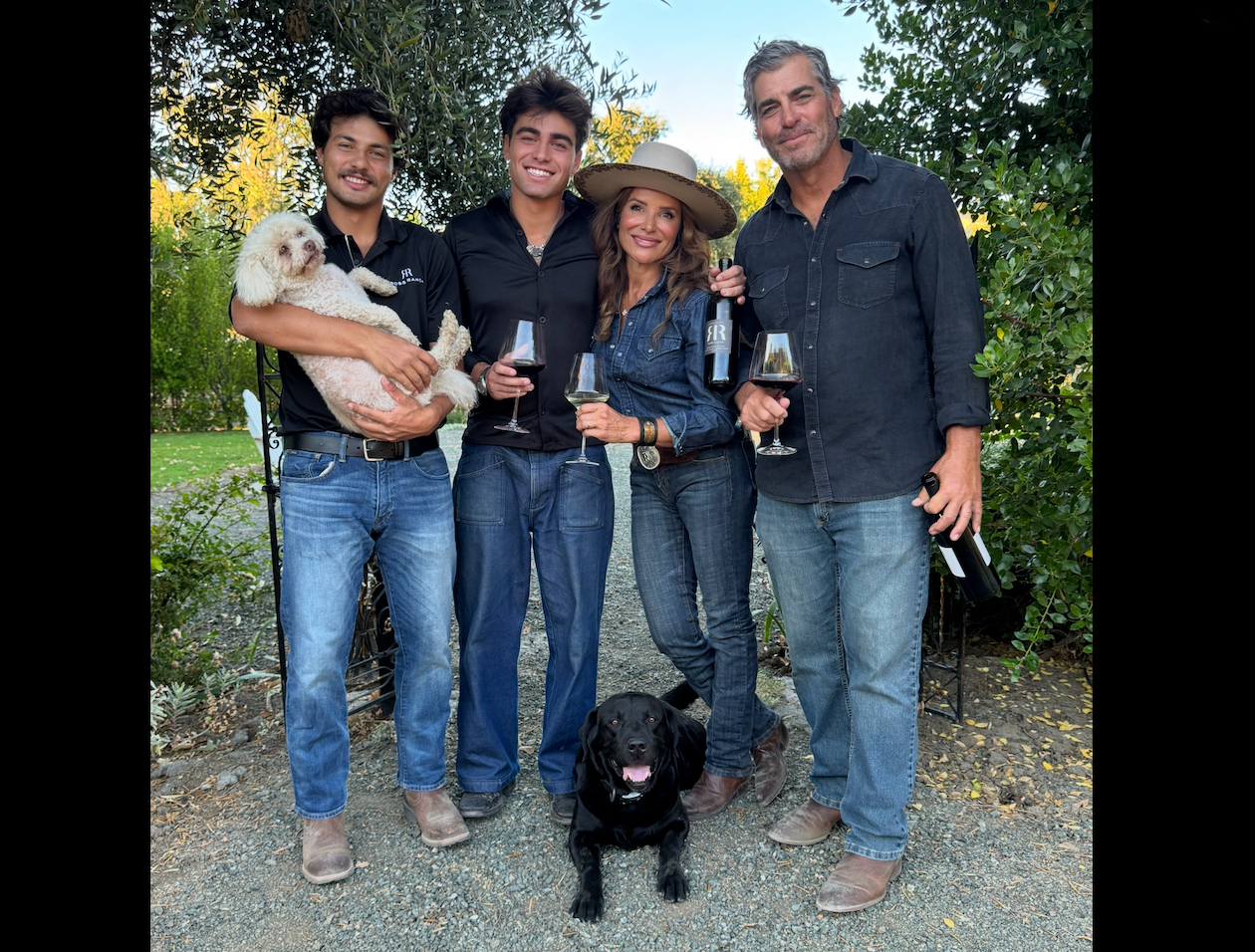
The wine story began before the ranch. In 2003, Keith and Claudia planted 90 Syrah vines in their Lafayette front yard. They made wine in a garage, with blending, bottling and corking done by hand. Their children took part in the harvests. This was a family project with an unusually tangible end product.
In 2018, they purchased Ross Ranch in Knights Valley, Sonoma County. The property brought 20 acres, oak trees and volcanic soil into the story. It also gave the family’s interest in wine a larger landscape in which to develop. A project that once fitted around a house now helped define a place.
Knights Valley sits between Mount St. Helena and the Mayacamas Mountains. The ranch’s vineyard is planted with nearly ten acres of Cabernet Sauvignon, divided into the Barn and Creek blocks. Its growing choices include Cabernet clones 4 and 7 on 3309 rootstock. These are the details behind the label, down to what is planted beneath the fruit.
The vineyard’s stated priorities include sustainable management and letting the character of the grapes come through in the wine. Alex and Ben Vyborny of Vyborny Vineyard Management have also contributed to the vineyard’s development and care. The family narrative and the agricultural specifications sit alongside each other: one explains the attachment to the place, the other the decisions involved in growing it.
Nearly 10 acres of Cabernet Sauvignon across two named blocks.
Schematic only. Block sizes and proportions are not represented.Dinner has a supporting cast
The farm-to-table side of Ross Ranch makes the sense of gathering literal. There is a garden, olive trees, animals and the wine itself. Guests are invited to learn about ranch life and viticulture. The meal has a surrounding landscape, and that landscape comes with chores.
Elizabeth and Taylor were only the beginning of the naming department. The chickens are The Dixie Chicks. An old oak is called The Campbell, and estate olives provide oil. The effect is personal rather than anonymous: even the trees have been introduced. Somewhere between the Cabernet blocks and the poultry, a very particular household becomes visible.
The ranch offers another form of hospitality, with food, wine and room to stay. It joins interests Ross already had in design and entertaining. Putting those elements together on a working property adds the demands of the land to the pleasures of having company. The setting is attractive; it also needs looking after.
- 200390 Syrah vines in Lafayette
- 2018A 20-acre property in Knights Valley
- TodayWine, a working ranch and hospitality
Now she writes the invitation
Wine country has also given Ross a subject for her own byline. As a Haute Living San Francisco contributor, she writes about wine, travel and the social life around them. The person who once worked on the sales side of magazines now appears in their editorial pages.
In 2026 she wrote about influencers and sommeliers, polo in wine country, and Calistoga. Those subjects sit close to the places and experiences in her working life. She approaches wine as something made on a property and encountered among people, with both the agricultural and social sides in view.
With Women of the Vine, she announced a six-issue series about women reshaping the wine industry, beginning in Burgundy with Eléonore Latour. The premise gives her a reason to turn outward from her own vineyard and look at how other women are finding their place in a business with long family histories.
“I make wine for a living,” she writes at the beginning of that series. It is a compact statement after a career of introducing other people’s work. The wine now belongs to her daily world. So do the guests, the family, the garden and the cattle with names borrowed from a movie star. There is plenty to talk about when everyone sits down.