There is a wonderfully literal answer to the question of how to improve a supply chain: build a bridge. In New Century, Kansas, CJ Logistics America announced a cold-storage project designed to connect a food factory to its warehouse by an above-ground conveyor. An active railway stood between the buildings. The proposed route went over it. For a business accustomed to trucks, appointments, and handoffs, the attraction is obvious: give the product a shorter trip.
- Warehousing, trucking, cold storage, and forwarding under one logistics partner.
- A Chicago predecessor, acquired by South Korea’s CJ Logistics.
- Flora Food Group as the anchor customer for a new Kansas cold warehouse.
- Practical improvements that start with counting emails and keeping experienced staff.
The customer was Upfield, now Flora Food Group, maker of Country Crock and I Can’t Believe It’s Not Butter. By September 2025, the warehouse was receiving inbound shipments. The company’s groundbreaking announcement had allocated roughly 60% of the building to Flora, with the rest available to other customers. Here was a commercial arrangement with a pleasingly physical expression: production next door, storage nearby, shared capacity around an established customer.
A warehouse business acquires a passport
CJ Logistics America has two histories worth keeping separate. Its American warehouse predecessor began in 1960 as Jim McIlrath’s Dry Storage Corporation in Chicago. Its Korean parent traces its origins to 1930. The present American operating company emerged from integration in 2020; DSC adopted the CJ Logistics brand in 2021. The name is recent. The experience behind it has been accumulating for decades.
Ann Drake helped reshape DSC into a supply chain partner. In a 2016 account of that transformation, she recalled the difficulty of persuading employees and customers to embrace reorganization. A telling moment arrived when a customer asked DSC to help grow its business. Storage was becoming a broader assignment: understand what the customer wanted to accomplish, then arrange the movement around it.
CJ’s announced price for a 90% stake in DSC in 2018. Acquisition consideration, rather than a customer service price.
The deal joined complementary capabilities. DSC supplied American warehousing knowledge and customer relationships; CJ supplied an international network and forwarding capabilities. Full ownership followed in early 2020. Today, CJ Logistics America serves businesses across the United States, Canada, and Mexico, connected to the parent’s wider network. Its work spans groceries, consumer goods, healthcare, tires, electronics, and other products whose uneventful arrival is somebody else’s business promise.
The refrigerator with a business plan
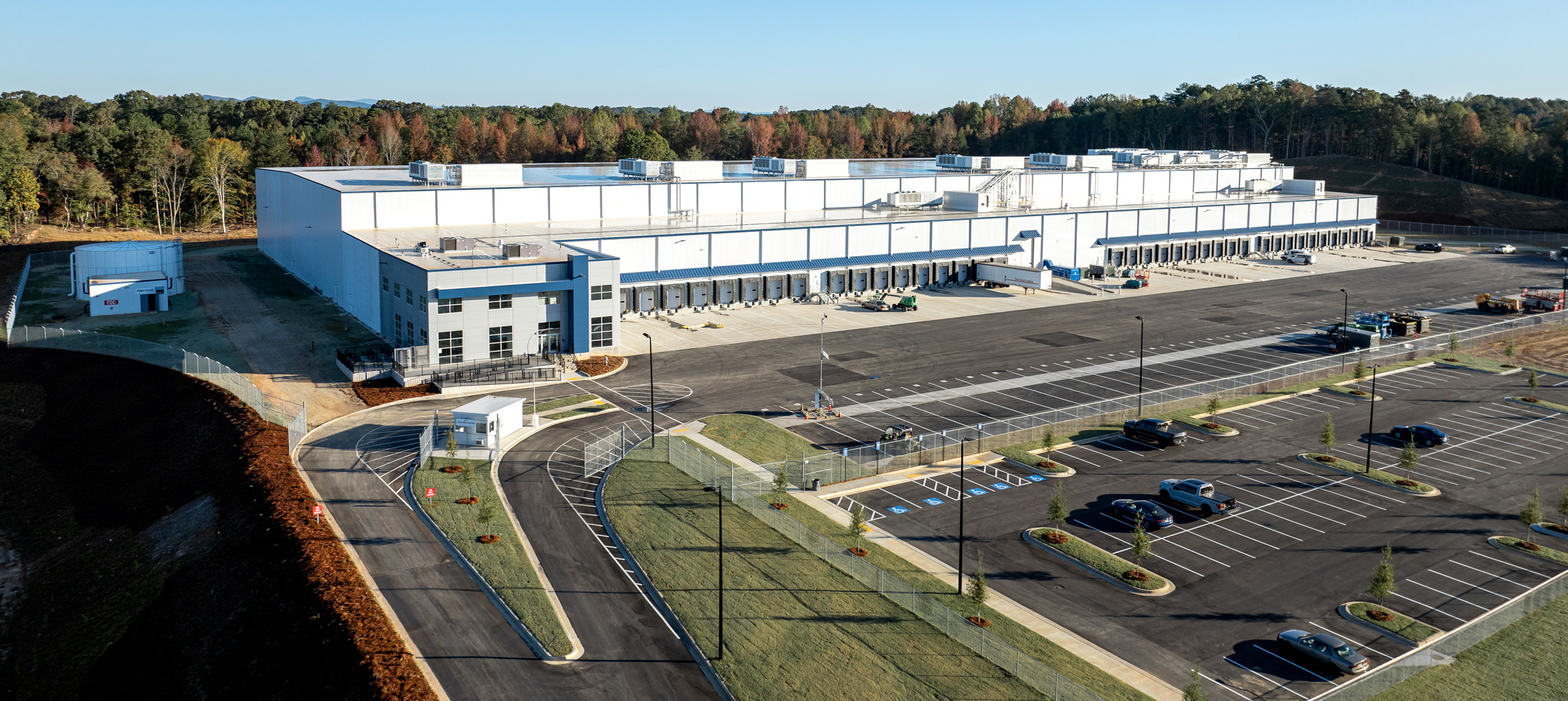
The Kansas building covers 291,000 square feet. Yukon Real Estate Partners and BGO developed it as a joint venture. The location brings road access and a direct rail spur into the warehouse; CJ says approximately 85% of the United States is reachable within two days. Treat that as a location claim, rather than a promise that every consignment will arrive on that schedule.
Gainesville, Georgia, supplies another version of the idea. Opened in November 2024, its 270,000-square-foot facility combines refrigerated storage with QFM blast freezing, which CJ says brings products to their desired temperatures in 24 hours. Separate rooms accommodate different goods, and a USDA office and inspection room sit on-site. For protein exporters, refrigeration and paperwork can be parts of the same operational problem.
Customers can buy pieces of this operation or outsource more of it. Dedicated warehousing configures facilities and staff around one customer. Multi-client warehousing shares space, labor, and resources. Transportation includes company-operated capacity, freight brokerage, and managed carrier networks. Forwarding handles international movements; consulting tackles network design. The business earns its keep through negotiated logistics agreements, with the scope determined by the shipper’s requirements.
Against contract-logistics alternatives such as DHL Supply Chain or GXO, CJ’s proposition combines local operating experience with its parent’s international reach. Cold-storage specialists offer another route. The useful buying question is whether one provider can coordinate a customer’s particular mix of storage, transport, and export work. A long service menu proves little unless the handoffs become easier.
The trouble was in the inbox
Consider a smaller intervention. CJ’s shared-services team used ServiceNow analytics to examine incoming work and found that appointment and scheduling requests accounted for 75.6% of email traffic. The finding changed the assignment. Staff were spending their attention arranging slots while other inquiries competed for time. CJ evaluated dock-scheduling platforms against cost, implementation, and integration, then introduced a self-service portal.
75.6% of email traffic: appointments and scheduling
Carriers could choose open slots, receive confirmation, and reschedule themselves. CJ reports 41,500-plus appointments through the platform in its first quarter, with confirmation time shortened by 1.5 hours. The transferable lesson is quite modest: inspect the work before choosing the technology. An inbox can contain a process map, provided somebody bothers to read it statistically.
Keep the people who know the aisles
Another published case starts with an unnamed tire manufacturer whose in-house warehouse suffered from high turnover and narrow performance tracking. CJ took over in 2018, relocated the operation from Rancho Cucamonga to Fontana, and added roughly 200,000 square feet. It transferred the existing staff, introduced engagement programs, modernized equipment, and widened the measures used to judge performance. Reported turnover fell from 64% to 23%.
“Keeping everyone on the same page, coaching to improve”Ken Heller, then COO, discussing OneTrack in 2023
That coaching emphasis also appears in CJ’s use of forklift-mounted OneTrack sensors. After a 2019 pilot and wider rollout, the company reported a 50% reduction in non-injury incidents by February 2023. These are operator-reported results, not universal forecasts. But the cases suggest a coherent habit: measure a specific difficulty, preserve useful knowledge, and give people a better way to act on what the measurement reveals.
The bridge offers the same lesson at a different scale. A factory-linked warehouse makes sense when production flows are stable enough to justify the connection. A small, irregular shipper may value shared capacity more than a dedicated building. Products still need compatible handling requirements. Copy the discipline of tracing the journey and questioning each transfer. Sometimes the improvement is a portal. Sometimes it is a workforce that stays. Occasionally, it is a bridge.
Follow the freight
Explore the company website, news and case studies, and warehouse technology.
Follow CJ Logistics America on LinkedIn, X, Instagram, or Facebook. Watch the global parent’s YouTube channel, or explore the Kevin Coleman interview on AI adoption.