A street usually tells you where to go. San Mateo’s B Street invites a different question: why hurry? Between First and Third avenues, two blocks became a pedestrian mall. Restaurants could spread outside. People could occupy the roadway. A familiar piece of municipal infrastructure acquired another job: giving a downtown somewhere to linger.
- San Mateo runs the everyday machinery of a city: streets, parks, libraries, permits and public safety.
- B Street shows how a temporary experiment becomes a permanent argument about public space.
- A $1 billion wastewater program exposes the less photogenic cost of keeping that city working.
The organization behind it is the City of San Mateo, the local government for roughly 100,000 residents on the San Francisco Peninsula. Its workforce exceeds 500 people. CalOpps, where applicants can find its vacancies, is one recruitment channel. The city’s work stretches from recreation classes to sewer engineering, with residents, businesses and visitors depending on different parts of the operation.
01 Two blocks, two opinions
The B Street experiment grew out of pandemic outdoor dining. In September 2021, council approved permanent closures on two segments; the pedestrian-mall ordinance followed in October. The physical idea was modest enough to understand on foot. Keep the intersecting avenues moving. Give the two intervening blocks to people.
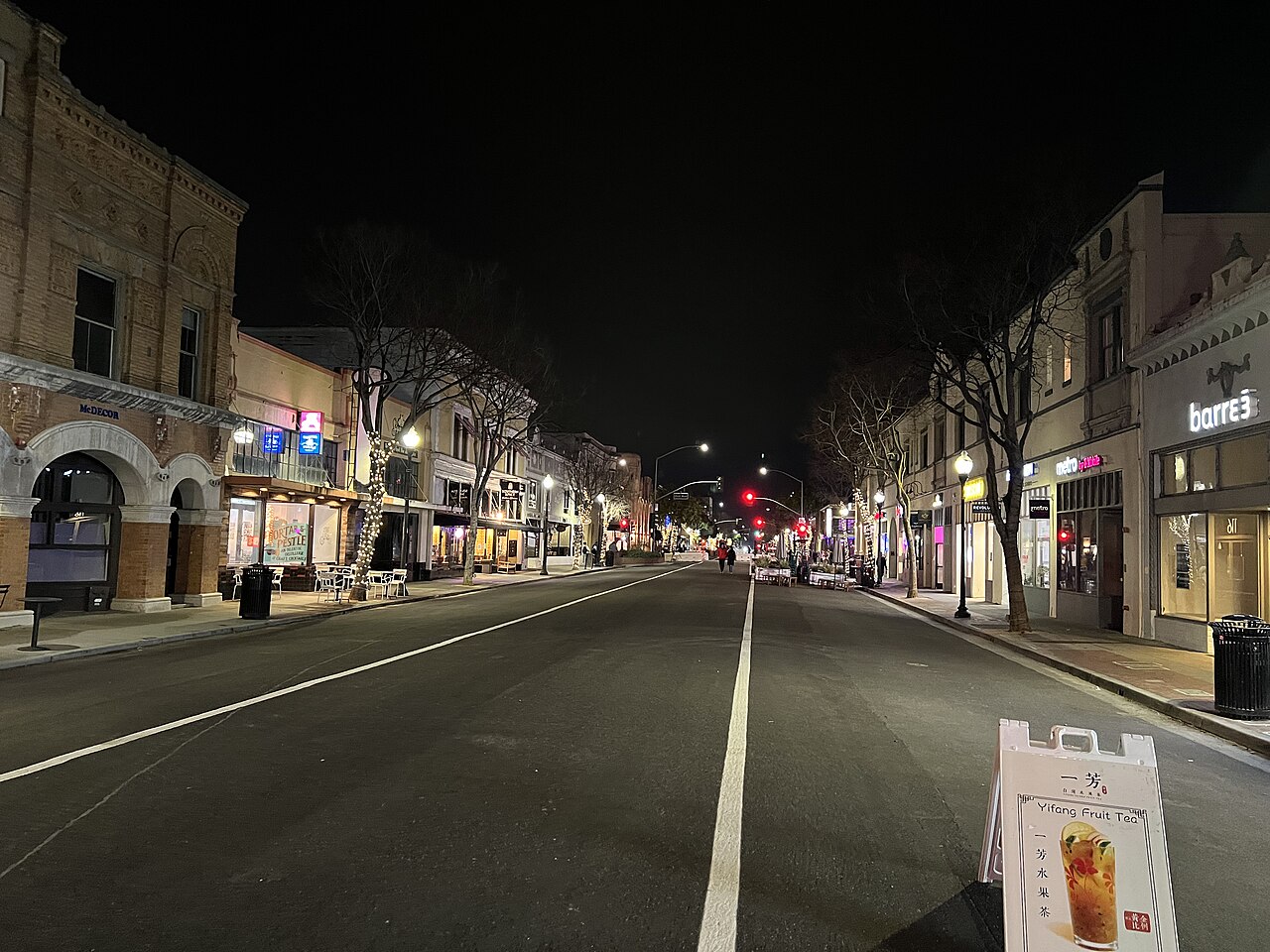

Permanent, however, did not mean settled. By May 2023, the council was reconsidering whether to reopen the block between First and Second avenues. A city survey, reported by the Daily Journal, found about 74 percent of businesses there favored reopening. On the neighboring block, 69 percent preferred keeping cars out. The same policy produced different answers a short walk apart.
Councilmember Robert Newsom initially favored reopening, then changed his position after hearing colleagues’ arguments. Both blocks stayed closed. His condition was revealing: more people needed to visit businesses, and business owners needed to feel the improvement. Public space had to work for the storefronts lining it.
“It can’t just be food.”
Robert Newsom, councilmember, May 2023
That is the useful tension. A restaurant can turn roadway into dining space; another retailer may care more about convenient access. Counting people enjoying a street does not answer every merchant’s question. The city’s subsequent improvement plan included seating, landscaping, accessible parking changes and pedestrian scrambles, which let walkers cross diagonally while vehicles wait.
The spending was tangible. In 2021, the initial package of bollards, road markings and signal changes was projected at $400,000. A possible later redesign was estimated at $3 million to $4 million. Those were proposals at the time, rather than a final project bill. Removing parking also meant surrendering meter income. Even an inviting place to sit has an operating model.
02 The billion-dollar part you cannot see
Now look beneath the pavement. San Mateo launched its Clean Water Program in 2015 after a state cease-and-desist order required action on sewer overflows reaching San Francisco Bay. The city describes a $1 billion initiative to modernize collection and treatment infrastructure. Pipes and facilities approaching or exceeding a 50-to-60-year lifespan needed replacement. Heavy rain demanded more capacity.
Here, the first failure was physical and regulatory: a sewer system could not reliably contain what it was supposed to carry. The response required engineering, construction and financing over years. It also crossed municipal boundaries. San Mateo and the Estero Municipal Improvement District are partners in the treatment-plant upgrade.
EPA-listed WIFIA project costs
$210.4mDistrict loan
$66.9mRemaining cost
$288.7m*
EPA lists $210.4 million in WIFIA lending to the city and $66.9 million to the district, against $566 million in project costs. These are public infrastructure loans with repayment obligations. EPA estimated the original 2020 arrangements would save the city $43.5 million compared with alternative financing. The interest bill belongs in the infrastructure story, too.
The system serves 143,000 people, according to EPA. Its benefits include better treatment, greater storm capacity and fewer unauthorized discharges. A resident may never see the equipment. The absence of an overflow is part of what the city delivers.
03 Give the pothole a destination
Other work begins with something much smaller. Graffiti appears. A streetlight fails. Someone notices a pothole. In March 2026, the city launched a new My San Mateo app and web service-request system; Android availability followed in July. Residents can report concerns, follow requests and receive updates.
The practical improvement is routing. A resident should not need to know which departmental chart contains a broken sign. The portal directs requests to staff for review and response. It handles non-emergency concerns. For someone trying to get a neighborhood problem addressed, a clear route and a visible status are useful services in themselves.
Job seekers have a different entrance: Human Resources and the city’s CalOpps listing. Families can register for recreation activities or use public libraries. Property owners approach planning and building services. These encounters explain the organization better than a software-style product catalog. Each starts with a specific local need.
04 The budget comes back to the street
The city finances this mix through public revenues, fees, grants and borrowing. Its accountability runs through elected government and public decisions. Neighboring cities compete for employers, visitors and talent, but municipal services follow jurisdiction. A San Mateo resident cannot switch sewer authorities as casually as changing a shopping app.
Planning gives those annual choices a longer horizon. Council adopted Strive San Mateo General Plan 2040 in March 2024. The city’s strategic plan is intended to connect its planning documents with budgets and capital projects. Its priorities for fiscal 2026-27 include climate resilience, infrastructure, transportation and housing. The challenge is translating those broad ambitions into specific work that can be funded and completed.
The published workplace principles offer a small clue to the expertise required: think long term, cooperate across the organization and seek improvement. A sewer engineer, librarian and permit reviewer share an employer even when their daily tasks barely resemble one another. Coordination matters because residents experience their work as one place.
Resources remain tight. The city reports approximately $4 million in General Fund cost reductions for fiscal 2026-27. It also identifies a continuing $5 million to $7 million structural deficit even if disputed vehicle-license-fee funding returns. Better public spaces and basic maintenance compete inside the same financial reality.
What can another city copy? Test a bounded change. Study the blocks separately. Keep deliveries, accessibility and emergency access in the design. Revisit the financing of long-lived assets. This approach depends on staff capacity and continued maintenance; without them, a closure can leave merchants frustrated and a reporting app can collect unresolved requests. San Mateo’s story keeps returning to that ordinary obligation: make the place work tomorrow.