At a global pharmaceutical company, a physician could exist in the database and still be practically invisible. There was an identifier, a name, perhaps a specialty and a location. But the details that made the record useful - contact information, institutional relationships, a fuller professional picture - were missing. Data stewards spent their time sorting exceptions. A system meant to support decisions had become another thing to maintain.
This is the problem Chryselys chose to describe in a published customer case. It is a revealing place to begin. In a business crowded with promises about artificial intelligence, the company starts with a more ordinary question: does the record contain enough trustworthy information to do the job?
- Connect fragmented pharma data before asking AI to interpret it.
- Use specialist tools for trial planning, research, and forecasting.
- Keep confidence scores, source trails, and human review in the loop.
01First, give the records something to agree on
Chryselys operates between pharmaceutical business teams and the systems carrying their data. Its work spans data engineering, commercial analytics, clinical planning, and market access. The common thread is reconciliation: making information collected for different purposes useful for one decision. A prescription, a sales call, and a physician profile may describe connected events while sitting in separate systems.
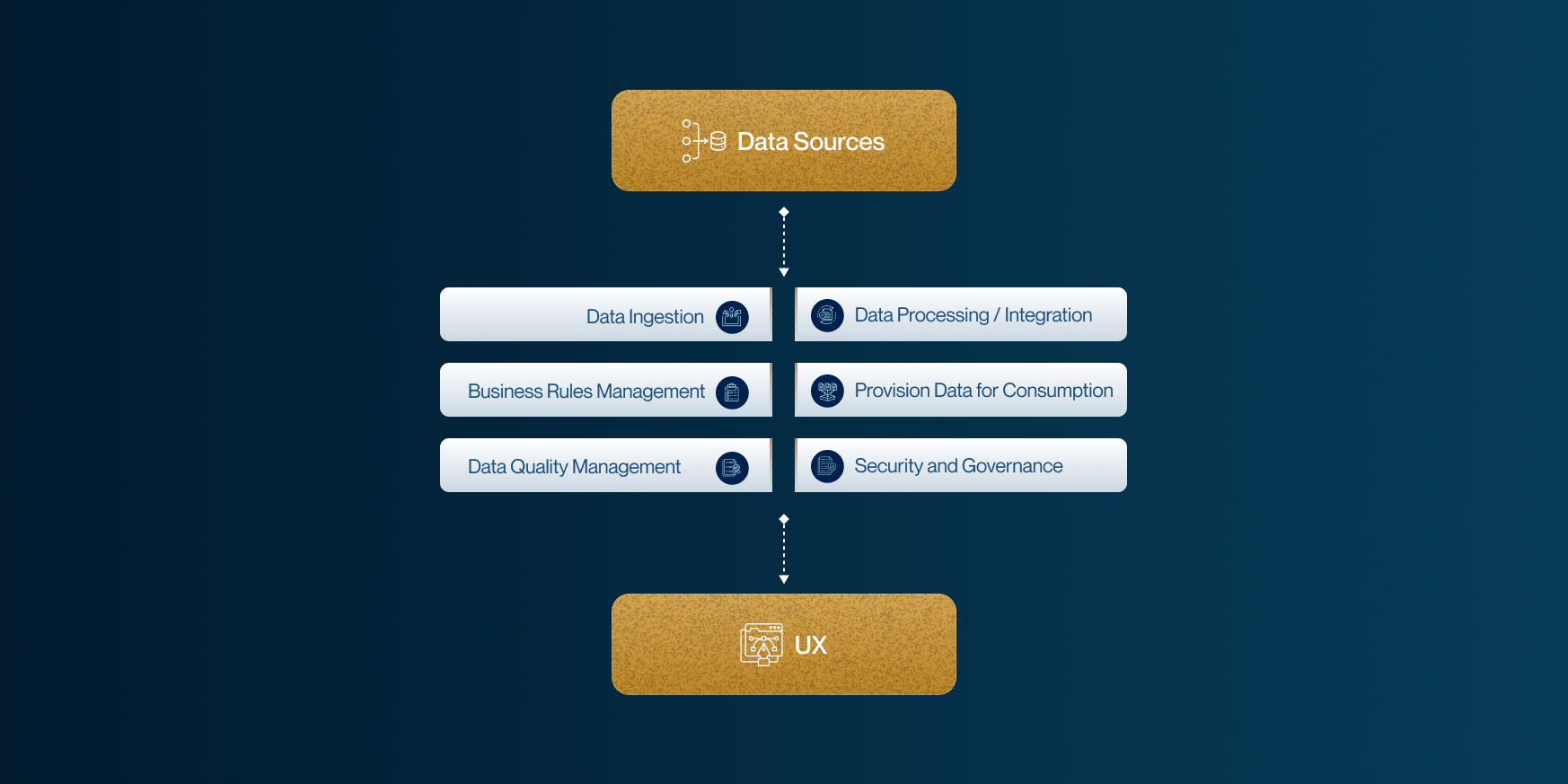
DataFusionIQ, its cloud data platform, brings together sales, customer relationship management, claims, marketing, and master data. It includes ingestion, integration, and configurable quality checks. The intended users include executives, field teams, analysts, and IT staff. The aim is a shared starting point for decisions.
The enrichment case shows the sequence. Chryselys first assessed available sources, then matched records against existing information. It used generative AI to fill remaining gaps from the web, scored candidates, and routed uncertain matches to human stewards. Weak matches were retained for audit rather than applied. Validated records went back into Reltio. The lesson a reader can borrow is the order: exhaust useful existing evidence before adding more.
02A patient journey can lose its patient
The same difficulty appears when the subject is a patient. Chryselys calls its multi-source claims approach Superstack. It examines individual datasets for capture rates and biases, links patient records, and merges claims while removing duplicates. Its explanation points to a practical obstacle: different vendors may cover different channels or populations, and their identifiers may not line up.
Combining files is therefore only the beginning. The analytical question is whether two records describe the same person, and whether a seemingly complete dataset still leaves a population out. More rows can increase confidence without increasing understanding. Buyers should check coverage and permitted linkage before evaluating predictions.
- 01ConnectLink records across sources
- 02CheckResolve gaps and uncertainty
- 03DecidePut evidence into a workflow
03Who can actually recruit the patients?
Clinical development gives this work a specific destination. Principal Investigator Targeting evaluates investigators against therapeutic expertise, patient networks, competing trials, and previous performance. The point is to help sponsors choose people whose experience and access fit a study, rather than treating every investigator with an impressive résumé as interchangeable.
REDPlanUP adds another dimension: the racial and ethnic mix of patients treated by investigators. Chryselys says it combines medical and pharmacy claims with open-source information to support more representative recruitment planning. That is a useful distinction. Knowing that a physician runs trials does not tell you whom that physician reaches.
KYRA Clinical extends the planning work into conversational questions about study criteria, geography, investigator selection, and feasibility. It draws on trial information, scientific literature, and internal knowledge. Chryselys describes its output as directional guidance. That wording matters: selecting a site, approving a protocol, and enrolling a participant still require decisions beyond a generated answer.
“Data should make decisions easier, faster, and more reliable.”Chryselys · About Us
04From interview transcript to tomorrow’s slides
On the commercial side, AIVY tackles a task recognizable to anyone who has assembled a research presentation. It accepts material such as healthcare-professional interviews, reports, congress abstracts, and meeting notes. Users ask questions in ordinary language, retrieve contextual answers with citations, and generate editable branded PowerPoint slides.
An insights team needs findings it can present and defend. AIVY is designed around that workflow, with modules for market research, congress intelligence, meetings, and patient-support safety signals. The pitch reaches past search into the labor of preparing a usable argument.
ForecastIQ addresses a different meeting: the one where finance, supply, and commercial teams need an agreed forecast. Its tools include patient-based and time-based models, ARIMA, custom business curves, scenario comparisons, and Monte Carlo simulation. Versioning, change logs, and approval trails preserve how assumptions changed. Digital Twin, meanwhile, simulates healthcare-professional responses to messages before a campaign goes live. Simulated responses need validation against actual behavior; they are a way to test assumptions.
05The business sits between advice and implementation
This is an enterprise business selling to organizations, with software platforms alongside consulting and engineering services. Chryselys’s website displays Novartis, Gilead, Janssen, and Genentech among its “Trusted By” logos. Those names are the company’s own representation of its relationships. The practical users are more specific: commercial operations, insights, medical, market access, and clinical teams.
Its positioning rests on pharmaceutical expertise combined with implementation. The company identifies itself as a Reltio Certified Partner and offers its own MDM ConnectIQ accelerator. That places it in the territory between specialist life-sciences advisers, systems integrators, and analytics software vendors. A buyer is choosing both a tool and people who can make it work inside an existing organization.
The leadership record shows a growing emphasis on AI and platforms. Prakash Karaka became chief AI officer in February 2024. In July 2025, Jason Carlin became CEO and DeviPrasad Singh became COO. Sanjeev Sardana remains listed as co-founder and principal. The careers page emphasizes ownership, curiosity, and movement across roles - the company’s stated view of how its people should grow.
06Copy the sequence, then question the answer
For a prospective customer, the sensible starting point is one consequential decision: which investigators to approach, where patients leave a treatment journey, or which forecast assumption to challenge. Then inspect the data needed to answer it. Test identity matching, source coverage, review queues, and whether a colleague can trace a result back to evidence.
The approach depends on usable source data, permission to connect it, and people willing to resolve ambiguity. Poor population coverage can survive a successful integration. A model can repeat yesterday’s patterns when tomorrow’s market changes. The work also carries integration, stewardship, and adoption costs beyond obtaining a platform. Chryselys’s most transferable idea is a disciplined sequence: connect, check, then ask. The quality of the answer begins well before the question reaches AI.
Keep following the connections
Explore the company’s tools, writing, and public updates.