A phone running out of battery is a small catastrophe with excellent timing. It waits until the ticket, the map and the person you are trying to meet all live inside it. Christopher Baron once helped build a business around that everyday predicament. Before venture capital and his latest job in wealth technology, there was Lifeline Technologies, a company offering shared portable chargers.
At Montreal’s Olympic Park, the idea acquired a particularly concrete form: four charging stations. Visitors could borrow a portable charger and keep moving. The business did not require anyone to become enthusiastic about batteries. It required a useful service to appear at the moment someone needed it. There is a certain elegance in a product whose explanation takes less time than finding a wall socket.
Today Baron is chief executive of Sofistic.AI, a Montreal wealth management software company. The equipment has changed. So has the customer. But the juxtaposition offers an interesting way into his career: first a service that helped visitors stay connected, now a platform intended to connect the financial information advisors need to do their work.
Four stations, one very ordinary problem
Lifeline was a venture shared with Charles Baron and Laurent Mailloux. In a September 2021 podcast conversation, Mailloux described starting the company with two longtime friends. That detail gives the business a human scale. Before it became a line in a professional biography, it was a project involving people who already knew one another.
The Olympic Park installation belonged to a wider effort to bring young companies into the venue’s operations. The park had met 21 emerging businesses through its innovation work. Lifeline’s chargers became one of the services actually put in place. An introduction and an installation are different things; only the latter gives a visitor something to use.
In May 2022, Baron described the partnership’s effect on demand, visibility across Montreal and interest from other establishments. His account was specific about the role of the venue: the park actively exposed visitors to the service. A useful object still needs to be encountered. Distribution can be as decisive as the object itself.
For a founder, an installation like this provides a public encounter between an idea and its users. Does someone understand the offer? Can they get what they need? Will the institution want to keep it? Those are useful questions to bring to any technology business, even when the next product has considerably more buttons.
Finance, then a closer look at technology
Baron’s professional route also runs through Invesco, where he worked with the wealth management industry on investment solutions. This is the earlier chapter that makes his present role a return as well as a departure. He had already worked alongside the people Sofistic now wants to serve.
He subsequently joined CGI’s technology due diligence team. That work involved examining potential technology risks in investments for the Caisse de dépôt et placement du Québec. It put software inside a different conversation: the question of what an investor is buying, and what might complicate the promise.
A demonstration can show what a product does on a good day. Due diligence asks about the machinery behind it. For readers looking at Baron’s move into software leadership, this part of his career deserves attention. The task of evaluating technology and the task of selling its benefits sit close together, though they ask different questions.
His educational record includes economics at Queens College and a graduate diploma in accounting at McGill. Economics, accounting and technology evaluation form a useful collection of subjects for a career spent around investments. They also remind us that an AI company’s chief executive can arrive through finance rather than through a laboratory or a programming career.
From assessing companies to joining one
After CGI came Investissement Québec’s venture capital team. Baron’s own account of leaving that organization emphasizes the opportunity to support early businesses. He described the experience as preparation for helping a Quebec wealth technology company grow. The transition was his stated connection between the two jobs.
Other public roles put him near the operational questions of young companies. LithologIQ, a mining technology business, lists him as an investor and director. Its biography connects his investment, technology and business development experience with financing needs and business opportunities. These are responsibilities close to the moment when a company must turn its technical work into a business.
Moving from an investment team to the chief executive’s chair changes the relationship to those questions. The company becomes the daily assignment. Decisions about the product, the people and the commercial direction converge in one organization. That is the significance of this career turn, beyond the new title on a profile.
The return has a different job description
Sofistic’s leadership transition took effect in June 2026. Baron became CEO; the previous CEO, Denis Gauthier, moved to co-chair of the board; Étienne Veilleux became executive chair. The arrangement kept the earlier leadership involved while giving Baron responsibility for operations and strategic direction.
On LinkedIn, Baron presented the opportunity as a return to a familiar industry. He wrote about helping financial advisors serve clients through technology, alongside thanks to his former colleagues. The announcement appeared in both English and French, matching the bilingual proficiency listed on his profile.
The company announced $6.8 million in funding earlier in 2026, including investment from Investissement Québec’s Impulsion fund. It is another connection between Baron’s earlier professional setting and his new one.
There is something appealingly circular about the move. A career that began near advisors’ investment work returns to that work after entrepreneurship, technology assessment and venture investing. The circle does not prove an inevitable destiny. It does make the latest appointment easier to understand: the customer is familiar, while the responsibility is new.
“helping financial advisors better serve their clients through technology”
Christopher Baron, announcing his move to Sofistic.AI
The filing cabinet acquires a dashboard
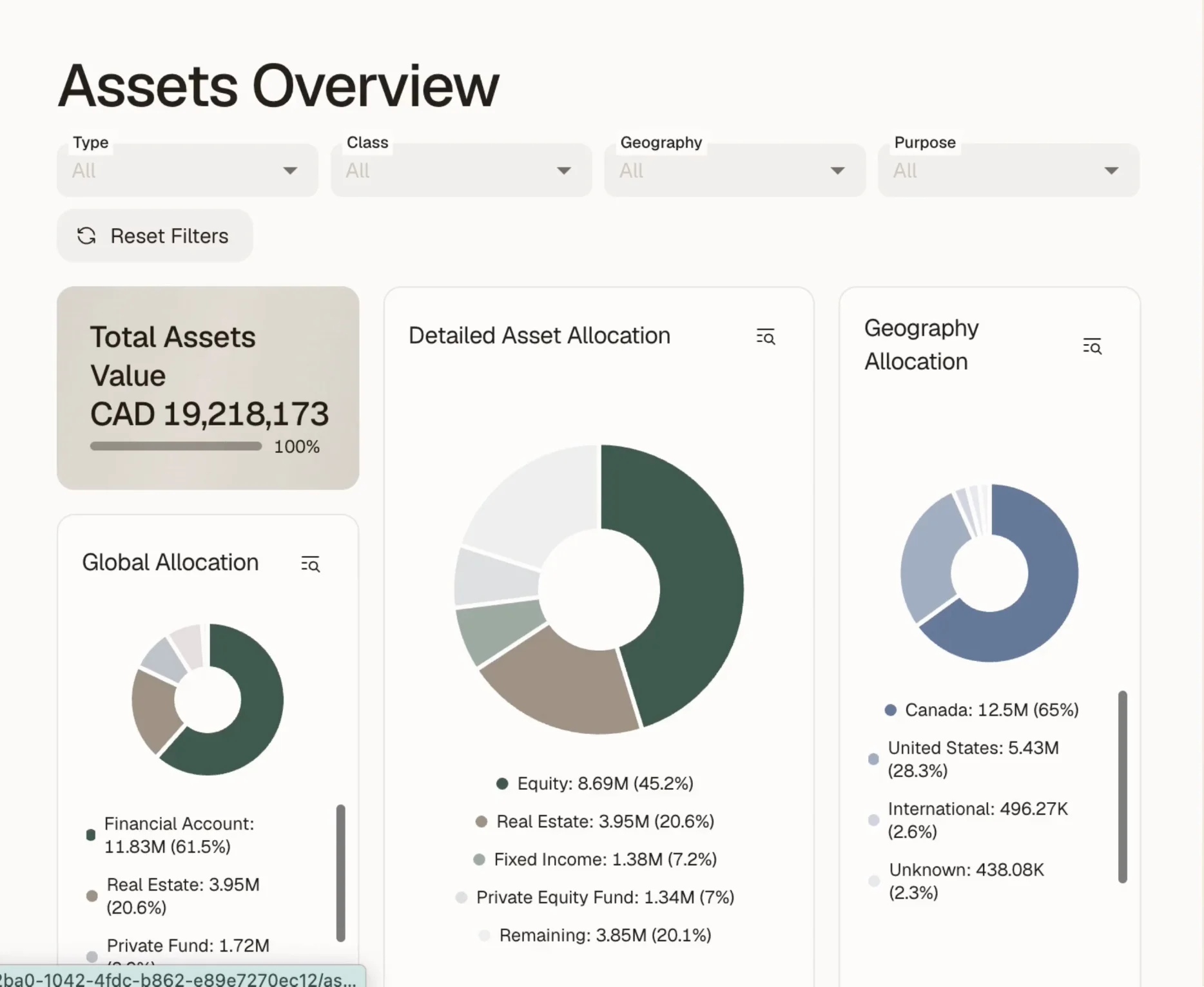
The platform he now leads brings client information together from planning tools, customer relationship systems and custodians. Its scope includes liquid assets, private investments and accounts held elsewhere. For an advisor, the point of assembling those pieces is to see more of a client’s circumstances in one place.
Consider the ordinary problem behind that description. A relationship can span several accounts and several systems, each with its own partial picture. Preparing for a conversation then involves collecting information before interpreting it. Software that joins the pieces has to earn its place by making the eventual conversation better.
That is a quieter ambition than the theatrical versions of artificial intelligence. It concerns the work around a meeting: gathering documents, preparing a picture of the client’s finances and noticing something that deserves attention. A dashboard is most useful when it allows the person looking at it to stop thinking about the dashboard.
A missing zero is a large problem
The technical work behind this promise is described by Sofistic’s AI lead, Fayrouz Ben Soui. In an October 2026 interview, she discussed financial document extraction, validation and weekly monitoring. Uploading a statement may look effortless to the person using the feature. Making every extracted number correct requires a process underneath it.
Her account also makes a useful distinction between a model’s confident wording and a dependable answer. When information is missing, confidence can survive even as accuracy disappears. For an executive responsible for a financial software business, that makes reliability a product question, a management question and a question of customer trust.
Ben Soui described development workshops with advisors and testing new techniques in a secure sandbox. She also explained that feedback influences priorities. The work is conversational in two senses: clients talk to advisors, and advisors talk to the people building the tools. Baron’s responsibility sits around that entire exchange.
Viewed from the chief executive’s office, these details explain why a product’s apparent simplicity can conceal an elaborate assignment. Someone must decide which problems receive attention first. Someone must connect the engineering work with the experience of the people paying for it. The company’s description of its development process gives that assignment a practical shape: advisors help identify useful features, while the technical team checks what those features produce.
For Baron, this is the environment in which his return to wealth management takes place. His familiarity with advisors supplies one part of the context. The people building and testing the software supply another. The appointment brings those forms of knowledge into the same organization.
A client relationship, with less preparation attached
In September 2026, Sofistic announced deployment across advisor teams at National Bank Financial’s wealth management business. That gives the present chapter a concrete institutional setting. The platform’s proposition is being put into the working environment of advisor teams, where meeting preparation and client information have immediate practical uses.
The parallel with Lifeline should be kept modest. A charger and a wealth platform are different products, with different obligations. Yet both invite the same plain question: what becomes easier for the person using this? That question is a useful way to read Baron’s career without turning each change of employer into a grand theory.
For Olympic Park visitors, the answer was the ability to keep a phone charged while continuing their visit. For advisors, Sofistic’s stated aim is a fuller view of client wealth and help with the work surrounding advice. Baron has moved from helping build one service to leading another. The next chapter will be written in the details of how it is used.