Christian Kletzl once tried to make selling your unwanted belongings almost embarrassingly easy. The experiment involved leaving boxes outside apartments and offering to do the resale work. Here was entrepreneurship reduced to its physical essentials: a container, an offer, and the hope that somebody would put something in it. Even that version failed to persuade enough people. Eventually, he stopped.
There is a certain charm in this episode, partly because it involves a future sales software founder discovering how little a convenient offer can matter when the demand is missing. A box on a doorstep is difficult to improve with another feature. For Kletzl, the test helped answer a question that code alone could keep postponing: should this business exist?
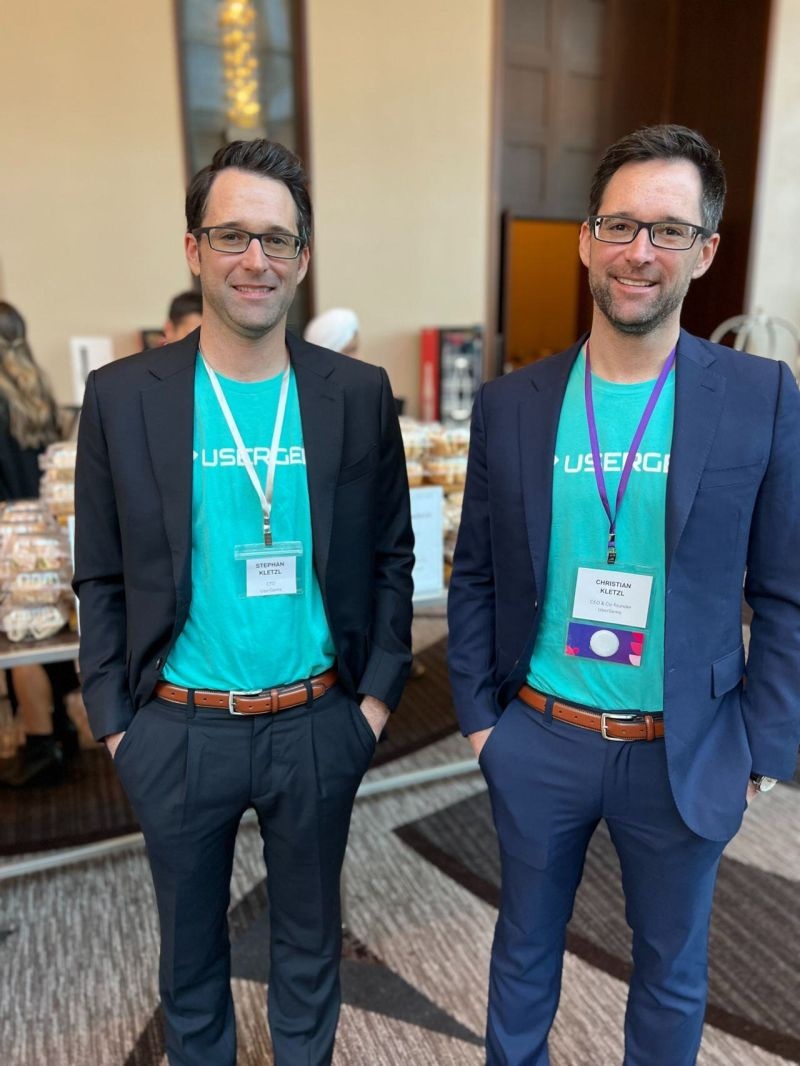
Years later, UserGems would grow around a much smaller observation. A customer changed employers. Christian and his identical twin brother, Stephan, followed up. The customer bought again. After the effort of persuading people to part with their old possessions, here was someone carrying a useful relationship into a new job.
Getting to the place where things get built
Kletzl’s early ambition had a destination: San Francisco. Originally from Austria, he wanted to work where technology companies were being made. Getting there required a series of practical steps. He worked in engineering at Microsoft, went to the United States for graduate school, and later joined Google as a product manager. Each move brought him closer to starting something himself.
His education combined subjects that would later compete for his attention. At FH Salzburg, he studied Information Technology and Systems Management. At Northwestern, he earned an MBA and a Master of Engineering Management, finishing in 2013. His student record included the Breed Prize from McCormick and Kellogg’s Dean’s Distinguished Service Award. A McKinsey summer associate role also sat between those academic and technical worlds.
The first product grew out of a decidedly ordinary inconvenience. After business school, moving meant dealing with belongings he wanted to sell. ShelfFlip would examine purchase information, work out resale values and help people sell things they no longer needed. Kletzl liked the prototype. He could see himself using it. The wider public declined to share quite enough of his enthusiasm.
His explanation leaves room for an uncomfortable possibility: “maybe you’re just weird.” A founder’s own problem can be real without supporting a business. ShelfFlip joined Y Combinator’s Summer 2014 batch, but accelerator admission could not settle the question of demand. The brothers kept changing the product, testing responses and looking for something customers would actually want.
The person outlasts the account
Another attempt was SmartHires, a network through which companies could share candidates. Someone might be talented but wrong for a particular vacancy because of seniority, location or another requirement. A neighboring company could have the right opening. The brothers were working on that proposition when a customer’s job change gave them a different problem to consider.
They tracked the person down and sold to him at his new employer. The experience suggested that a buyer’s familiarity with a product could travel. Christian and Stephan went to the Austrian Alps to develop a prototype that could help them follow such moves. When they described it to other companies, the tracking tool attracted more interest than the business it had been built to support.
The logic runs in two directions. At the original company, a departing supporter can leave a vendor exposed when renewal comes around. At the new company, that same person may already understand the product and the problem it solves. One change of employer creates a reason to check on an existing account and a reason to begin a new conversation.
One move. Two reasons to pay attention.
UserGems introduced its Champion Tracking signal in 2019. The vocabulary belongs to enterprise software, but the underlying habit is familiar to anyone who has maintained a professional relationship: remember the person after the email address changes. Kletzl’s business made that habit something a team could repeat, rather than leaving it entirely to an individual’s memory.
The engineer picks up the phone
The brothers’ division of work has an agreeable wrinkle. Christian studied engineering and came to lead the business. Stephan studied business and came to lead engineering. Both could develop software. Their qualifications provided a starting point; the company still required somebody to talk to potential customers.
Christian has described how uncomfortable the early sales calls felt. Technical competence did not automatically provide fluency in a buyer’s questions, a company’s purchasing process or the moment to ask for a commitment. That fluency came through practice. For a founder used to building a product, a conversation becomes another place to discover whether his understanding of the problem survives contact with somebody else.
The family humor survived the division of responsibilities. Christian has joked that Stephan’s extra gray hairs came from making the product work with Salesforce. Behind the joke sits a substantial part of their work: fitting accurate information into systems that sales teams already use. A tool may look straightforward until it has to behave reliably inside somebody else’s working day.
“you cannot bother me enough”
Christian Kletzl, describing what he tells new hires
Inside the company, Christian has described telling each new hire to bring questions directly to him. The invitation is quite literal: he recounted setting aside time to help new customer success hires get started. It gives his preference for collaboration a practical form. An employee has permission to interrupt, and the chief executive has made himself responsible for answering.
A funding round still comes with arithmetic
In October 2021, UserGems secured a $20 million Series A. By 2024, it appeared at No. 319 on the Inc. 5000; in 2025, it was No. 993. Those are public milestones in a story whose earlier chapters involved discarded ideas and uncertain demand. They also introduce a different set of decisions about what a company can afford to become.
Kletzl’s writing on efficient growth returns to a plain concern: a business should be able to survive within its means. A funding round can accelerate progress, but depending on another raise simply to remain operational leaves the company vulnerable. He favors measuring output and the economics behind growth, rather than treating the number of people hired as an achievement in itself.
That view also changes how he thinks about customers. When budgets tighten, a prospective buyer has to explain a purchase to colleagues who may never use the product. In his writing about revenue operations, he focuses on implementation, adoption and the fit with existing processes. The person checking those details can stop a deal even when the intended user wants it.
It is a useful perspective for an engineer who moved into sales. The attractive demonstration has to become a manageable commitment. Can the team get it running? Will it create more work? Does another tool already solve the problem? These questions ask the vendor to understand the customer’s organization, including the people whose contribution to a sale is occasionally to prevent it.
A signal needs somewhere to go
The product’s development has followed the practical work around those conversations. In September 2022, UserGems released Meeting Assistant, connecting Google Calendar information with Salesforce. When another person joined an invitation, the tool could add and enrich that contact. Kletzl described wanting a fuller picture of the people in a deal, with less subsequent administration.
By February 2024, his argument for sales technology extended beyond detecting a job change. A useful signal needed a clear next action and a measurable result. Knowing that something happened could leave a seller with another research task. The product had to help the team decide whom to approach, how to do it and which colleagues needed to know.
In a February 2025 discussion, he described using AI to support that execution: choose relevant contacts, remove manual tasks and draft messages using the information available. He also emphasized keeping executives at customer companies informed about results. A product can be useful to its daily user while remaining poorly understood by the person deciding whether to renew it.
His September 2026 presentations described an “AI GTM brain” bringing together business context, external information and intelligence. The first includes what a company knows about its own customers and opportunities. The second includes the changing people and circumstances outside it. The third helps turn those materials into priorities and coordinated outreach.
- 01Business contextCustomer history, opportunity information, messaging
- 02External dataPeople, companies and changing buyer signals
- 03IntelligencePrioritization, personalization and coordinated action
The latest tools let customers work with UserGems through Claude or ChatGPT using MCP, a connection that exposes the platform’s functions to an AI assistant. His October 2026 conversation about the product went as far as accepting that the familiar dashboard could become less central. The business he is trying to serve remains the same: help a team decide where its attention should go.
Leave room for another answer
Kletzl’s account of decision-making includes opportunity cost: continuing along one path means giving up time that could be spent on another. That concern makes sense beside the earlier products. ShelfFlip needed a stopping point. The job-change prototype needed room to become something more important than the company it initially served.
He has also named a holiday he would like to take: the Norwegian wilderness, watching the Northern Lights. It is a pleasing destination for someone whose working life involves interpreting signals. Away from the forecasts and contact records, there would be something to watch without turning it into a sales conversation.
For now, the thread through his work is that small act of following up. The customer went somewhere else. The relationship remained available. After all the boxes, prototypes, corporate jobs and product changes, Christian Kletzl had found a question worth continuing to ask: where did that person go?
Keep following the thread
Writing, conversations and places to find Christian.