A fermentation recipe is an unusual place to begin a CEO story. It has none of the ceremonial appeal of an opening bell, and considerably less room for a flattering photograph. Yet when Chris Osowski described his early agenda at Green Plains, he talked about improving plant recipes and making maintenance more reliable. The executive who had just taken responsibility for an entire public company was discussing the details that could make its existing plants work better.
He became chief executive on August 19, 2025, after more than three years as executive vice president of operations and technology. The promotion brought an engineer into a job where machinery, commodity prices, debt and customers all require attention. It also made him a director. He had crossed from overseeing an essential part of the business to answering for the connections between its parts.
That distinction gives his story its shape. Osowski’s career has moved through technical management, production support, international operations and global technology. At Green Plains, those experiences now meet in one assignment: turning an industrial operation into a business that can produce dependable financial results.
Argyle, New Delhi, Moscow
Osowski is a native of Argyle, Minnesota. He studied agricultural and biosystems engineering at North Dakota State University and earned an MBA from Minnesota State University. Agriculture supplied the subject; engineering and business supplied two ways of examining it. His subsequent career would involve both the physical processes that turn crops into products and the organizations responsible for making those processes pay.
By September 2003, he was a technical manager at POET. In March 2007, he moved to Renewable Energy Group as a production support manager. Senior positions at Tate & Lyle followed from August 2008 to August 2013, before he joined ADM. These were successive jobs within agricultural processing, ingredients and renewable energy, giving his later CEO appointment a long industrial prehistory.
ADM took that career overseas. He led India operations in New Delhi during the mid-2010s, then served as general director of Aston Starch Products, an ADM joint venture in Moscow, from July 2018 to August 2020. His next assignment was vice president of global technology, a role he held until December 2021.
POET
ADM
Green Plains
Green Plains
The technology role involved developing five-year capital plans, coordinating centers of technical expertise and considering equipment effectiveness alongside growth, costs and sustainability objectives. A machine could be examined as a piece of engineering and as a claim on company capital. That combination is useful preparation for a CEO whose decisions must survive both kinds of scrutiny.
The geographical range matters without requiring a travelogue. New Delhi and Moscow were management assignments, with responsibility attached. They place his Omaha role within a career spent working across industrial organizations and national borders. The Midwest remained part of the route, but the route was hardly confined to it.
An engineer inherits the whole equation
Green Plains announced Osowski’s arrival in January 2022. His brief included safety, environmental and operating performance, along with innovation and operational improvement. It was a broad technical job, covering how the organization ran its assets as well as how it might improve them.
When he became CEO in August 2025, chairman Jim Anderson described the board’s interest in a safety-first, measurement-driven culture of operational excellence
. The wording suited the experience of the person selected. Osowski already knew the company’s plants and its operating organization. The appointment placed that knowledge at the center of the leadership agenda.
One early transaction showed how much wider the CEO’s responsibilities extended. On September 26, Green Plains completed the sale of its ethanol plant in Rives, Tennessee, to POET for $190 million in cash, including an estimated $20 million of working capital. The company said the transaction eliminated its junior mezzanine debt and improved liquidity.
For a business built around production facilities, selling one is a consequential form of housekeeping. The transaction reduced the portfolio while improving financial flexibility. It also illustrates why counting plants alone gives an incomplete picture of an industrial company: the assets and the obligations financing them have to be considered together.
A pipe has two ends
The carbon-capture program offered another version of the same problem. In March 2025, while Osowski still held the operations and technology title, Green Plains announced construction of compression infrastructure at its three Nebraska facilities. Central City, Wood River and York were being prepared to capture carbon dioxide for permanent storage.
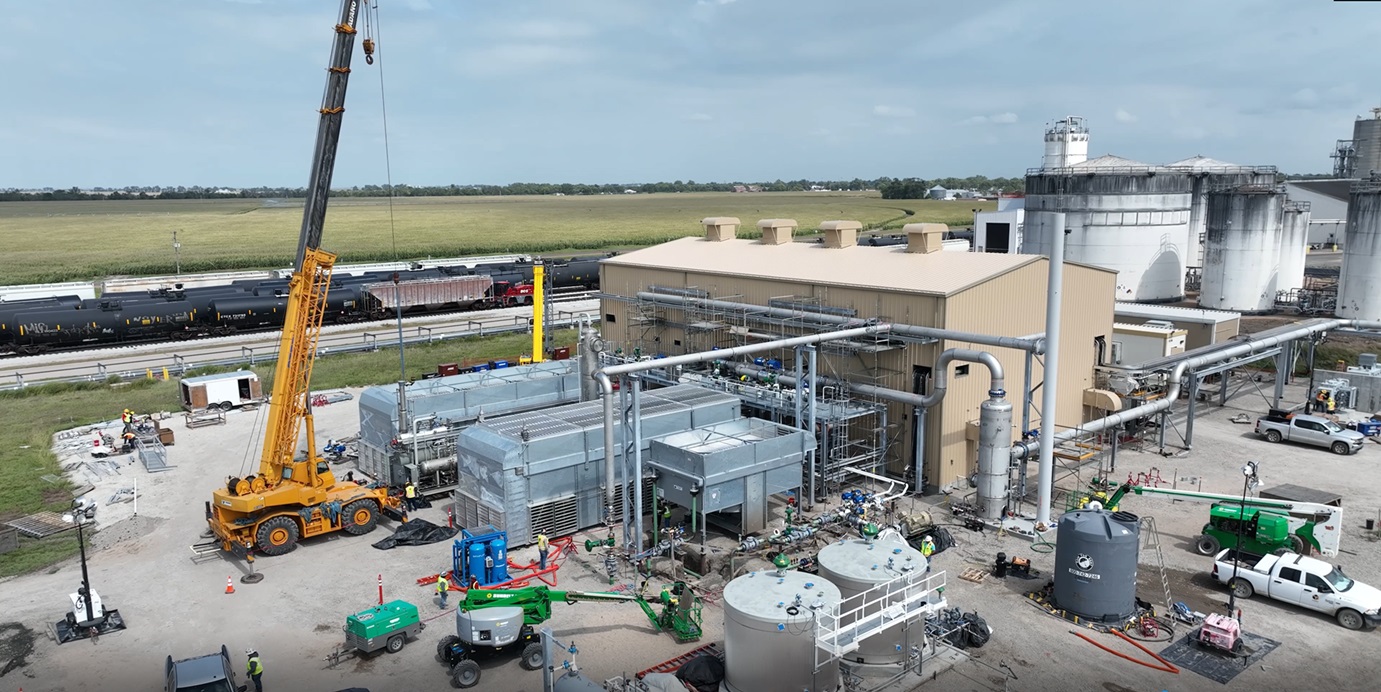
By December 8, 2025, carbon dioxide from all three facilities was being captured, transported through Tallgrass’ Trailblazer pipeline and permanently sequestered at its southeast Wyoming hub. The sequence had crossed from equipment installation to a working connection between production sites and storage.
Green Plains also reported receiving its first payment of approximately $14 million for transferred 45Z clean fuel production credits. That payment represented part of its 2025 credits. It was distinct from the physical milestone, though both belonged to the lower-carbon strategy. Keeping the engineering and the accounting in view is essential to understanding what the program was delivering.
Wood River · York
Trailblazer pipeline
Southeast Wyoming
At the Stephens investment conference that November, Osowski had described visiting Tallgrass partners at the other end of the pipeline. He discussed commissioning, equipment performance and the remaining work with the practicality of someone checking the full chain. His qualification was brief: we still have to execute
. It was a useful sentence to keep beside the forecasts.
The numbers need their footnotes
In the first quarter of 2026, Green Plains reported net income attributable to the company of $32.9 million, against a $72.9 million loss a year earlier. Its eight operating ethanol plants achieved 97 percent utilization. The quarter was also the first full quarter with all three Nebraska carbon facilities online.
Those results gave Osowski measurable progress to discuss. They also required readers to look inside the earnings figure. The company reported $71.5 million of adjusted EBITDA, including $55.2 million in net production tax credit value. The operating plants, market conditions and carbon program were contributing to the same reported outcome through different mechanisms.
The second quarter continued the improvement: $67.1 million in net income attributable to Green Plains and $93.3 million in adjusted EBITDA. The latter included $34.6 million from the base business and $58.7 million of net 45Z production tax credit value. Plant utilization was 88 percent, with maintenance affecting the quarter.
Osowski linked the performance to operating improvements, ethanol economics, commercial execution and the lower-carbon business. The breadth of that explanation is worth retaining. A CEO can influence how a company runs while still operating within markets and policy arrangements that affect its earnings. The results belong to that whole picture, rather than to a solitary executive accomplishment.
The people inside the operating plan
Osowski’s appointment announcement also contained a promotion for someone else: Trent Collins became senior vice president of operations. Collins had joined Green Plains in April 2024 as vice president of operational excellence, after earlier roles at Benson Hill and ADM. Osowski described having worked closely with him over the years and emphasized his operating experience and commitment to accountability.
The appointment put an established working relationship into a role central to the new CEO’s priorities. In an industrial company, the distance between a decision at headquarters and its implementation on a shift can be considerable. The people responsible for translating it matter.
In January 2026, Ann Reis joined as chief financial officer, effective January 6. She brought experience from Southwest Iowa Renewable Energy, ConAgra Foods and Lincoln Financial Group. Osowski highlighted the combination of finance and operations experience. That choice of emphasis fits a business where improving the plant and improving the financial position are closely related tasks.
A bell, a billion gallons, and a bushel
On August 27, 2026, Osowski rang the Nasdaq Opening Bell in Times Square to mark Green Plains’ twentieth anniversary as a listed company. The occasion supplied the ceremonial photograph that maintenance schedules rarely receive. In discussing the anniversary, he credited employees, shareholders, customers, farmer partners and local communities. It was a public moment for a business whose everyday work takes place elsewhere.
October brought a milestone closer to that everyday work. Green Plains’ Superior, Iowa, plant had produced its billionth gallon of ethanol. Commissioned in 2008, the facility employed nearly 50 people. Osowski emphasized the years of reliable operation behind the total. A billion gallons makes a tidy announcement; producing them requires a very untidy number of ordinary working days.
On October 19, the company introduced Farm Forward, initially at its three Nebraska locations. Participating farmers may be eligible for premiums of five to twenty-five cents per qualifying bushel, across five performance bands. The initiative is designed to connect qualifying agricultural practices with the value of lower-carbon feedstocks and fuel production.
“Farmers should have the opportunity to share in the value they help create.”
Chris Osowski · October 19, 2026
The program extends the operating question upstream, before a crop arrives at the plant. Its launch describes an intention, with outcomes still to follow. For Osowski, it adds farmers’ participation to a set of responsibilities already spanning equipment, finance and commercial relationships.
The career that began in technical management now encompasses that entire chain. His most revealing public moments remain the practical ones: a visit to the storage end of a pipeline, a discussion of maintenance, an explanation of what must still work. The CEO title makes the assignment larger. The small details keep their vote.