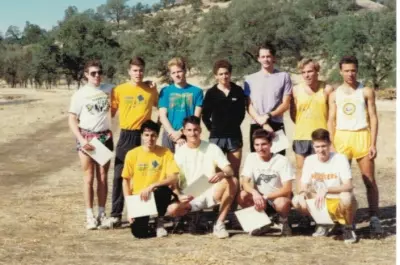
The earlier Hall of Fame was for running. In 2011, Humboldt State honored its 1991 men’s cross-country team, a group that had won its conference, won the NCAA Division II West Region and finished third at nationals. Among its runners was Chris Hobson, by then a vice president at Core-Mark. Long before his name appeared at the top of a corporate leadership list, it appeared in a pack.
That is an appealing place to begin a story about someone whose business is getting things to other places. Hobson now leads Core-Mark International as president and chief executive officer. The convenience distributor serves retailers across the United States and Canada. Its work involves products, purchasing, warehouses, trucks and the daily problem of making a small shop’s limited space earn its keep.
The comparison with running has its limits, of course. A delivery truck does not receive extra credit for a spirited finishing kick. But the two chapters offer a useful way to look at Hobson’s career: progress measured over years, with other people involved at every stage. When his industry honored him in 2025, he described the journey as a marathon.
A résumé with a loading dock
Hobson attended Humboldt State University, where he earned a Bachelor of Science degree. His early working life took him through several sides of the convenience business. After college, he worked as a merchandiser and sales representative for a family-owned beverage distributor, then as a manufacturer representative working with distributors and their accounts. He also became a market manager at 7-Eleven.
Those jobs place the same transaction in different hands. The retailer needs stock that sells. The supplier wants its products represented. The distributor must make the movement between them work. Hobson had experience on all three sides before his corporate responsibilities widened. That gives his résumé an unusually practical shape: the shop floor comes before the executive floor.
He joined Core-Mark in 2000 as a general sales manager. In January 2005 he became president of its Hayward division, followed by the Corona division in August 2007. These were operating appointments in California, long before the chief executive title arrived. The distance from selling goods to running a division was covered inside the same company.
There is something revealing about that sequence. A promotion can expand someone’s authority without changing the questions that reach their desk. Sales, stock and service remain connected. In Hobson’s case, the next move would take those questions from individual divisions into the company’s wider marketing operation.
The small shop’s crowded calendar
In December 2009, Hobson became vice president of marketing, responsible for Core-Mark’s Fresh and Vendor Consolidation initiatives. The names sound like items on a meeting agenda. The underlying questions are more tangible: can a convenience store carry a broader fresh-food offer, and can more of its merchandise arrive through a simpler supply arrangement?
Consolidation asks retailers to examine products arriving from separate direct-store-delivery vendors and consider moving some onto their primary distributor’s truck. The attraction is straightforward: fewer separate arrangements to coordinate. Hobson later pointed to that work as an important part of Core-Mark’s development. The business of convenience includes a considerable amount of inconvenience behind the counter.
The marketing brief grew. In 2013 he became senior vice president of marketing. A new sales and marketing role followed in January 2015, bringing responsibility for national accounts, field sales, merchandising and sales support alongside his marketing and purchasing duties. The company’s stated ambition at the time was to double revenue and EBITDA over five years.
That was an ambition, rather than a result to award him retrospectively. What matters to his story is the assignment: bring a dispersed sales organization into a more coherent whole. His career was moving from the performance of a particular division toward the connections between divisions, customers and the people selling to them.
- 2000General sales manager
- 2005Hayward division president
- 2009Vice president, marketing
- 2021Chief operating officer
- 2024President & CEO
Both sides of the map
Hobson moved into western divisional leadership in October 2017 and eastern divisional leadership in January 2019. The 2017 management changes came as Core-Mark described a wider national footprint, acquisitions in the Northeast and Midwest, and investment in western operations. Regional leadership put his earlier sales and marketing experience back into an operating role.
In January 2021 he was named executive vice president and chief operating officer. His eastern divisions had delivered successive years of EBITDA growth. The appointment put a unified divisional leadership organization under him, with Andy Newkirk promoted to senior vice president of operations and reporting to Hobson. The remit included supporting divisional transformation and centralization.
Later that year, the ownership changed. Performance Food Group completed its acquisition of Core-Mark on September 1, 2021, bringing Core-Mark and Eby-Brown into an expanded convenience business. Westlake, Texas, remained its headquarters, while Eby-Brown retained operations in Naperville, Illinois. Hobson’s next chapter would unfold inside a larger distribution group.
On January 1, 2024, he succeeded Scott McPherson as president and CEO. Finance, human resources and information technology joined his existing responsibilities. McPherson moved into a broader role at PFG. For Hobson, the top job arrived after more than two decades of assignments across the organization. The organizational chart had finally caught up with the breadth of his route through it.
The shelf has a business plan
The company Hobson leads now describes a network of 45 distribution centers serving more than 50,000 retail locations in the United States and Canada. Those figures describe Core-Mark’s reach; the daily decisions remain local. A particular retailer still has a particular amount of shelf space, a particular customer mix and a bill to pay.
Core-Mark’s offer extends into menu programs, ordering tools, loyalty programs and retail analytics. For a chief executive with Hobson’s background, that is familiar territory at a different scale: products must reach stores, and stores need reasons for customers to buy them. A warehouse full of possibilities is useful only when something moves off a shelf.
Core-Mark’s published network figures, checked October 2026. United States and Canada.
Its Center of Excellence includes a culinary test kitchen, a space for strategic planning and areas devoted to store innovation and data. Category management uses market information and Blue Yonder technology to develop planograms: layouts specifying where products belong. The humble shelf turns out to have quite a demanding office job.
These services help explain the breadth of the CEO’s brief. An ordering system, a menu and a merchandising plan all meet at the same retailer. The operating challenge is making them useful together. Hobson’s passage through selling, purchasing, marketing and distribution gives this part of the business a place in his career story, beyond the movement of trucks.
Someone said yes first
There is a smaller story about how people advance, tucked into Hobson’s public professional life. Recommending a leadership book by former boss Jeff Hamill, he recalled that Hamill had trusted him with his first substantial leadership role while he was young. He remembered honesty, directness and strategic focus. Years later, he was still acknowledging the opportunity.
Another colleague describes the relationship from the other end. Suzanne McDonald, discussing her move into a Core-Mark division presidency, named Hobson and Sandra D’Asaro as people who believed she could do the job. Their confidence helped her accept it. The detail is more useful than a general declaration about developing talent: it identifies an actual decision and the people who supported it.
Placed together, the two accounts show a recognizable pattern. An early boss gives someone a larger chance. That person later helps another colleague consider a larger role. Such decisions rarely make a corporate timeline, yet they influence who gets to appear on the next one. Hobson’s LinkedIn profile also records service as a national trustee of Boys & Girls Clubs of America beginning in January 2025.
“We really want to bet on ourselves”
Chris Hobson, December 2025
Another Hall of Fame, another team
At the December 9, 2025, industry gala in Austin, Hobson entered the Convenience Store News Hall of Fame as its supplier inductee. Kevin Smartt of TXB was the retailer inductee; Greg Parker received the Retailer Executive of the Year honor. Hobson’s remarks thanked his wife, mentors, colleagues, retailers and vendor partners. The occasion had his name on it, but his acknowledgments covered a much larger group.
His stated plans look forward: invest in technology and infrastructure, develop Core-Mark’s capabilities and help the next generation of leaders. Those aims bring the story back to opportunity. A company needs capacity for future business; a colleague needs a chance to assume future responsibility. Both require a decision before the eventual outcome is visible.
The college photograph remains a pleasing companion to the executive biography. It records a younger Hobson among teammates, with a result they achieved together. Decades later, his work involves a different kind of coordination, spread across stores and distribution centers. The scale has changed. There are still plenty of people to get across the line.