The useful thing about a sneaker is that everybody understands where it stands. On a foot, preferably. A brand is trickier. It can drift into a mood board, a sponsorship buffet, or a solemn recitation of its founding date. Chris Davis has spent his career keeping New Balance on firmer ground. His method begins with an unusually candid admission for a marketing executive: some ideas ought to fail.
Davis, New Balance's Global Brand President and Chief Marketing Officer, divides marketing investment into three baskets. Fifty percent goes to work the company knows how to do. Thirty percent goes to calculated risks. The final 20 percent is for experiments, including those with a meaningful probability of falling flat. A successful experiment graduates into the 30. If it keeps working, it eventually joins the dependable 50.
The arithmetic is neat enough for a slide. The real product is permission. A large company gets a sanctioned place to be curious, and a failed idea gets judged as tuition rather than vandalism. New Balance can protect the grey shoes that earned affection and still give someone a budget to plant an odd little flag elsewhere. Few balance sheets include a line for nerve. Davis found room for one.
The heir takes the stairs
Davis was born into the family behind New Balance. His father, Jim Davis, bought the company in 1972, on the day of the Boston Marathon. That fact makes a tidy origin story and an untidy career problem. Family ties can open a door, but they also put a fluorescent light above it. Every decision arrives with an extra question attached: did he earn the room?
His public work history offers a practical answer. He joined in 2008, first working event operations around the Beijing Olympics and then merchandising in direct-to-consumer. He moved through associate product work at Warrior Sports, the company's lacrosse and hockey business, then product and brand management for Warrior and New Balance Baseball. There were no grand pronouncements about culture from a corner office. There were products, categories, athletes, retailers, and the daily education of seeing where an idea snags on its way to a customer.
Baseball became a particularly useful classroom. Davis has called it a beta test for New Balance's entry into team sports, co-authored with mentors Mark Kleiner and Mark Kavanaugh. The company already had running credibility and a retro lifestyle business. Baseball occupied the awkward middle: a chance to learn how performance product, athlete relationships, and a specific sporting community had to fit together. The experiment later informed entries into basketball, tennis, global football, and other competitive fields.
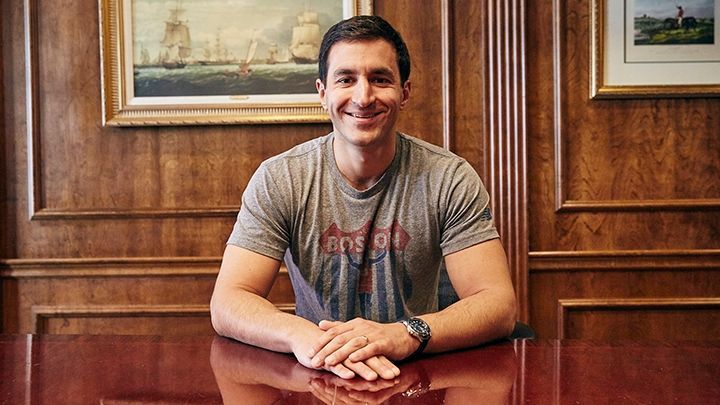
In 2014, Davis took on the global lifestyle, collaborations, Tokyo Design Studio, and New Balance Numeric skate businesses. Two years later he moved into global marketing and sports marketing. In 2020 he became chief marketing officer and senior vice president of merchandising. The Brand President title followed in 2024. Today his official remit covers the brand, partnerships, product architecture, merchandising, and demand generation across 130 countries.
“As leaders, our job is to get the right answer, not have the right answer.”Chris Davis, Navigating Sports Business
That sentence is more revealing than a dozen leadership acronyms. It shifts the executive from oracle to editor. The job is to assemble people who can see around one another's blind spots, then let the strongest answer survive its author. Davis links that process to growing a team and taking satisfaction in the growth of its members. For someone associated with a family company, it is a pointed preference for collective judgment.
Heritage is material, not a museum
New Balance was founded in 1906. A lesser marketer could dine out on the date until everyone asked for the bill. Davis prefers a sharper distinction: New Balance is a brand with heritage, not a heritage brand. One formulation treats history as a supply of ingredients. The other risks turning history into a velvet rope.
This is why the company's recent vocabulary can hold domestic manufacturing, performance running, basketball, skateboarding, and luxury collaborations at once. Davis has helped steer relationships involving sports leagues, athletes including Coco Gauff and Shohei Ohtani, and fashion groups including Prada, Moncler, and LVMH houses. The pairings are broad, but the governing question stays narrow: can both parties make something that feels like themselves?
The graduation path of a good strange idea
Davis calls the approach partnership over sponsorship. The distinction is work. An athlete is not hired merely to stand beside a logo. New Balance expects co-authored product, content, and strategy, while taking responsibility for elevating the athlete's platform in return. It is a two-way contract of attention.
The company's early basketball move made the philosophy enjoyably literal. Darius Bazley, then a teenage prospect who had chosen an unconventional route toward the NBA, became New Balance's first announced basketball partner. During the year before his draft, the company also made him an intern. He trained twice a day and contributed to basketball product strategy, marketing, and social media. It was partly an activation, partly an apprenticeship, and wholly more memorable than handing a teenager an oversized ceremonial check.
The episode carried the ingredients Davis looks for: independence, participation, and an entrance with a point of view. New Balance did not yet possess a gleaming basketball roster. It had a prototype shoe and a prospect willing to do something strange. A challenger does not always need to shout. Sometimes it needs to arrive through the side door with an intern badge.
Better is an editing problem
New Balance's preferred phrase is “the best, not the biggest.” It is a useful piece of corporate restraint because it refuses the most convenient score. Bigger is easy to count. Better requires taste, patience, and an argument about what deserves to remain.
Under Davis, one answer has been “fewer, bigger, better”: concentrate attention, choose partners carefully, and give the resulting work room to register. Another has been to flip spending toward upper-funnel brand building rather than treating every message as a hurried request to buy. The company says revenue doubled from 2020 to 2024. The commercial result matters, but so does the shape of the bet: longer-term brand memory was treated as an asset worth funding.
Private ownership helps. Davis has said the company can focus five years out rather than organize itself around the next few quarters. Yet patience alone does not explain the pace. He has also described New Balance as trying to move at “the speed of Instagram.” The tension is the strategy: long horizon, short learning loop.
His recent public notes show the same instincts applied to physical retail. A store, in Davis's account, is not simply a place where inventory waits under flattering light. It is where product, community, culture, and experience become tangible. In 2026 he used New Balance's first West Coast flagship at The Grove in Los Angeles to argue that the strongest stores create belonging. He made a similar case for locally rooted design in Chengdu and for a co-authored New Balance and Kith destination in West Hollywood.
“We are a brand with heritage, not a heritage brand.”Chris Davis
The line works because it contains both affection and refusal. Davis is not fleeing the old New Balance. He is refusing to let age make decisions automatically. The 990 can be craft object, running descendant, fashion signal, and dependable grey shoe without submitting an identity crisis form.
A system for staying interesting
In 2025, Davis ranked second on Forbes's list of influential chief marketing officers. In 2026, he appeared for a fourth consecutive year, at number six. Lists are snapshots, but the repeated recognition points toward a sustained body of work rather than a single campaign flare.
The more transferable achievement is still the little ratio. Fifty, thirty, twenty gives innovation an address. It prevents experimental work from having to disguise itself as certainty, and prevents the reliable core from being mocked merely because it is reliable. It also creates a route between the two. Today's oddity can become tomorrow's operating habit, provided it earns the promotion.
That is an elegant answer to a problem that stalks every established company. How do you remember without repeating yourself? Davis's version is to keep the memory, widen the authorship, and budget for surprise. The shoe stays on the foot. The brand gets somewhere new.