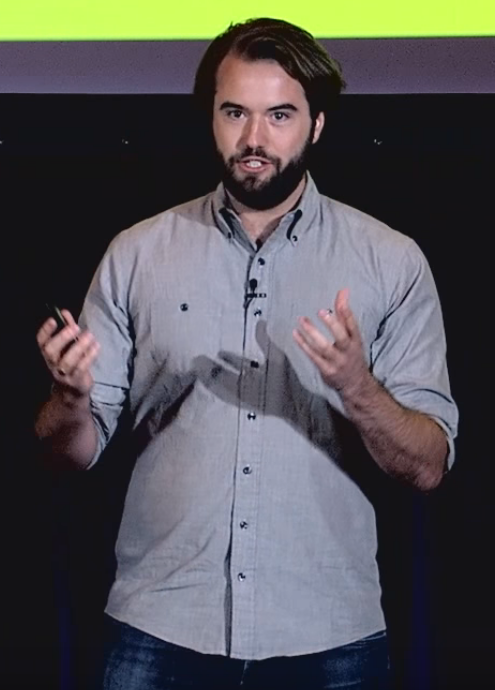
The Engineer Who Rewired Publishing
There is a specific moment in 2017 that keeps coming up when Chris Best talks about why he built Substack. He had just left Kik - the messaging app he co-founded at age 20 and grew to 300 million users as CTO - and he was reading a newsletter called Stratechery by Ben Thompson. Thompson, a solo writer with a paid subscriber list, was making more money than most journalists at major publications. Best, trained as a systems engineer at the University of Waterloo, looked at that and saw a broken system that could be fixed with a better one.
The son of two public school teachers from Richmond, Virginia, Best has never shaken his instinct to build things that serve people rather than extract from them. At Kik, he and co-founder Ted Livingston had built one of messaging's most popular platforms on $45,000. The tools existed. The problem was the model. Advertising required scale. Scale required algorithms. Algorithms rewarded outrage. Best wanted out of that loop.
So in May 2017, he co-founded Substack with Hamish McKenzie - a journalist and former tech reporter - and Jairaj Sethi, a quietly crucial technical architect who had worked with Best at Kik. Their thesis was almost embarrassingly simple: writers should be paid by readers, not advertisers. No middleman. No algorithm determining whose voice gets amplified. Just a writer, a subscription, and an inbox.
You want to have a sci-fi vision and a short-term plan. The whole middle ground often fucks you up.
- Chris Best, CEO of SubstackSeries C, 2025
as of March 2025
$1M+ Annually
July 2025
From Waterloo to the Long Bet
Best enrolled at the University of Waterloo in 2005 to study Systems Design Engineering - a discipline that trains you to see the world as interconnected systems, not isolated parts. He graduated in 2010 after a string of software internships, the last of which happened to intersect with the early days of what would become Kik. When Ted Livingston asked him to co-found the company, he was 21. The timing was perfect and the odds were absurd.
Kik launched as a mobile messaging app - initially bootstrapped on $45,000 - and within a few years had hundreds of millions of registered users. Best served as CTO for eight years, building the technical architecture that underpinned a platform that teens in North America treated like a second internet. The company became a unicorn. Best became someone who knew what it took to scale consumer platforms to enormous size.
Then he left. And started from scratch with a Substack newsletter about the future of media as his reference point and a co-founder who had spent years covering the same industry as a journalist. The contrast is instructive: most people who build a 300-million-user platform then raise money for something glossy and inevitable-looking. Best picked a model that seemed quaint - paid newsletters - and went through Y Combinator's Winter 2018 batch to build it properly.
The internet had spent twenty years training people to expect free content. Best's bet was that what readers actually wanted was trust, quality, and a direct relationship - and they would pay for it once the friction disappeared. Substack removed the friction. The writers provided the rest.
The growth has been asymmetric in the best way. In 2023, Substack had 2 million paid subscriptions. By March 2025, it had 5 million - a number that represents real dollars flowing from readers to writers, not engagement metrics or ad impressions. More than 50 creators on the platform now earn over a million dollars a year from their readers. This is the detail Best returns to repeatedly in interviews, because it's the proof of concept he was always building toward.
The $100 million Series C raised in July 2025 - backed by The Chernin Group, BOND, and an unusual set of investors including Klutch Sports Group CEO Rich Paul and SKIMS CEO Jens Grede - values Substack at $1.1 billion. Best has used the capital to expand what Substack is: beyond newsletters into podcasts, audio, video, and now a TV app for Apple TV and Google TV. The acquisition of Letter, a collaborative writing platform, brought team capabilities to a product previously built for solo voices.
He runs his own Substack at cb.substack.com, where occasional essays surface - including one titled "From engineer to CEO" that documents what it feels like to migrate from building systems to leading people. Another post, "Jairaj Sethi, the SECRET co-founder you never met (until now)," reads like a corrective to the myth of the founder as a lone genius. Best seems genuinely committed to that correction.
The Direct Line Theory of Media
Best's framework for what Substack is trying to do keeps returning to a single axis: direct vs. intermediated. Traditional media put advertisers between writers and readers. Social platforms put algorithms between creators and their audiences. Substack removes both. The reader decides what to pay for. The writer decides what to write. No system is optimizing for clicks or time-on-site or whatever metric happens to be in fashion.
This is where Best's engineering background shows most clearly. He doesn't talk about media in terms of narrative or cultural importance - he talks about incentive structures. If the economic model rewards outrage, the system produces outrage. If the model rewards genuine value to a paying reader, the system produces genuine value. The technology isn't the product; the economic architecture is.
His public stance on press freedom and content moderation has drawn criticism. He's argued for a platform philosophy that leans toward permitting rather than restricting, while acknowledging that some limits are necessary. "You can't define success as 'no one is ever mad at us,'" he's said - a position that reflects both conviction and the reality that running a platform where everyone from mainstream journalists to controversial voices publishes means someone will always be unhappy with your decisions.
Recurring revenue hits different. It funds you.
The core of Substack is the direct connection with your audience.
We have to stand for sanity.
A new economic engine for culture, a new social contract, a renaissance.