At a Choice hotel, the clues arrive in familiar pieces: a Comfort sign by the highway, the smell of a waffle iron near the lobby, a Quality Inn receipt in an inbox. The building may look like part of a chain. Economically, it is usually a local business wearing a global uniform. An independent owner has financed the property, hired the staff and taken the nightly operating risk. Choice Hotels International supplies the name above the door and the machinery behind it.
That machinery is the more interesting company. At June 30, 2026, Choice's system contained 661,089 rooms, up 2.6 percent from a year earlier, across more than 7,500 hotels. Yet the corporation said it owned just 19 operating hotels, with one more under construction. The imbalance is deliberate. Choice is not mainly trying to be a landlord. It is selling hotel owners a bundle of trust, traffic and tools - and collecting fees when the bundle helps fill rooms.
The model stretches from Econo Lodge and Rodeway Inn through Comfort and Country Inn & Suites to Cambria, Ascend Collection and Radisson brands in the Americas. Twenty-two flags sit on one platform. A traveler sees variety. A franchisee sees access: national marketing, a central reservation system, mobile booking, a loyalty program, procurement, training, revenue management and a distribution network that would be expensive to assemble alone.
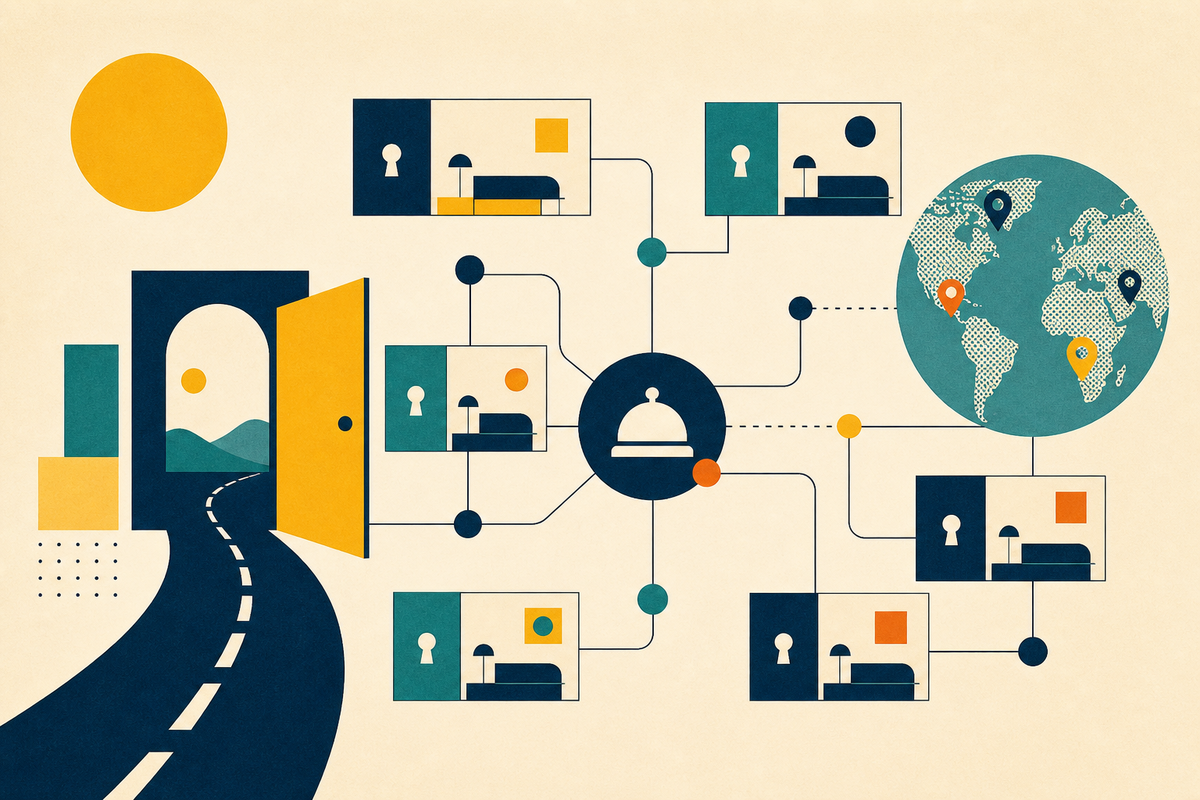
The product hiding behind the pillow
Choice's customer is two people at once. One is the guest searching for a practical overnight stop, a week near a job site or a more polished city stay. The other is the hotel entrepreneur deciding whether a known brand can produce enough demand and operating efficiency to justify its fees and standards. The company has to please the person paying for Tuesday night while proving its value to the person paying the mortgage.
For owners, the problem is fragmentation. A single hotel must price perishable inventory every day, answer group requests quickly, appear in search results, recognize loyal guests and keep a rotating staff current on brand procedures. A room unsold tonight cannot be stored for next week. Choice spreads the cost of solving those problems across thousands of properties, then packages the solutions inside a franchise agreement.
The newest product names make that logic unusually visible. Choice Hotels Business Direct lets small and midsize companies set travel policies and book directly. EasyBid helps properties respond to group requests; EasyBid Plus can prepare the response for an owner. CHARLIE is a round-the-clock AI coach for hotel teams. RAISE is designed to make pricing and inventory work less manual. They are not guest-room amenities. They are small attempts to remove friction between a request and revenue.
“Our biggest opportunity now is sharpening execution.”Dominic Dragisich, interim chief executive
A brand for nearly every exit
Choice's range is a practical defense against a fickle travel market. Economy brands offer recognition and value. Midscale names serve road trips, work crews and small-business travel. Extended-stay hotels trade daily room turns for longer, steadier visits, often with kitchens and weekly rates. Upscale and soft brands give Choice access to higher-fee hotels without forcing every property into the same design.
Rodeway Inn
Quality Inn
Sleep Inn
Everhome
MainStay
Ascend
Radisson Blu
The soft-brand idea is especially revealing. Ascend Collection, launched in 2008, lets an individual hotel keep its own character while plugging into Choice's distribution and loyalty network. It passed 500 open hotels in March 2026. For an owner of a historic inn or local boutique, that is a middle route: do not become a standardized box, but do not remain invisible either.
Extended stay provides a different sort of leverage. Guests who remain for weeks need fewer check-ins and room turns than transient travelers. Developers like the operating logic, and Choice can offer several price points. In the second quarter of 2026, U.S. extended-stay net rooms grew 13 percent year over year for a twelfth consecutive quarter of double-digit growth. Extended stay represented 39 percent of the company's roughly 77,300-room development pipeline.
The franchise flywheel
Choice earns initial franchise fees when a hotel joins, then recurring royalties commonly tied to room revenue. It also receives management, procurement, partnership and service fees. Owners contribute assessments for marketing and reservation programs; those funds are meant to support the system rather than become an ordinary profit pool. In 2025, Choice reported $1.597 billion in total revenue, or $981 million after excluding reimbursable revenue from franchised and managed properties.
The flywheel is simple when it works. More hotels give travelers more places to earn and redeem points. More members and direct bookings make the system more valuable to owners. More owners spread the cost of advertising and technology. Scale produces data that can improve pricing and recommendations. The resulting economics funded $625.6 million in adjusted EBITDA in 2025, a company record.
There is tension inside that loop. Guests may blame the brand for a stay delivered by an independent operator. Owners may resent standards or fees if reservations disappoint. Online travel agencies can deliver customers while also taking a toll and weakening the direct relationship. Marriott, Hilton, IHG, Hyatt, Accor and especially Wyndham compete for owners, sites and loyalty. Choice must keep proving that its system delivers more value than an alternative flag or independence.
Old roads, new plumbing
The company began in 1939 as Quality Courts United, when seven Florida motor court owners referred travelers to one another and agreed on service standards. The technology was a recommendation and a shared promise. Stewart W. Bainum Sr. later merged his motel business into the network and shaped the modern corporate lineage. The company became Choice Hotels International in 1990 and emerged as a focused public franchisor in the 1990s.
Its history reads like a sequence of attempts to make a scattered network act as one: round-the-clock toll-free reservations, a global reservation system, an internet-based property management system, an early global hotel iPhone app, then choiceEDGE, a cloud central-reservation platform launched in 2018. The migration to cloud infrastructure was completed in 2024. In 2026, Choice expanded its work with Amazon Web Services and Salesforce to put governed AI agents into hotel and corporate workflows.
“These tools are built to help our owners win more business.”Patrick Pacious, former president and CEO
The Radisson Hotels Americas acquisition in 2022 supplied another kind of plumbing. For roughly $675 million, Choice added nine brands and a stronger upscale presence across the Americas. During Pacious's nine years as CEO, the portfolio doubled from 11 brands to 22. He stepped down in May 2026; former chief financial officer and growth executive Dominic Dragisich became interim CEO while the board opened a search.
That handoff lands at a useful inflection. Second-quarter U.S. room openings reached their highest level for that quarter since 2019, international rooms grew 12.5 percent, and global franchise agreements awarded rose 20 percent. At the same time, the company still had work to do in its domestic base. Total U.S. system rooms were 0.3 percent below the prior year, even as extended stay and other higher-value segments grew.
Where Choice fits now
Choice occupies a broad middle of the lodging market with an economy heritage, a strong midscale position, an extended-stay engine and a deliberate push upward. It cannot out-luxury the luxury specialists, and it does not have Wyndham's sheer economy footprint. Its argument is versatility: enough brands to fit many properties, enough guests to generate demand, and enough proprietary infrastructure to make life easier for owners.
Travelers can use the system as a practical ladder. The same Choice Privileges account can cover a roadside overnight, months in a suite with a kitchen, a locally styled Ascend hotel or a Radisson Blu visit in the Americas. Owners can use Choice to choose a market position, convert an existing hotel, develop a new one, sell rooms directly, answer group leads, train staff and adjust rates. The company sits in the market wherever brand recognition and local ownership need to coexist.
The cleverness is not hidden in any single app or pillow. It is in the repeated trade. Local entrepreneurs keep the buildings and much of the upside. Choice turns a dispersed collection of hotels into a searchable, bookable, recognizable network. The sign is only the visible part. Underneath it, the company is selling coordination.