Charley Moore once had a phone that congratulated him for making a sale. Every order at the young Rocket Lawyer triggered a ping. There are more dignified ways to describe the arrival of revenue, but few so satisfying. Someone, somewhere, had decided that this unfamiliar service could help.
He told the story to a SaaStr audience while discussing the journey to 100,000 paid subscribers. The numbers had grown; the memory was still individual. In a profession accustomed to discussing the value of an hour, Moore had become interested in the value of an easier beginning.
His career has passed through the Navy, Berkeley Law and the early internet business. Rocket Lawyer, founded in 2008, made him a familiar figure in legal technology. In March 2025 he retired from the company. That year he founded Invictus AI. The software has changed. His concern about who gets useful help has proved rather durable.
A customer education, delivered on weekends
Before law school, there were the family service stations in the Midwest. Moore worked weekends and summers from childhood, encountering small business as something requiring attendance rather than admiration. A customer at the counter is an excellent corrective to an abstract business theory.
He grew up in the St. Louis area. His father had driven trucks before saving enough to open a gas station; his mother was a teacher. Entrepreneurship and formal education were both close at hand. Years later, when explaining his work, Moore returned to those early experiences of serving customers.
The United States Naval Academy took him into another kind of service. He became a naval officer and served in the Gulf War. The Navy also offered an example of legal assistance available as a benefit. He saw how practical support could make a difference to the people receiving it.
That experience would acquire a commercial expression later. A person should be able to get help before a legal problem becomes an expensive emergency. The idea sounds uncontroversial until someone has to build the business that delivers it.
At the table with the early internet
Moore graduated from Berkeley Law in 1996 and went into the technology business’s legal engine room. At Venture Law Group in Menlo Park, he represented emerging companies and their investors. His work included Yahoo during its early growth and IPO period, alongside WebTV and Cerent.
Those clients had a resource that small businesses could rarely take for granted: access to experienced lawyers at consequential moments. Moore understood the value of that expertise. He also saw how the price restricted its audience. The internet offered a way for clients and professionals to work through the same screen.
He had an entrepreneurial chapter before Rocket Lawyer, founding OnStation, which was later acquired by The Cobalt Group. He had therefore occupied several seats around a business: the family employee, the adviser, and the founder. Each provides a different view of what a customer is actually buying.
When Rocket Lawyer arrived in 2008, its proposition joined legal documents with access to professional help. The problem was familiar enough to be almost invisible: people needed the law to get ordinary things done, yet the process of obtaining assistance could discourage them from starting.

Permission to make the first step easier
By 2021, Rocket Lawyer offered more than 1,000 online documents, along with access to attorneys who could help customers use them. The breadth matters because legal needs do not arrive in a tidy professional category. A customer may be starting a company one month and sorting out a personal document the next.
The early business still needed revenue. Moore has described starting without the luxury of gathering a huge audience and deciding how to earn money afterward. Free trials and a developing freemium approach were experiments within that constraint. Making an introduction easier had to coexist with building a company that could pay its bills.
A simpler interface still left room for professional judgment. The service combined documents with access to attorneys, allowing customers to move from an everyday task to a conversation when circumstances required it. A small business could need both. Convenience had to accommodate questions as well as forms.
By 2016, Moore was emphasizing collaboration with lawyers and the ability to answer questions through mobile devices. Employee legal plans offered another route to customers. The distribution idea carried an echo of his Navy experience: help could arrive through an institution people already belonged to.
The rocket had to argue its own case
Moore’s account of naming Rocket Lawyer contains a pleasing complication. A company designed to make legal services feel approachable encountered people who worried that its name was insufficiently serious. Investors, prospective employees and lawyers offered their doubts. Even the colors became a matter for debate.
Some favored softer shades. Moore recalled his chief revenue officer cutting through the discussion: “Charley, Rockets are Red.” There are occasions when a branding strategy benefits from being short enough to fit on a napkin.
European expansion brought another examination. Consultants researched potential names across countries, and the existing rocket survived. The joke has a practical point. Moore was trying to persuade customers that legal help could be accessible; a name weighed down with institutional grandeur would have made a curious introduction.
The business itself needed more than a memorable introduction. In April 2021, Rocket Lawyer announced $223 million in growth financing led by Vista Credit Partners. Its plans included scaling the Rocket Legal Cloud platform. The financing placed substantial resources behind a project that had begun with individual orders announcing themselves on a phone.
Growth capital announced by Rocket Lawyer, led by Vista Credit Partners.
Changing the rules takes a second kind of patience
Moving documents online was only part of the undertaking. Legal services operate within professional rules, and new ways of delivering them require more than a better website. In September 2020, Rocket Lawyer became the first national company approved for Utah’s regulatory sandbox for alternative legal providers and services.
The sandbox gave Moore a setting in which to pursue changes to how help could reach customers. He discussed it alongside Rocket Lawyer’s European expansion and the need for greater diversity in legal technology. Product design and institutional change were becoming neighboring responsibilities.
His writing had already shown an interest in the friction between incumbents and newcomers. In a 2013 column, he examined startups facing litigation and emphasized preparation: understand the legal position, retain counsel and budget for a fight. The founder making law easier to use was well acquainted with its capacity to make business difficult.
Persistence runs through his interviews. He describes progress arriving after setbacks that might have persuaded somebody else to stop. It is an unglamorous virtue, with the advantage of remaining useful after the applause has finished.
A blocked shot, a useful cheque
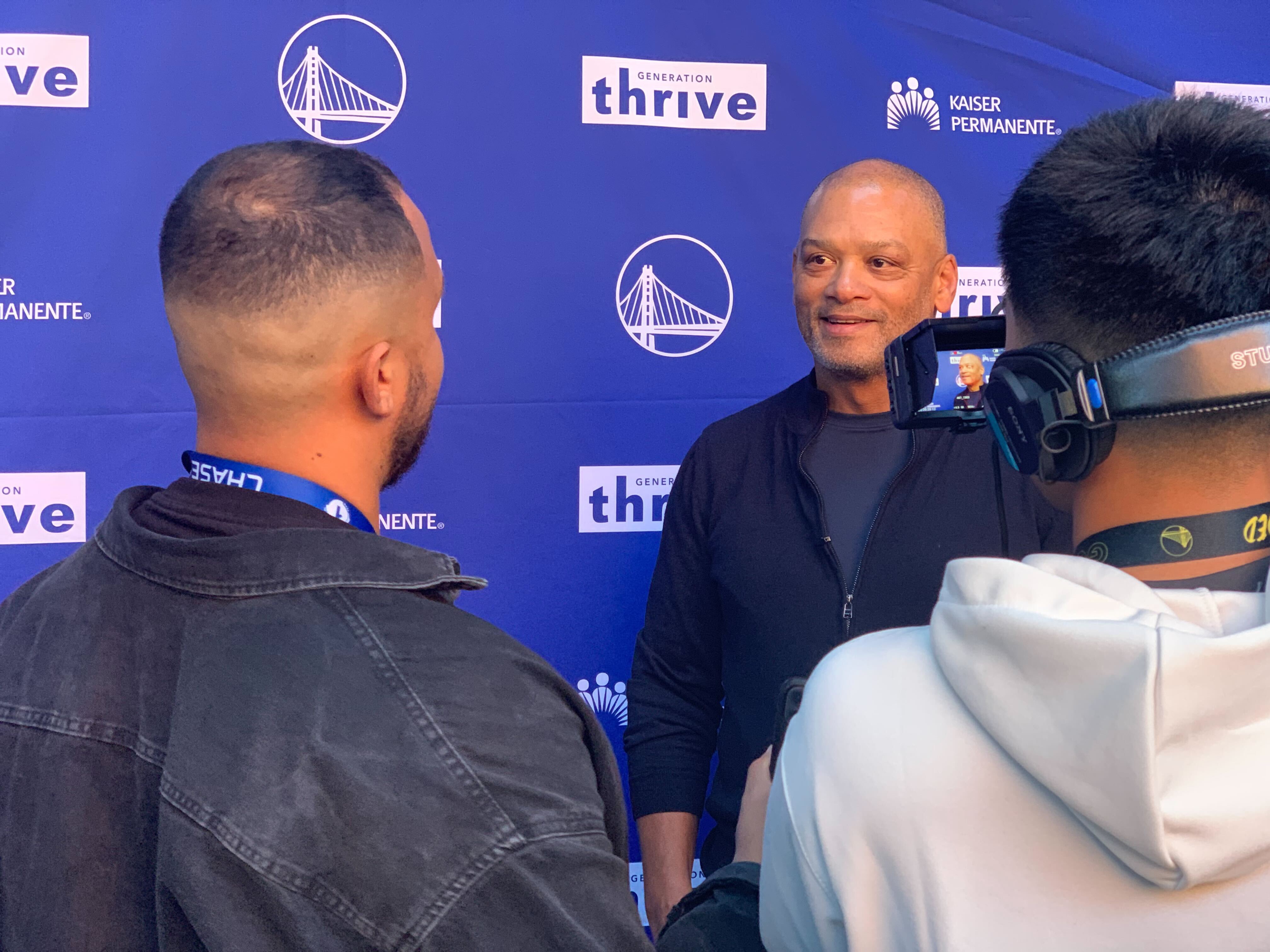
Basketball supplied a different setting for the same interest in access. During the 2022-23 season, Rocket Lawyer’s Warriors partnership tied donations to blocked shots. On March 31, 2023, Moore presented a $250,000 cheque to Generation Thrive at Chase Center.
The partnership also put legal benefits into the hands of nonprofit organizations. Documents, electronic signatures and advice are less photogenic than a presentation at center court. They are nevertheless things organizations need while trying to direct their resources toward young people and education.
Generation Thrive’s Bridging the Bay program supported nonprofit leaders working on educational equity. Rocket Lawyer provided free group legal benefits to its 16 participating nonprofits and the Warriors Community Foundation’s 66 grantees for 2022-23. Here, the company’s service could accompany its donation.
A new company, and things worth keeping
Rocket Lawyer announced Moore’s retirement on March 20, 2025, naming chief financial officer Paul Hollerbach interim CEO. Moore thanked customers and colleagues and reaffirmed his belief that technology could broaden access. The announcement marked an ending at the company he had founded, rather than a retirement from building businesses.
Invictus AI followed in 2025. Its current offering concentrates on compliance software, pairing AI agents with human supervision through affiliated Invictus Counsel. Moore is its founder and CEO. The arrangement retains a familiar interest in combining software with professional judgment, while giving the new business a specific task to pursue.
Outside company descriptions, his answers become more particular. He names art museums as a source of inspiration and likes historic places when traveling. He has three sons. An inscribed watch for one of them made his list of recent distinctive purchases. Finishing his first book was on his bucket list in July 2025.
“Creating durable things.”
Charley Moore, on what brings him joy
That answer to a question about joy is brief enough to resist embellishment. It accommodates a business, a relationship, perhaps a book that has yet to be finished. Moore has spent years making complicated services easier to approach. He still seems interested in making things people will keep using, long after the first congratulatory ping.
Keep company with Charley
Explore his work, conversations and writing.