The expensive part of a legal question can begin before anybody answers it. You have a lease to read, a customer agreement to send, a business to register. First you must decide whether the question is serious enough to pay someone to ask. Rocket Lawyer has spent its life trying to make that first decision easier.
- Make documents, sign them and get help understanding them in one service.
- Memberships combine software with different levels of attorney access.
- Personalized, privileged legal advice is a separate paid service.
Its customers include families, freelancers and small businesses. In a September 2026 interview, CEO Paul Hollerbach singled out businesses with fewer than ten employees. That is a revealing detail. A company that small can encounter employment rules, commercial leases and supplier contracts without having anyone whose job is to understand them. The paperwork arrives long before the legal department.
The code gave way first
Founder Charley Moore had been a Silicon Valley lawyer, working with technology companies, before starting Rocket Lawyer in 2008. He wanted ordinary people to have a more affordable route to legal help. But distributing that help through software created a second problem: building something dependable enough for strangers to trust.
In his 2016 SaaStr talk, Moore recalled prototype code breaking at roughly 25,000 paying subscribers. The company rebuilt its platform; he put the investment at tens of millions of dollars. Customer support also needed investment. Cheap access, it turned out, required substantial machinery behind the screen.

The brand had its own resistance. Moore later recalled investors, prospective employees and lawyers doubting that anyone would take “Rocket Lawyer” seriously. A consultant studied the name for Europe and came back supporting it. Even the color required discussion. His chief revenue officer’s argument was economical: “Charley, Rockets are Red.”
A form is only the first step
Today the service covers a sequence of jobs: prepare a document, obtain signatures through RocketSign, understand a contract, ask an attorney a question. It also helps with business registrations, registered agents and trademarks. Tax assistance is offered through Taxfyle. The appeal is practical: fewer separate services to find while trying to finish one piece of work.
Rocket Copilot adds a conversational route into that sequence. Introduced in collaboration with Google Cloud in December 2023, its first release helped entrepreneurs name businesses. Legal Q&A followed in May 2025. Contract Review arrived that August, highlighting terms, possible red flags and points deserving closer attention. The expansion follows the questions a business owner might ask before and after signing.
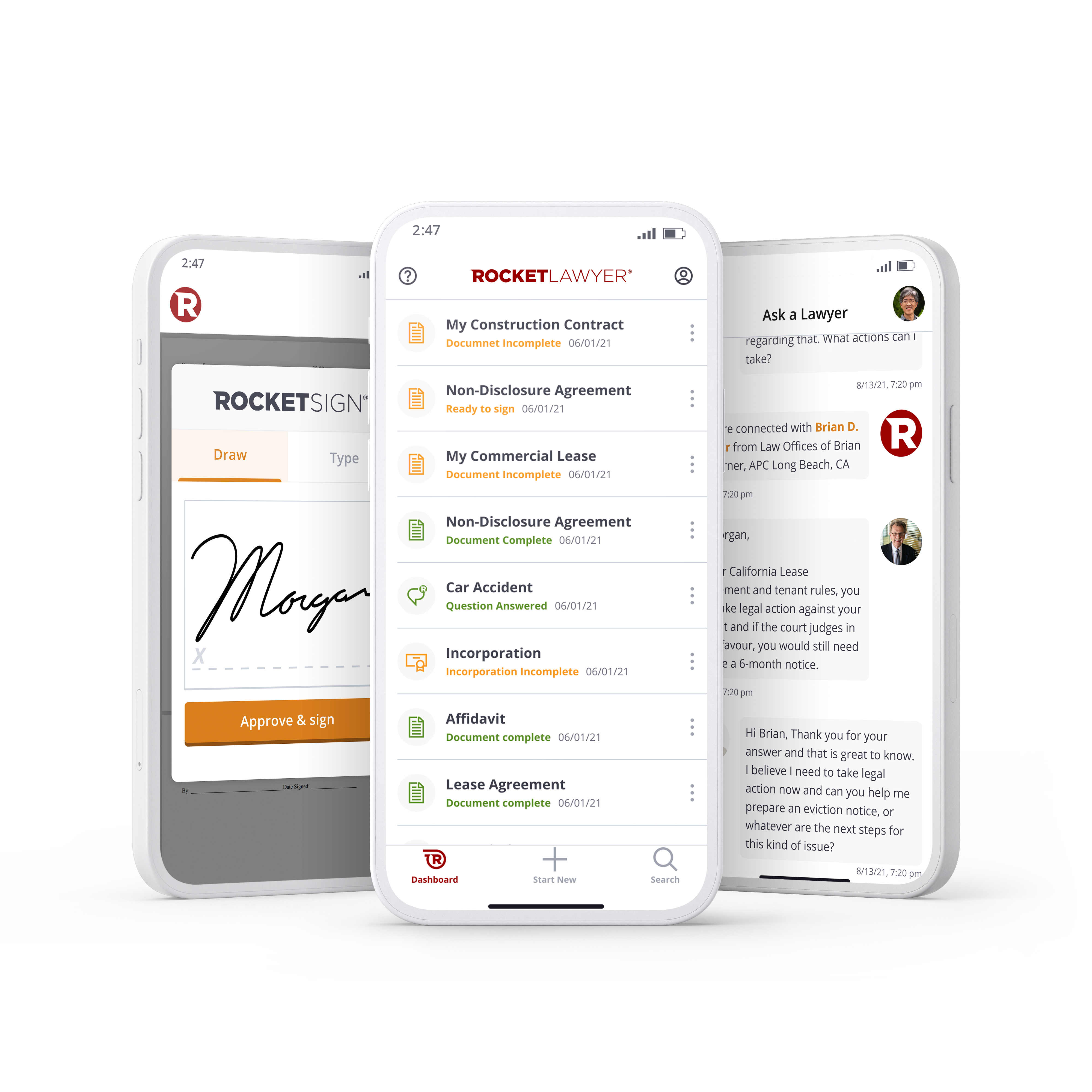
Consider a contractor reviewing a client agreement. The useful sequence is to upload the contract, inspect the flagged terms, then decide which unresolved points need an attorney. This is an illustrative workflow, not a promise about an outcome. It gives the customer a narrower question to take into a paid conversation - and a reason to keep the original document close at hand.
The distinction between information and advice matters here. A contract summary can help you spot something to question. A lawyer engaged to advise you can weigh the particular facts and recommend what to do. Rocket Lawyer’s August 2026 Legal Advice Sessions formalized that second route, matching members with an appropriately licensed attorney for a purchased appointment and follow-up notes.
- 01UnderstandAI explanations & contract flags
- 02AskAttorney questions & live information
- 03EngagePaid, personalized legal advice
Different jobs. Different levels of professional involvement.
The subscription had to change
Rocket Lawyer’s September 2026 membership announcement contains an unusually useful admission. The previous model assumed similar needs across members. Some paid for access they barely used; others needed more support than the plan supplied. The replacement offers Standard, Plus and Pro, keeping core digital tools together while varying attorney access.
As checked in October 2026, those plans cost $149, $249 and $349 a year. Monthly billing is available. Privileged advice costs extra: $149 for 30 minutes or $249 for an hour. State filing charges remain separate. The headline membership price therefore answers only the first budgeting question.
Annual billing. Add-ons and government fees extra. Checked October 24, 2026.
For a business returning regularly with contracts and compliance questions, bundling can make sense. For someone with one isolated task, an ongoing subscription deserves closer arithmetic. Memberships renew automatically unless canceled. And a difficult dispute still calls for a clear agreement about what counsel will handle. A platform’s convenience does not settle the scope of representation.
Follow the question
Rocket Lawyer sits between document providers such as LegalZoom, general AI assistants and traditional attorneys. Its competitive argument is the connection among those activities. The company also sells enterprise legal programs, reaching people through organizations rather than relying entirely on individual sign-ups. In 2021, a $223 million financing led by Vista Credit Partners supplied capital to expand its digital platform.
The company had already established operations across North America, the United Kingdom and the European Union when it announced that financing. A Brazil launch followed in December 2021 under local leaders Rafael Steinhauser and Michel Cury. Going abroad involves more than translating a form: the legal context and the local delivery arrangement matter.
There is a regulatory side to that expansion. In September 2024, its wholly owned law-firm subsidiary, Rocket Legal Professional Services, received an Arizona Alternative Business Structure license. The arrangement reflects a specific regulatory permission to combine technology ownership and legal practice. It cannot simply be assumed to apply everywhere.
That distinction is useful for anyone comparing providers. Ask who prepares the document, who answers questions and who actually represents you if the matter becomes contested. Those can be separate parties with separate obligations. Buying them through one interface makes the shopping easier; it still pays to understand each job.
The newest distribution experiment brings the service into someone else’s conversation. In October 2026, Rocket Lawyer announced a Claude connector that can send an attorney question or arrange a 20-minute consultation. It carries relevant context forward, reducing the need to explain the problem again after leaving an AI chat.
The paperwork arrives long before the legal department.For the smallest businesses, that is the opening.
That offers a lesson other service businesses can copy: place the next useful action beside the question that creates it. Make the handoff understandable, price it clearly and say when human judgment is required. Rocket Lawyer’s opportunity lives in those transitions. The document may be finished. The person holding it still has a decision to make.