A house is an awkward thing to put on an assembly line. It must eventually leave the assembly line. It needs a road wide enough to travel, a piece of land willing to receive it, and a buyer who can finance the whole arrangement. Champion Home Builders, Inc. has spent decades working on the first problem. Its recent acquisitions suggest that the other problems deserve just as much attention.
- The product: homes built indoors, then transported and installed.
- The business: manufacturing increasingly connected to company-owned retail and financing.
- The buyer’s catch: the house price and the move-in cost are different numbers.
That distinction makes Champion interesting beyond construction. A factory can make a product efficiently while the customer still struggles to buy it. Champion’s current strategy offers a useful case study in bringing the production system closer to the purchase decision.
First, move the work indoors
In 1953, Walter W. Clark and Henry E. George started Champion in Dryden, Michigan. The early operation produced two homes a week, built by hand. The company’s own history now counts more than three million homes sold across its family of builders. A modest production experiment became a network of regional businesses.
The central idea remains pleasantly literal: give the house a roof over its head while people build it. Champion describes factory construction as a sequence of workstations, with tools and materials close to the workers using them. Weather has fewer opportunities to interrupt. Repeated tasks become easier to organize. Materials spend less time exposed outside.
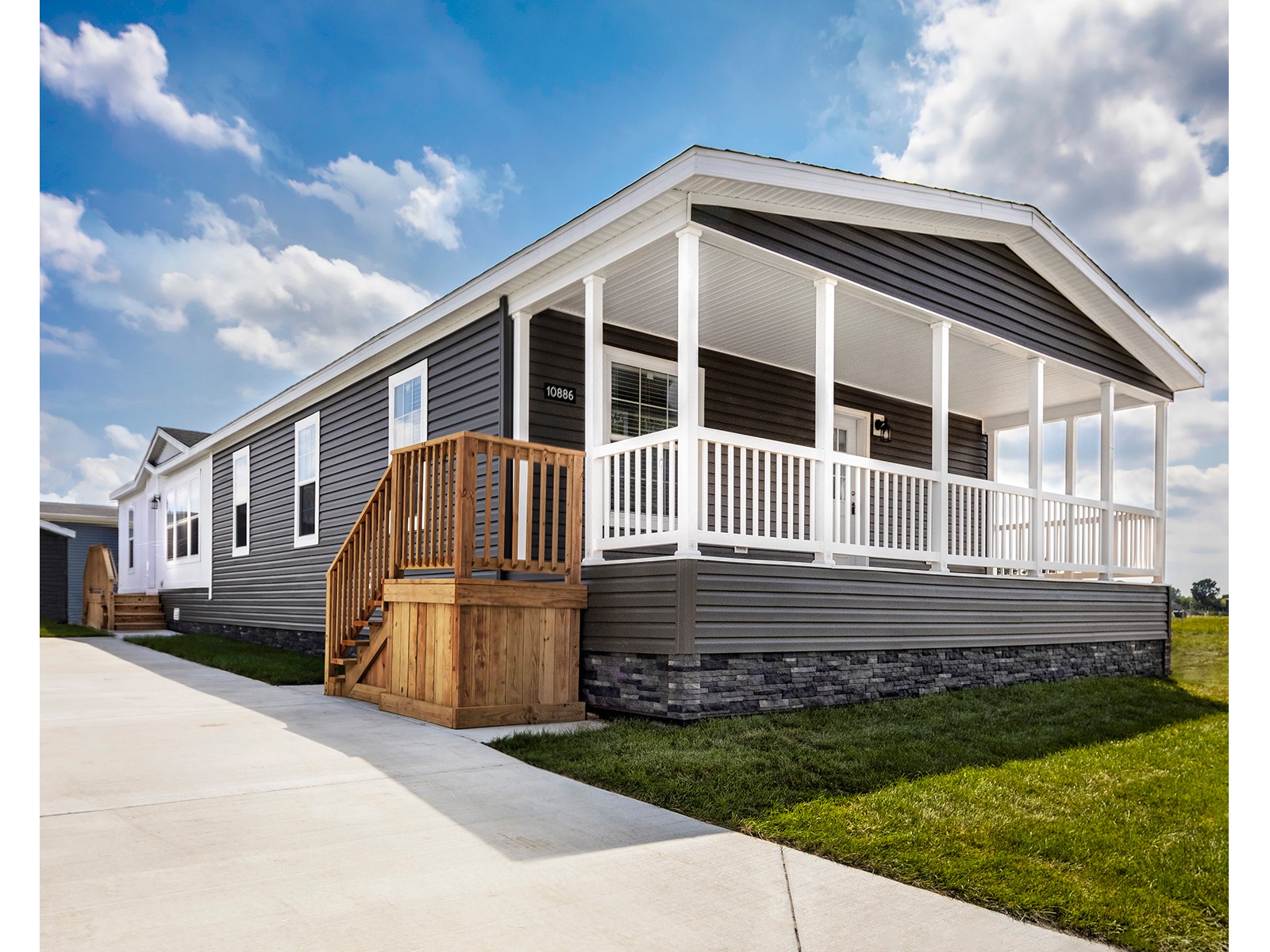
There are two important versions of this process. Manufactured homes follow the federal HUD construction code; modular homes follow applicable state or local building codes. Both are factory-built. The distinction matters when choosing a home for a particular property, and “prefab” alone does little to explain it.
Champion’s portfolio extends from single-section homes to larger multi-section models, accessory dwelling units and park-model RVs. Its modular buildings also serve multifamily and hospitality projects. The customers include individual households, retailers, builders, developers and community operators. They are buying different products, but all depend on the handoff between factory and site.
The factory could not fix the credit market
The history contains an uncomfortable interruption. In November 2009, predecessor Champion Enterprises and its domestic operating subsidiaries entered Chapter 11. Court findings traced deteriorating sales to falling real-estate values, weak demand and scarce financing for manufactured homes. By 2008, operating income could no longer meet cash needs.
Demand and cash flow deteriorated before the filing. Closing plants and cutting capacity could reduce expenses; those actions could not make the old debt burden disappear. Efficient construction had encountered a problem outside the production line.
“When you buy a car, they don’t ship you the parts”- Jack Lawless, then Champion CEO, 2013
In March 2010, investors including Centerbridge, MAK Capital and Sankaty acquired the operations out of bankruptcy and supplied $50 million in new capital. The recapitalized business carried $40 million of term debt. The reset involved ownership, financing and the balance sheet, alongside the continuing work of building homes.
Champion later combined with Skyline in 2018. Today, Champion Home Builders, Inc. operates within publicly traded Champion Homes, Inc., the parent renamed from Skyline Champion in 2024. The group’s financial figures describe that wider business, rather than the subsidiary alone.
Buy the route to the customer
Look at the recent shopping list. In 2023, the group announced its Regional Homes acquisition for approximately $328 million, plus $130 million of assumed debt, mainly inventory financing. The proposed terms also included an earnout and working-capital adjustments. Regional brought manufacturing and a substantial southeastern retail network.
Iseman Homes followed in 2025, bringing ten sales centers across six states. Its importance was geographic as much as numerical: stores near existing plants could strengthen distribution. Champion said Iseman’s management would remain. Local knowledge was part of what it wanted to keep.
In May 2026, Champion announced an agreement for eleven Homes Direct locations in western markets. Its August earnings release described the acquisition as recently closed. These locations complemented its manufacturing footprint and brought experience helping customers with permits, financing and site preparation.
The logic is straightforward. A store can supply orders to a nearby factory. Owning both can let the group retain manufacturing and retail margins. Champion Financing, formed with Triad Financial Services in 2023, addresses another dependency: credit for customers and inventory financing for retailers.
That is an interpretation of the strategy, rather than evidence of a single executive epiphany. The acquisitions document the shift: Champion is investing in more of the steps between browsing a floor plan and occupying a home. Its advantage rests partly in making those steps work together. Clayton and Cavco offer competing factory-built alternatives; conventional builders and existing homes compete for the same household budget.
The number that needs a second number
The parent reported $710.2 million in sales for the quarter ended June 27, 2026. Its average selling price per U.S. home was $95,600. That figure reflects the company’s mix of products and channels. It is not a national, all-in consumer offer.
Ask which costs your quote includes: land, foundation, transport, installation, permits, utilities and site work.
Champion’s pricing guide lists exactly these additional considerations. A buyer with suitable land and accessible utilities faces a different project from someone starting with an undeveloped parcel. Delivery access matters. So do local requirements. A good floor plan cannot resolve an unsuitable site.
The practical move is to start with the location, then ask a retailer for a written scope and complete project budget. Compare what is included before comparing totals. Tour the model, identify paid options, and establish who handles installation and service. These questions are part of buying the home.
For other businesses, the transferable lesson is to examine the handoffs that prevent customers from purchasing an otherwise useful product. Champion’s history also supplies the limit: owning more steps requires capital, coordination and enough demand to keep capacity productive. A factory needs orders. A household needs somewhere to live. The work is making the two arrive together.
Open the floor plan
Explore homes · Read the blog · Company news