When Chad Abraham became chief executive of Piper Jaffray in January 2018, he had already spent more than a quarter of a century at the firm. His next consequential career move would involve changing its name. Two years later, Piper Jaffray became Piper Sandler, carrying the name of an acquired business onto the door. For a banker who had worked his way up from analyst, it was a rather public acknowledgment that the next chapter required other people.
The title arrived after the apprenticeship. Abraham had joined in 1991, spent years building a technology banking career on the West Coast, and eventually helped run investment banking and capital markets. The interesting question in his story is how someone stays at one institution for decades while continuing to change the institution around him.
His answer has taken physical form: offices, specialist teams, new colleagues, different businesses under a shared name. The career has the continuity of a long marriage and rather more acquisition agreements.
A Minnesota career with a California beginning
Abraham studied economics and political science at Northwestern University. In 1991, he entered Piper as an investment banking analyst. His first thirteen years at the firm were spent on the West Coast in technology investment banking, a geographical detail that complicates the picture of a career rooted in Minneapolis.
In 1996, he opened Piper’s Menlo Park office. Establishing a presence in Silicon Valley gave the young banker a task larger than completing his own assignments: helping a regional institution establish itself among technology companies. An office is a modest noun for that undertaking. It requires people, clients and reasons for both to keep coming back.
By 1999, he was a managing director and head of technology investment banking. The progression matters because his later decisions repeatedly return to the problem he encountered early: how to assemble enough expertise in a particular market to earn a place in its important conversations.
In 2005, he became head of capital markets. Five years later, his responsibilities widened again, to global co-head of investment banking and capital markets. The technology specialist was now helping decide where the broader business should grow.
- 1991Investment banking analyst
- 1999Head of technology investment banking
- 2005Head of capital markets
- 2010Global co-head, investment banking and capital markets
- 2018Chief executive officer
- 2019Chairman of the board
The promotion came with a partner
Abraham shared the investment banking leadership job with Scott LaRue. During their leadership, the division’s revenue rose from roughly $150 million to more than $500 million. The expansion included energy and financial services coverage, broader debt capital markets capabilities, and additional people and offices.
It is tempting to read such a number backward, as if growth had been inevitable once the right executive arrived. The shared credit makes a more useful story. Abraham’s advancement depended on building a business alongside another leader; his subsequent promotion preserved that habit of partnership.
When the board selected him as CEO, it also appointed Deb Schoneman president, effective on the same day. Schoneman had joined Piper in 1990, a year before Abraham. Andrew Duff, the outgoing CEO, stayed on as chairman. The handover put two long-serving colleagues in charge while retaining a connection to the previous leadership.
Duff said of the pair: “they inherently understand our business, culture and values.” The observation helps explain the choice. Abraham knew the machinery because he had spent years operating different parts of it. He would become chairman himself in May 2019.
The $485 million question: who stays?
In July 2019, Piper announced its agreement to acquire Sandler O’Neill + Partners. The transaction closed on January 3, 2020. With it came a new name, Piper Sandler, and a substantially expanded financial services business.
The announced consideration was $485 million, including $100 million of tangible book value. There was also a separate $115 million retention plan. Those figures describe different things and deserve separate lines. One purchased the business. The other addressed a particularly awkward feature of buying an investment bank: the valuable people can go home at five and choose another employer.
“Transactions in investment banking are always about the people and culture.”Chad Abraham · July 2019
Sandler O’Neill’s Jon Doyle would lead the combined financial services business. Jimmy Dunne would continue advising clients. The arrangement gave experienced bankers responsibilities tied to the work and relationships they already knew.
The purchase also carried a strategic choice. Piper was seeking greater depth in particular sectors, including financial services. Adding an established practice offered a different timetable from recruiting individual bankers and waiting for a new team to mature. The new sign outside was the visible part; keeping the relationships inside was the harder assignment.
Returning to familiar territory
Abraham’s early technology career remained relevant as the firm expanded. In October 2022, Piper Sandler completed its acquisition of DBO Partners, a San Francisco Bay Area technology investment bank founded by Gordon Dean, Mark Bradley and Nick Osborne.
DBO brought experience across software, security, engineering, semiconductors and other technology markets. It also added general partner advisory services for financial sponsor clients. Osborne became co-head of technology investment banking alongside Steve Schmidt, leading a group of more than fifty banking professionals.
The resemblance to Abraham’s early work is geographical and practical. Once again, Piper was enlarging its technology presence in the Bay Area. By this point, however, Abraham’s job involved bringing an existing team into a wider business, rather than opening an office himself. The young banker’s old territory had become part of the chief executive’s continuing agenda.
Another addition followed in 2024: Aviditi Advisors, co-founded by Ryan Schlitt and John Robertshaw. It became Piper Sandler’s private capital advisory group, serving financial sponsors, alternative investment managers and limited partner investors. The acquisition widened the range of conversations the bank could have with private capital clients.
The former analyst faces the room
There is a useful photograph from 2022. Abraham stands at the front of a room of summer interns in Minneapolis. The tables are crowded with laptops. Two screens display a presentation. The scene has the familiar furnishings of corporate training, including enough patterned carpet to discourage anyone from looking down for long.
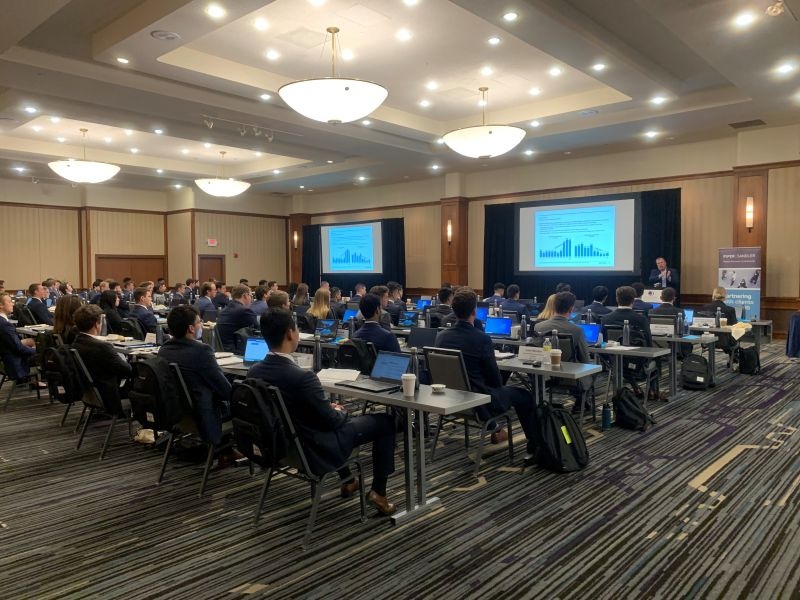
The firm described him as kicking off analyst and associate intern training. In 2024, another incoming group, numbering more than one hundred, heard from him about Piper’s culture. These appearances connect his present job with the entry point of his own career.
A CEO can approve a hiring budget without ever meeting the people it brings in. Here, the former analyst was part of their introduction. The photograph offers a small, concrete counterpart to the language about talent that accompanies so many banking acquisitions: a room full of people still at the beginning.
His institutional commitments have also extended beyond Piper. He serves on the board of Columbus McKinnon, the industrial company. His previous trusteeships include The Blake School and the Nature Conservancy’s chapter covering Minnesota and the Dakotas. These are separate responsibilities, alongside the bank that has occupied his working life since 1991.
Abraham and Schoneman have also put their names to the firm’s expectations of its employees. Their message introducing Piper’s code of ethics assigns responsibility for the collective reputation to individual decisions. It asks employees to take accountability for their conduct with clients, business partners, regulators and one another. That is a more demanding description of culture than the atmosphere at a welcome reception.
For an executive who buys businesses as well as hiring people, it identifies a continuing obligation. Bringing teams together creates daily questions about how colleagues behave and whose interests they serve. The signed message places that responsibility across the organization, including the leaders whose names appear beneath it.
A larger map, with names attached
During 2026, the expansion acquired new addresses. In January, Piper Sandler completed its purchase of Abu Dhabi-based MENA Growth Partners, establishing an investment banking hub for the Gulf Cooperation Council region. Nabeel Siddiqui was to relocate from London to lead the regional investment banking effort while retaining his existing European responsibilities.
September brought the launch of European equities trading from Paris, led by Ben Allen. In October, the firm established an infrastructure debt advisory team in London with Stewart Robinson, Hugo Muller and Anish Shah. The team would sit within energy, power and infrastructure, advising on financing and capital raising.
Each announcement names the people expected to make the expansion work. That detail gives a practical meaning to international growth. A city on the map needs someone who knows what to do there, and colleagues elsewhere who have a reason to call.
The next number is still a target
In June 2026, Piper reorganized parts of its leadership around private equity advisory. Rob Parker and Tripp Griffin became co-heads of services and industrials investment banking. Matt Sznewajs and John Tye moved into private equity advisory leadership alongside David Lee. Private equity already represented roughly half of the firm’s advisory revenue.
The results provided another measure of the enlarged business. Piper reported $970 million in net revenue for the first half of 2026, or $961 million on its adjusted basis. The distinction matters: these are company results, and the two accounting measures describe the same period differently.
Looking further ahead, Abraham and Schoneman set a medium-term objective of $2 billion in corporate investment banking revenue. Their agenda included developing internal talent, adding capabilities and expanding geographically. It remained an objective, with execution still to come.
Abraham’s career began with the work assigned to a new analyst. Thirty-five years later, his responsibilities include deciding which teams to add, which colleagues should lead, and where a Minneapolis institution should establish its next foothold. The names have changed along the way. His continuing assignment is to give the people behind them a reason to build something together.