A contact-center manager can tell you which agent missed a first-call-resolution target. The software can probably tell you before the manager arrives. It can chart the miss by shift, queue and week. Then comes the awkward question: what should that agent do tomorrow? A line graph is an accurate witness and a terrible coach. Centrical exists because its founder, Gal Rimon, spent years looking at that particular gap.
- What it sells: enterprise software that links performance data to coaching, short lessons, practice and recognition.
- Who buys it: large sales and service operations, particularly contact centers with many agents and supervisors.
- How it charges: per-user licenses; a public 300-user AWS Marketplace offer is $74,500 for one year.
- The bet: a useful next action matters more than another immaculate dashboard.
The dashboard’s missing verb
Rimon had been chief executive of business-intelligence company Gilon Business Insight. Centrical says he noticed a recurring defect in that world: reports explained performance but did little to alter it. In his account, there were “dashboards full of insights, but very little that actually moved the needle.” He founded GamEffective in 2013. The first answer was game mechanics: points, missions and visible progress for work that can otherwise feel like an endless procession of tickets.

Gal Rimon, who moved from measuring work to asking how the measurement might change it.
The company’s old name was candid, though increasingly cramped. It became Centrical in 2019 as the product widened from gamification into performance management, learning and coaching. A leaderboard can make a goal visible. It cannot, by itself, teach someone how to handle an angry customer or give a manager time to help. Centrical’s more interesting move was to connect those jobs.
“Dashboards full of insights, but very little that actually moved the needle.”
Gal Rimon, on the problem that led to CentricalFrom one weak signal to a useful next move
The platform pulls operational measures such as resolution, quality, conversion and customer satisfaction into a view employees and managers can use. A dip can trigger a short lesson, a practice task or a coaching prompt. A good result can prompt recognition. The next measurement tells the team whether the intervention helped. That sequence is Centrical’s distinction in a crowded market of contact-center suites, learning systems and gamification products: it tries to keep the metric, the response and the result in the same workflow.
See it
A KPI, quality score or knowledge gap moves.
Choose
Find the person and the next useful action.
Practice
Coach, learn, rehearse or recognize.
Measure
See whether the behavior and outcome changed.
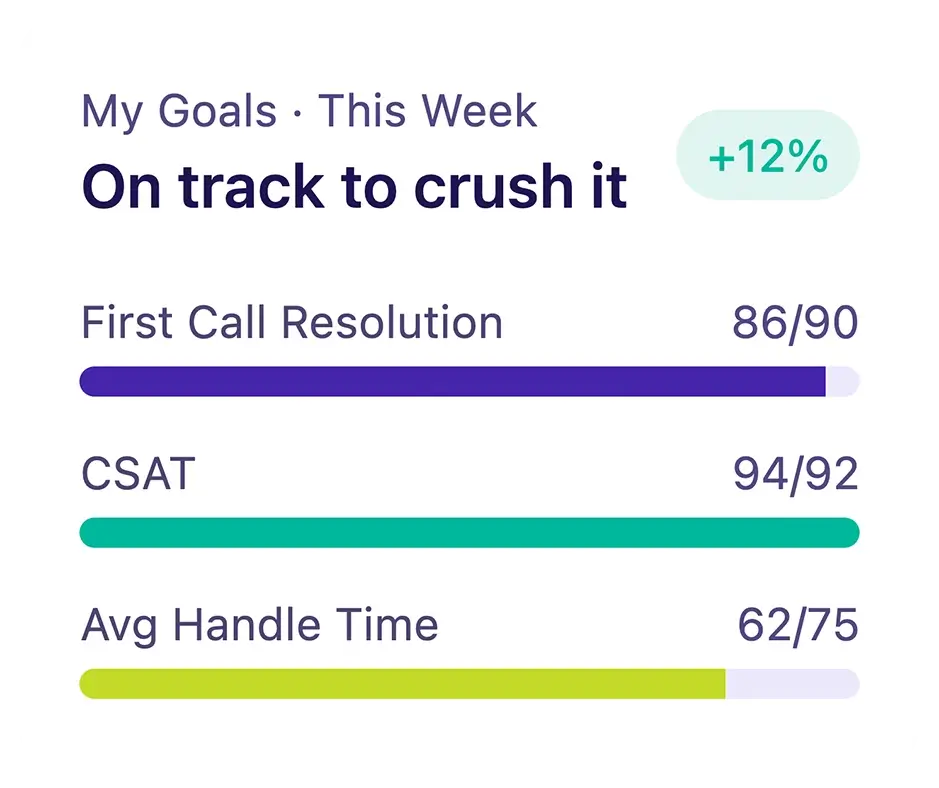
For the employee, that may look like a personal goal and a five-minute exercise in the flow of work. For the supervisor, it is a ranked coaching opportunity and a record of what followed. For a learning team, it is a way to look past course completions and ask whether a skill appeared in live work. Centrical also offers quality evaluations, employee feedback, game-like challenges and an AI assistant. Its 2026 AI Role-Play product lets agents rehearse voice or chat conversations against company-defined scenarios, with feedback that feeds back into coaching. It is an add-on to the wider platform, not a separate purchase for someone who only wants a simulator.
What happened in the field
Microsoft’s support operation is the company’s clearest early example. Its outsourced agents needed to absorb updates and handle calls consistently across centers. The published case study describes personalized goals, microlearning and recognition. Microsoft reported 10% more calls per shift and 12% less absenteeism; 89% of agents said they knew and could apply new information, up from 23% awareness before the program. Those are customer-reported outcomes, not a controlled trial. They still tell a more specific story than “engagement improved”: the agents had a reason to take the last call and a shorter path from a new instruction to using it.
adidas had a different problem. Outsourced consumer-service vendors in more than 20 countries had separate onboarding routines, so a new hire’s experience depended heavily on the vendor and trainer. Centrical helped make a shared two-week sequence: learn the basics in short modules, observe experienced colleagues, then practice. Team leads could see progress; badges echoed adidas’s own brand values. The company’s case study reports a 27% faster time to proficiency, 30,000 training hours saved annually and more than $215,000 in yearly savings. The software mattered, but so did the redesigned training routine. A buyer copying the result would need both.
The same pattern shows up outside a company’s own payroll. Deutsche Telekom used a mobile partner hub to reach salespeople in more than 900 independent stores. That required more than a quiz library: external sellers needed relevant information and recognition while the telecom company respected data boundaries with partners who also sold competing brands. Centrical is a tool for that awkward middle territory, where a business depends on people it does not directly employ.
The price of making a metric move
Centrical sells business software, so the buyer is usually an enterprise team rather than an individual manager with a credit card. Its published pricing page says every license is priced per user, with the amount dependent on the license type. One public AWS Marketplace listing for the Centrical Connector for Amazon Connect offers a 12-month standard plan for 300 users at $74,500, roughly $248 per user for that year. It is one packaged offer, not a price list for every deployment. Support is tiered by project scope, and AI Role-Play is an add-on. A serious buying decision therefore depends on the users enrolled, integrations, modules and the time managers will actually devote to acting on the prompts.
The market is full of software that can count calls and assign training. NICE, Verint and Genesys sell broad contact-center systems; learning platforms handle courses; sales gamification tools run contests. Centrical’s claim is more specific. It joins performance signals to an intervention and then checks what changed. Its integration with Genesys Cloud brings real-time contact-center KPIs into that process. Work with Capita and Verint shows the product can sit beside other enterprise systems rather than asking a contact center to start over.
A new kind of rehearsal
The company raised $39 million in June 2026, led by Leeds Illuminate and Kingfisher Investment, to expand internationally and develop AI tools for teams that increasingly include both human and digital workers. In the same month it made AI Role-Play generally available and announced guided coaching and real-time signals. A simulated difficult call is a sensible extension of the original idea. It gives an agent a place to fail safely, then hands the result to a coach before the real queue supplies its own examination.
There is a limit to the idea, and it is practical rather than philosophical. A bad metric can make a precise recommendation for the wrong behavior. A stale training module can teach yesterday’s policy very efficiently. And a manager who cannot spare ten minutes to coach will not discover an extra ten minutes inside a dashboard. Centrical works best when a team has reliable operational data, a clear behavior it wants to change and someone prepared to act on what the software finds. Its own history offers a small lesson for any workplace: the score is only the beginning of the story.