The turning point arrived over the holidays, in the quiet stretch at the end of 2019 when a half-formed idea can suddenly sound practical. Martin Dumont's Montreal real estate practice was growing. His wife, Celina Machado, had spent years being asked for opinions on signs, brochures and other commercial tools. One conversation exposed what was already happening: she was advising the business from the edge. Why not step inside it?
By the following May, during the first months of lockdown, Machado had joined as an associate and taken responsibility for operations and marketing. She was walking away from a stable job and a 15-year career in public relations and marketing. Yet the move was less a rejection of her old work than a demanding new use for it. The team had business volume. It needed structure, procedures and someone willing to connect planning, accounting, communication and day-to-day execution.
That distinction matters because real estate is often presented through its most visible artifacts: the sign, the listing, the polished room, the handed-over key. Machado entered through the backstage door. Her first value was not a dramatic sales pitch. It was the ability to make a growing organization legible to itself.
The useful kind of complement
Dumont described the division of labor plainly. His strength was relationships in the field. Machado gave the company a development strategy and a working organization. He called her a "one-woman orchestra," an affectionate phrase that also hints at the danger of the job: the person coordinating everything can become invisible precisely because the performance keeps moving.
A division of attention, not a performance score
Two kinds of work inside one client promise
Their shared promise was easy to remember: treat clients the way they would want to be treated. The line sounds simple because client-service lines are supposed to sound simple. The hard part is operational. If an organization intends to listen, remain available and guide people from one end of a transaction to the other, who owns each handoff? What happens when volume rises? Which details require a procedure, and which require judgment?
Machado's communications background offered a useful answer. Marketing is not confined to attracting attention. It can clarify the experience a business intends to deliver. Operations then makes that experience repeatable. Put the two together and a promise stops being brochure language. It becomes a sequence of behaviors.
“We don't want to perform but to build.”Celina Machado on the values behind the team
The quote contains an entire management philosophy. Performance seeks the visible moment. Building accepts the unphotogenic work that makes later moments possible. In brokerage, that means more than growth for its own sake. It means a team capable of absorbing growth without asking clients or colleagues to absorb the chaos.
A couple is not an org chart
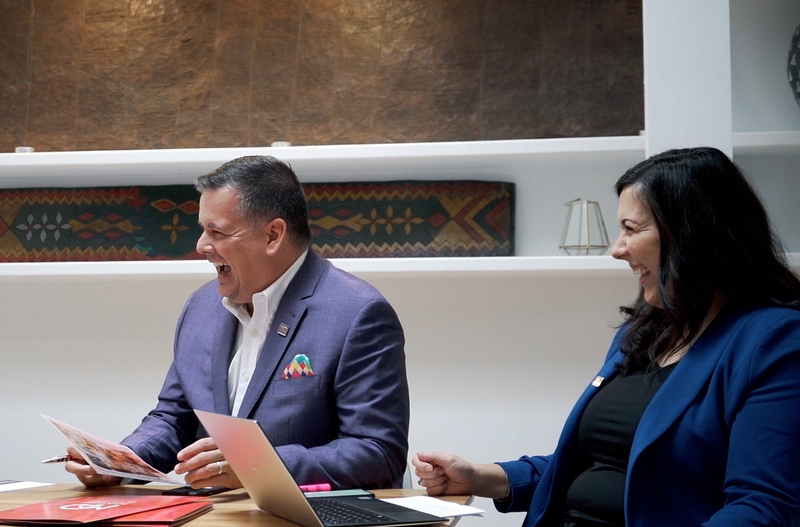
Working with a spouse introduced another layer. In their first public interview as a business pair, both admitted that they did not maintain a clean separation between work and home. Business, family and the strange compression of lockdown ran together. Their gain was not a perfect boundary. It was mutual understanding, a shared project and schedules that could be coordinated around their daughter.
Machado also understood that intimacy can unsettle a team if it leaks into management. Her advice to other families was specific: remain completely professional, and do not speak in front of colleagues as you would in the living room. The point was not etiquette for its own sake. It was protection. Coworkers should not have to decode a marriage in order to understand a decision.
At first, she worried she might be seen as the wife arriving to change everything in an already established group. The fear faded, she said, as she integrated and the team installed improvements that made everyone's work better. It is a revealing anxiety. A new operator needs enough authority to alter the system and enough humility to earn trust from the people already inside it.
Studies at Université de Montréal.
A career in public relations and marketing develops the communication craft she later brings to brokerage.
A conversation with Martin Dumont turns recurring informal advice into the idea of a formal partnership.
Machado joins the team to lead operations and marketing, then trains as a real estate broker.
The team lists her as marketing director and residential real estate broker in Greater Montreal.
Learning the transaction from inside
Machado did not remain solely behind the scenes. She pursued the training required to become a residential real estate broker, a choice she framed as a way to become more involved in the team. Her current Sutton profile lists active properties across Montreal and nearby municipalities, and the team's own roster identifies her in both roles: marketing director and broker.
The double position closes a useful loop. An operator who understands the work only through a dashboard will miss its emotional texture. A broker who lives only inside individual deals may struggle to see the patterns that should become systems. Machado can move between both views. She can consider the client's consequential decision and the team's repeatable process for guiding it.
She has described brokers as advisers and, at times, mediators. That is a more accurate picture of professional service than the television version she has criticized, where women in real estate are flattened into charm and spectacle. Her alternative vocabulary is grounded: professionalism, work, efficiency and devotion to the client's project. Starting in brokerage, she has said, is starting as an entrepreneur. It requires courage and perseverance.
“It takes courage and perseverance.”Machado on entering real estate brokerage
Those qualities are easier to appreciate when the work is seen as a long chain of decisions rather than one closing. A home transaction brings money, timing, memory and uncertainty into the same room. The broker's task is partly technical and partly interpretive: make the next step clear, preserve trust and know when a conversation needs mediation rather than momentum.
The civic habit behind the business
Long before her real estate title, Machado repeatedly chose roles that involved organizing people. She joined the first cohort of Montreal's youth council in 2003. She volunteered with a neighborhood public market and with WordCamp Montréal. She served on the board of Éco de la Pointe-aux-Prairies from 2019 into 2023 and held a board role at CPE Picasso, including a term as president.
The subjects varied, but the work shared a shape. Boards, events and neighborhood organizations turn broad intentions into meetings, responsibilities and follow-through. That is also the operator's craft. It is the patient conversion of "we should" into a date, an owner and a next action.
The real estate team carried that civic habit into a collection for Dans la rue, gathering clothing and hygiene products for young Montrealers. The gesture fits the philosophy the group publishes on its listings: listen, remain available and accompany people through a process. Community engagement and client service are not identical, but each asks the same first question. What does the person in front of us actually need?
The ambition was a team
In 2020, Machado offered a concrete medium-term goal: increase business volume and strengthen the group until it reached roughly ten members. At the time, she had only recently arrived and was still joking about whether working with her husband would succeed. The current team page now lists a roster of brokers and support staff that meets that scale.
Headcount alone says little. The more interesting achievement is that the original thesis survived growth. Machado is still publicly identified through the paired responsibilities that brought her in: marketing leadership and brokerage. The business still describes itself through a client promise rather than a transaction count. The couple still works inside a larger team, which means their private partnership had to become an institution other people could inhabit.
A sign and a brochure started the conversation. A system became the work. Machado's story is a reminder that career experience travels in disguised form. Public relations became client judgment. Marketing became a shared promise. Volunteer governance became operational patience. The visible job changed, while the deeper practice of organizing trust stayed remarkably consistent.
There is also a lesson here about ambition. Machado's stated target was specific enough to manage: a stronger team of about ten people and enough structure to support more business. She did not describe growth as an abstract destiny. She described an organization with a size, a set of roles and a reason to exist. That makes the ambition testable. It also makes it easier for colleagues to see where they fit.
The work of marketing inside such a company is therefore closer to editing than ornament. Decide what the business means, remove the gap between the claim and the experience, and give every person a clear version of the promise. Machado's path from communications to brokerage makes that work visible. The best message is not the cleverest line on the sign. It is the expectation the team can still honor when several clients need attention at once.