The revealing thing about a school district is that nobody experiences the whole of it. A kindergartner knows a classroom. A parent knows the pickup line and the portal password they have forgotten. A taxpayer sees a referendum number. A teacher sees the memo. A superintendent sees all of these at once, which is another way of saying that the superintendent sees a communications problem.
This is the peculiar market CEL Marketing PR Design chose to understand. The Minneapolis company does the familiar agency work - public relations, brand strategy, graphic design, websites, social media, digital campaigns and crisis communications. But its most distinctive work sits in the education column, where a logo must survive a school board meeting, a mobile screen, a gym floor, a translation and the fierce affection people have for a mascot drawn in 1974.
CEL was founded by Cindy Leines in 1988, in a home office with a Mac Plus II and no internet. Its first client was author Sherokee Ilse, whose work brought attention to pregnancy and infant loss. The tools have changed almost beyond recognition. The essential task has not: take something complicated, listen closely, and help other people see why it matters.
“We consider ourselves to be in the business of human services.”Cindy Leines, founder and CEO
The first crack is usually consistency
A school system rarely wakes up because its blue is the wrong blue. The first failure is more ordinary. Staff stop using the district logo. Every building invents a flyer. Course information hardens into a stack of PDFs. Families cannot tell which program lives where. Enrollment slips, or a once-routine referendum suddenly needs explanation.
At Lincoln-Way Community High School District 210 in Illinois, three high schools had vigorous identities while the district’s brown mark felt so detached that staff and students avoided it. CEL did not erase the schools. It designed a collegiate district badge using all three school colors, then built a simpler LW210 mark for student-facing uses. The useful bit was not aesthetic compromise. It was a system in which formal documents, athletics and events could look related without pretending to be identical. The work later received state and national school-public-relations recognition.
Robbinsdale Area Schools had a different version of the same problem. Career and academic pathways were scattered across departments, schools and formats. CEL helped turn the pile into a branded, searchable framework with course filters and custom icons. Families could move from a broad interest to school-specific options without learning the district’s internal org chart. This is the company’s real product: not a prettier container, but less friction between an institution and the person trying to use it.
What changed their minds
For many clients, the moment of conversion was not a clever pitch. It was a loss of control. Richfield Public Schools began with a contained assignment: four stakeholder meetings, a logo, a style guide and a rollout plan. Then the communications director left in April. CEL’s role expanded to more than a dozen community sessions, online feedback, interim communications work and a website migration. When the pandemic arrived mid-project, the site still launched on time.
At Laura Jeffrey Academy, the disruption was enrollment. The STEM-focused charter school saw a pandemic-era dip and could no longer treat awareness as background noise. CEL sharpened the message, refreshed the visual system, rewrote pages for search, created social templates, built lead-capture forms and joined the digital work to events and family ambassadors. Social reach and engagement nearly doubled, most selected keywords reached Google’s first page, and the school met its 2022-23 enrollment goal.
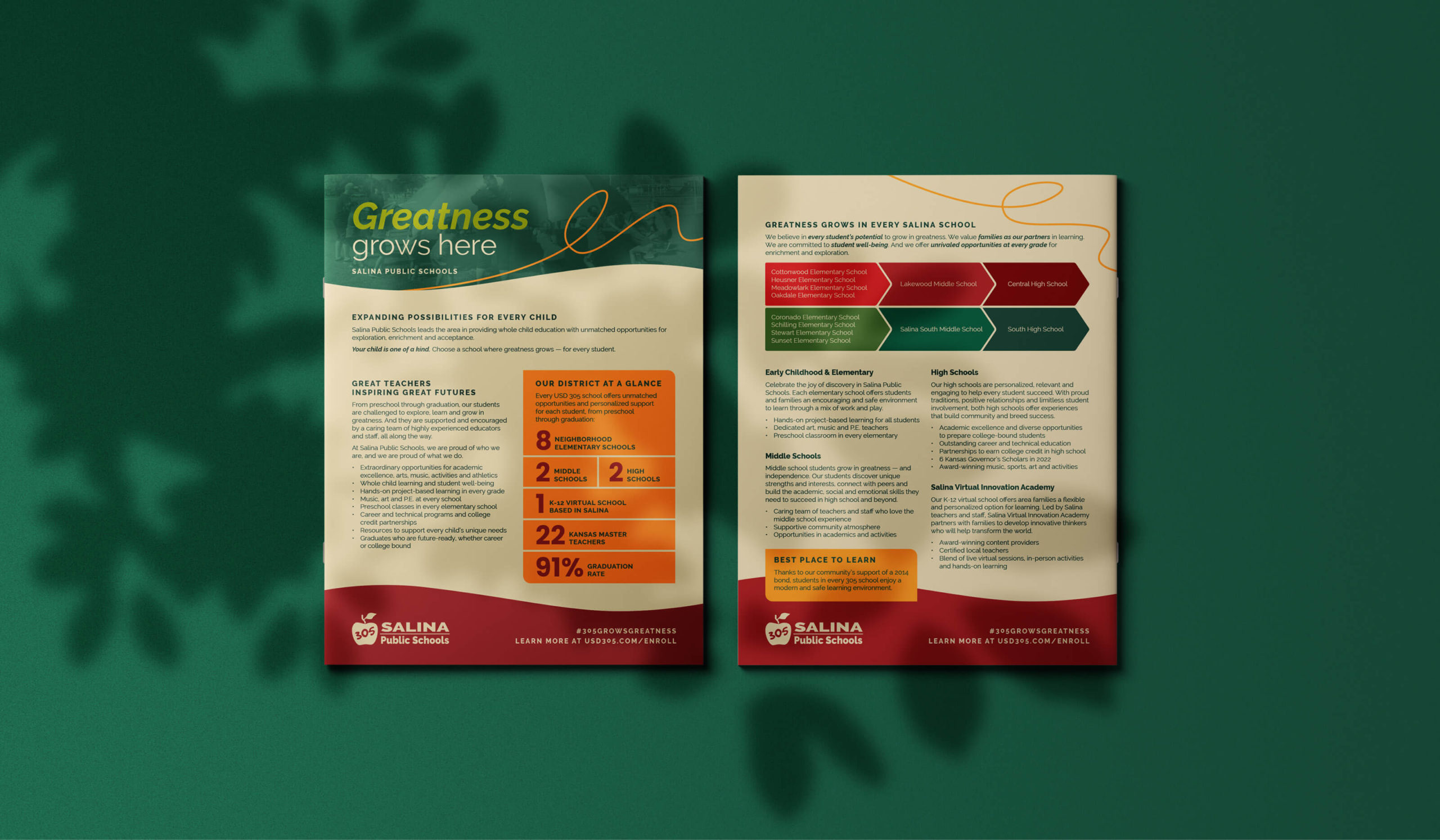
Salina Public Schools makes the pattern especially clear. Its campaign produced more than 418,000 Google impressions and over 3,000 clicks, but CEL also equipped principals to write postcards and call families who had not returned after 2020. Some people asked to be removed. Others re-enrolled. The district exceeded its goal. The modern marketing funnel, it turns out, may end with a principal picking up a telephone.
- Listen to competing constituencies
- Find the shared promise
- Build one usable system
- Give the client tools to run it
What does the invisible office cost?
CEL does not publish a menu of prices, and a crisis plan is not interchangeable with a website migration. Public-school records nevertheless offer two useful markers. In 2024, Orcutt Union School District in California authorized a CEL brand-refresh agreement not to exceed $30,000. The described scope included research, comparative analysis, stakeholder engagement, messaging, identity design, files and rollout advice. In 2025, Elkhart Community Schools approved a $5,400 addendum for three months of page creation, content updates, navigation changes and routine website maintenance.
Those figures are examples, not a rate card. Their more interesting lesson is about business model. CEL sells projects, continuing support and, when needed, borrowed capacity. The latter matters in school communications, where a one-person office can be asked to manage enrollment, emergencies, web publishing, board communications and a superintendent’s public voice before lunch.
The five moves worth stealing
- Map what each audience is trying to do before drawing the navigation.
- Invite stakeholders early enough that their input can still alter the work.
- Pair broad digital reach with a trusted person’s direct invitation.
- Design the handoff - templates, permissions and file naming are part of the brand.
- Measure actions such as inquiries, tours and enrollment, not just attention.
An interpreter in a market full of megaphones
A generalist agency can buy ads. A platform vendor can install a content-management system. An internal team knows the politics. CEL’s position between them is that of specialist interpreter: it brings enough school context to ask useful questions, then enough creative and technical range to turn the answers into an identity, campaign, website or response plan.
That position has limits. The method depends on leadership willing to hear inconvenient feedback, staff willing to use a shared system and an underlying school experience that can withstand attention. No palette can repair poor service. Personal outreach becomes intrusive when the audience has not consented. A stakeholder process becomes theater when the decision was made before the first meeting. CEL’s own best work points to the condition: communication works when operations and promises agree.
Leines says she worries about the day every project begins to look the same. It is a useful anxiety. School districts need consistency inside a system, but not sameness between systems. The invisible office succeeds when a family finds the right course, a teacher finds the right file, or a voter understands what a number means. Nobody applauds the information architecture. They simply get where they were trying to go.