A new chief executive has plenty of opportunities to speak. Cathy O’Callaghan made room to listen. In her first days at Ford Credit in February 2024, she went to see dealers and employees and joined customer calls. After more than three decades inside Ford, she was learning what the company sounded like from the other end of the line.
It is a useful opening scene for a career in finance. The balance sheet provides one view of a business. Someone trying to arrange a vehicle purchase provides another. The two belong in the same conversation, although large organizations have a remarkable talent for placing them in different meetings.
O’Callaghan had spent years helping Ford understand and explain itself. As controller and chief accounting officer, she led the reporting changes that accompanied the company’s division into Ford Blue, Ford Model e and Ford Pro. At Ford Credit, she inherited a different problem of explanation: making the business of financing a vehicle work for the person who wants to drive it.
A long career with several maps
She is a native of Wales, with a bachelor’s degree in economics from the University of Reading and membership in the Chartered Institute of Management Accountants. She joined Ford in 1990. That date is an unusually durable item on her résumé; the geography around it kept changing.
Her European assignments included finance director of Ford Switzerland and Ford of Britain, controller of European manufacturing operations and logistics, and finance director for product development. She later became chief financial officer of Ford South America. Switzerland, Germany, Brazil and the United States all became places where she lived and worked.
Each assignment dealt with money, but the underlying questions differed. Product development concerns choices made before a vehicle reaches a customer. Manufacturing and logistics concern the work of getting it built and delivered. A national finance operation brings another set of obligations. Moving between them offers a practical education in how an automaker’s decisions connect.
There is also a personal geography. She has spoken warmly about the places and people encountered along the way. A long tenure at one employer can look static on paper. Hers contains changes of country, business responsibility and perspective. The company name stayed put while much else moved.
- 1990Joins Ford
- 2018Corporate controller
- 2023New segment reporting
- 2024Ford Credit CEO
Making a large company legible
In February 2018, Ford announced that O’Callaghan would become vice president and corporate controller, and CFO of Global Markets, effective June 1. She was moving from South America into responsibilities spanning the company. In the controller role she would report to CFO Bob Shanks; as Global Markets CFO, to Jim Farley.
The double reporting line gives a sense of the job’s reach. Corporate accounting and operating finance meet in the same set of decisions, even when they approach them from different directions. Someone must make sure the enterprise can explain what it has done while helping its leaders decide what to do next.
By March 2023, O’Callaghan was helping explain a substantial change in that enterprise. Ford held an investor teach-in with her and CFO John Lawler to discuss financial reporting for its customer-focused segments. It supplied recast 2021 and 2022 financials, giving investors a way to look backward through the new organization before judging its future.
The distinctions mattered. Ford Blue covered gas-powered and hybrid vehicles. Model e covered electric vehicles and the digital platform and software serving Ford and Lincoln vehicles. Ford Pro addressed commercial customers’ vehicles and services. A single corporate total could conceal the very different work happening within those businesses.
During the question-and-answer session, analysts pressed on how transactions between segments worked. O’Callaghan explained the treatment of costs and fees, including what did and did not move between businesses for emissions-compliance purposes. It was accounting with consequences for how investors understood the strategy.
“What you see is what you get.”
Cathy O’Callaghan, financial-reporting teach-in, March 2023
The line came during that detailed discussion of segment transfers. It suits the larger task, too. A financial structure is useful when people can understand the distinctions it makes. Otherwise, the spreadsheet has merely acquired more tabs, which is an achievement most offices can manage without a corporate reorganization.
The new job began on the phone
Ford announced her next move in December 2023. She would succeed Marion Harris at Ford Credit on February 12, 2024; Mark Kosman would succeed her as chief accounting officer. The timing followed Ford’s reporting of its fourth-quarter and full-year 2023 results, allowing one set of responsibilities to close before the next began.
She inherited an existing modernization effort. Under Harris, Ford Credit had been digitizing and personalizing its offerings. O’Callaghan’s appointment put an executive with broad knowledge of the automaker in charge of a business whose daily work connects customers, dealers and Ford.
Her listening tour made that connection tangible. A customer call brings the process down to the scale of one person and one question. A dealer conversation brings another view: the point where a vehicle, a buyer and a financing decision have to come together. The exercise gives an executive something an organization chart cannot supply.
For her, the attraction included learning a different part of Ford after years in automotive finance leadership. That willingness to be a beginner again is a telling professional choice. Seniority gives someone permission to have an answer. It also gives them the freedom to ask a better question.
When the dealer becomes a teacher
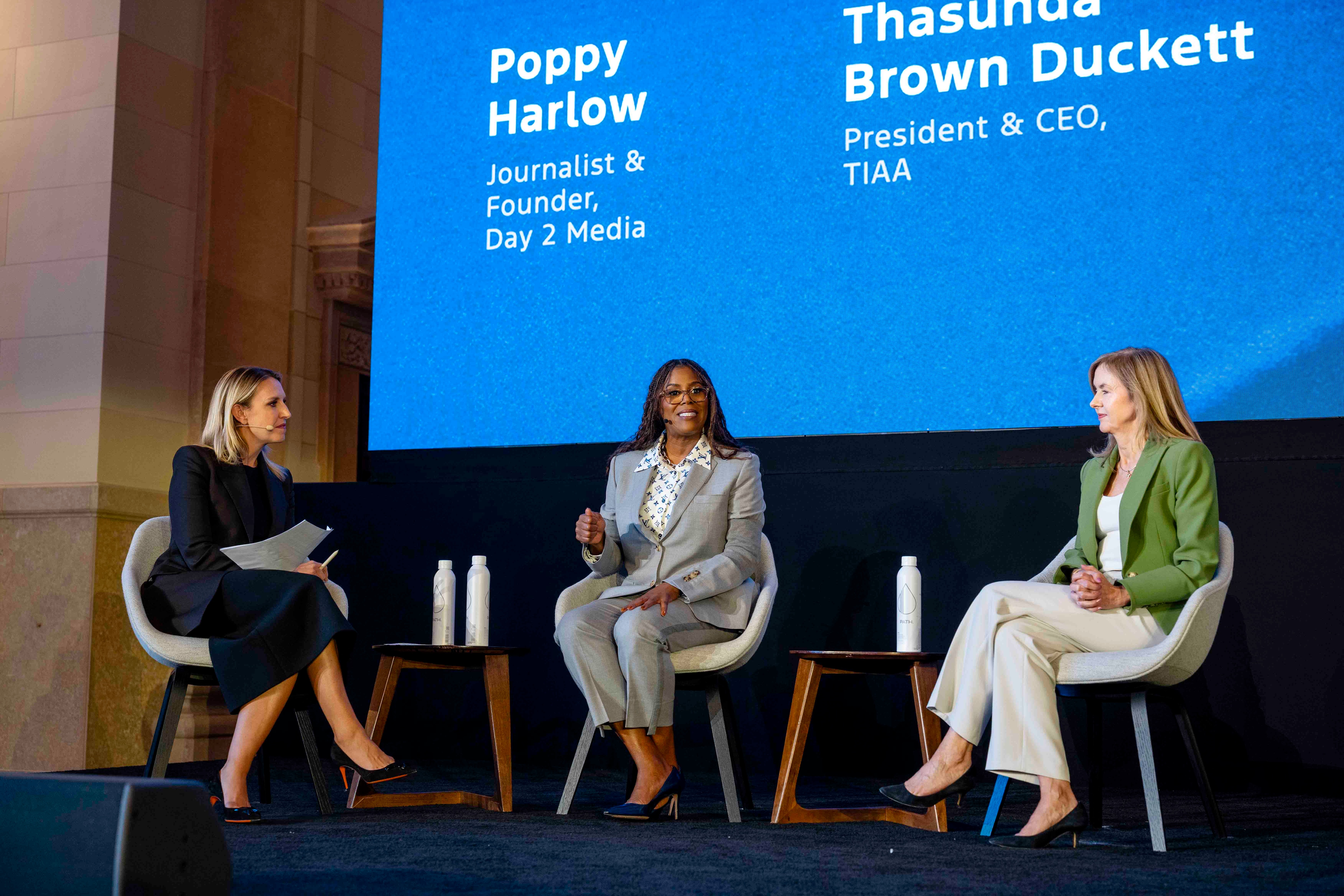
At Ford Pro Accelerate in Detroit on September 30, 2025, O’Callaghan shared a discussion with TIAA president and CEO Thasunda Brown Duckett, moderated by journalist Poppy Harlow. The subject was financial opportunity for essential workers and the businesses employing them.
O’Callaghan drew attention to an awkward gap. People can be accomplished at their trade without having the financial education needed to expand a company. Knowing how to do the work and knowing how to present the business to a lender are separate skills. Success at the first does not automatically supply the second.
Her suggestions were practical: connect owners with trade organizations, help them understand business plans and point them toward resources already available. The work begins before the credit decision. A lender cannot assess records that an owner has never learned to prepare.
She also described a role for dealers as coaches. Experienced dealer principals have navigated their own growing pains. They can help smaller businesses understand financial records, available credit and the decisions that accompany employing people. A commercial relationship can carry knowledge as well as a vehicle.
That argument extends her own career’s concern with making information usable. Inside Ford, the audience had included analysts examining segments. Here it included owners learning to describe their businesses. In each case, better understanding can improve the quality of the next decision. The scale changes; the need for clarity survives.
A bank still has to be built
On January 22, 2026, another development widened her assignment. The FDIC approved Ford’s deposit-insurance application for a proposed Utah-chartered industrial bank, subject to conditions and written agreements. O’Callaghan announced the conditional federal and Utah approvals for the planned Salt Lake City operation.
The proposed model connects savings with automotive finance. The bank would obtain funding primarily through retail savings accounts and time deposits on its website and mobile application. It would provide automotive financing nationwide, principally by purchasing retail installment sales contracts originated by independent Ford dealers.
Approval brought requirements. The bank must maintain a minimum 15 percent tier 1 leverage ratio, while Ford must support its capital and liquidity. The FDIC’s order would expire if the bank was not established within twelve months, unless extended. The milestone came with a calendar and obligations.
O’Callaghan described roughly a year of work to assemble people, systems and processes before taking deposits. Ford Credit already operated two European banks whose experience could help. She credited the application team led by bank president Frank Stepan and described a gradual expansion of products over time.
Her stated aim was to add savings choices, broaden financing offerings and, over time, help lower funding costs. Those were ambitions for the initiative, rather than results already delivered. The distinction matters. Banking rewards preparation long before a customer sees the finished service.
Leaving room for the customer’s moment
The public executive role also includes the ordinary work of bringing people together. At a December 2024 town hall with Jim Farley, Ford Credit paired discussion of business plans with a clothing drive for Detroit’s Pope Francis Center. The meeting made room for the community beyond the company.
A more recent customer story offers a smaller illustration of what O’Callaghan wants the financing experience to feel like. Sharing a parent’s account of buying a Bronco Sport as a surprise for her daughter, she praised financing that works quietly in the background. The memorable part belonged to the family.
That is a demanding aspiration for someone whose working life has involved so much complexity. Reporting structures, credit decisions and banking systems all require attention. Customers have other things to think about. O’Callaghan’s task is to organize the first list well enough to leave them room for the second.
Her career began with an economics degree and became an education across markets. It now reaches from a dealer’s conversation to the preparations for a bank. The thread running through it is the distance between understanding a system and making it useful. At the end of that distance, someone is waiting for the keys.