An old railroad depot is a sensible place to think about connections. In 2015, the O’Neil Group Company bought a three-building property around the Santa Fe depot in eastern downtown Colorado Springs. The cargo would be different this time: ideas, technical problems, and introductions between people who rarely share an office. Catalyst Campus grew from that proposition. A small company might have a useful invention. Somewhere in government, someone might have precisely the problem it solves. Getting the two into the same conversation is a business in itself.
- Mission-focused programs help small firms understand military customers.
- The accelerator takes no equity; access still requires work.
- A new investment boot camp addresses what happens after customer discovery.
01 / A better address for an introduction
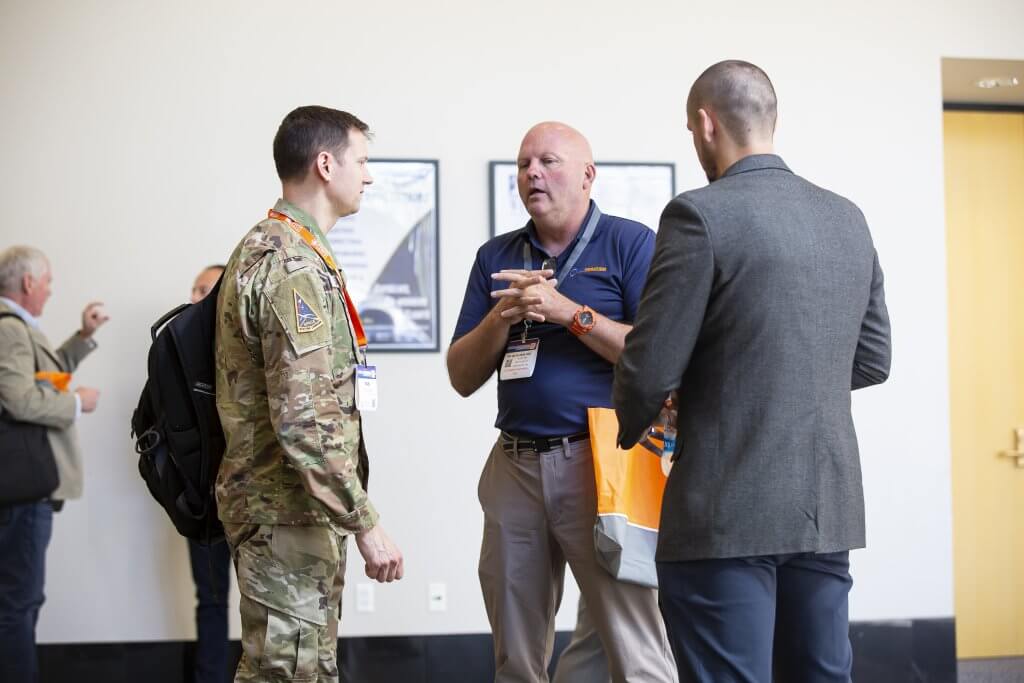
Catalyst Campus describes itself as a nonprofit collaboration hub. Its practical offering combines office and meeting space, startup programs, and services that bring government, industry, academia, and investors together. That mixture matters. An office lease gives a company somewhere to sit. A useful ecosystem gives it someone worth getting up to speak to.
The campus occupies a particular position in the market: between unfamiliar suppliers and organizations with demanding missions. Its users include small technology businesses, military program stakeholders, established companies, and researchers. The attraction is concentrated aerospace and defense context. A founder can work on understanding a requirement, meet an experienced adviser, or present a solution to an audience that knows what operational use would entail.
02 / Give the cohort an actual problem
The Catalyst Accelerator’s main format is a three-month, partly residential program. Typically, six to eight companies gather around a defined defense or space challenge. They receive business development guidance, technical feedback, and contact with government users and industry specialists. A demonstration day brings their work before government, commercial, and investor audiences. The sequence makes the introduction more useful: participants have time to learn what they should be asking.
Consider the spring 2026 AI/ML Orchestrator cohort. Its problem sponsor was Space Delta 7. The assignment concerned the intelligence workflow from tasking and collection through processing, analysis, and dissemination. The published problem statement described a largely manual production line with pockets of automation. That is a much sharper brief than “do something with AI.” It identifies a workflow, a user organization, and an operational bottleneck.
The campus also lists software and data programs in its ecosystem. Platform One provides defense software-development services; Orbital Labs works on Space Force mission applications. Bluestaq developed the Unified Data Library on campus. These distinctions deserve care: Catalyst supplies a setting and relationships, while those organizations supply their own technologies. An interesting neighborhood does not acquire the copyright to everything made there.
“The access to both commercial expertise and government customers is key to our success.”KiMar Gartman · Former accelerator program director
03 / The trouble with the old survival kit
One campus case study concerns a B-52 ejection survival kit whose aging equipment no longer had vendor support. CyberWorx brought together military stakeholders, cadets, faculty, and an outside expert recruited from the United Kingdom. Over three days, they defined requirements and tested a preliminary redesigned kit. Catalyst reports that the program office said the effort removed two to three years from its normal development cycle.
That is an attributed account, rather than an independently measured guarantee. Its useful lesson is smaller and more portable: recruit people for the problem in front of you. A room full of impressive résumés can still be missing the person who knows why a survival kit gets damaged during ejection. The purpose of collaboration is to expose that missing knowledge before a project spends years protecting an assumption.
04 / Keep the cap table. Bring your calendar.
The accelerator says its programs are equity-free. Government support and sponsorship help sustain the work; the campus also offers innovation services and physical space. The arrangement differs from an investment accelerator whose central transaction exchanges capital for ownership. Here, the immediate offering is preparation and access. Participation still consumes staff time, and an introduction cannot make a procurement decision for the customer.
There is evidence of substantial activity. The accelerator website currently reports 181 companies served and 472 contracts won, alongside $387 million in contract follow-on funding and $331 million in investment follow-on funding. These are program-reported outcomes, viewed in October 2026. They describe participating companies’ progress. They are not Catalyst Campus revenue, and they do not establish how much progress would have occurred without the programs.
Accelerator-reported cumulative figures · viewed October 8, 2026
05 / The next obstacle has a balance sheet
After eight years focused on business development and government customer discovery, Catalyst designed an Investment Readiness Boot Camp. Scheduled for October 12-23, 2026, it targets space technology businesses before Series A, with no more than $5 million already invested. Its subjects include financial planning, scaling, and pitching. The program explicitly shifts attention away from government customer discovery.
The practical terms are revealing: one hotel room per company for eleven nights, with other travel costs borne by the business. Meeting investors and preparing to raise money remain different from receiving money. The new format acknowledges that distinction. Finding a plausible buyer can advance a startup to another difficulty: financing enough capacity to deliver.
06 / Copy the question before the campus
A founder can use Catalyst to explore a relevant cohort, ask about office space, or attend an industry event. The September 2026 SBIR/STTR workshop covered proposals, data rights, intellectual property, and compliance: subjects less glamorous than a satellite, but consequential to anyone trying to sell technology to government.
The transferable method is to start with a concrete user problem and put people who understand its different parts together. It depends on a real mission fit and a business willing to learn. A consumer company seeking broad retail distribution would need a different network. Even for defense firms, the campus can organize conversations and preparation; customers and investors retain their own decisions. The depot’s modern usefulness lies in making the journey easier to begin.