Careerflow did not begin with a grand theory about artificial intelligence. It began with a woman looking for work in the wrong year. Nikita Gupta moved from Singapore to the United States in 2020, when the pandemic had scrambled hiring, and ran into a wall of rejection. In interviews she has put the count at roughly 300. The experience supplied a less glamorous but more valuable insight: job hunting is not one task. It is an untidy pile of documents, keywords, browser tabs, recruiter messages, deadlines and small humiliations.
Gupta and Puneet Kohli started helping people with resumes and LinkedIn profiles by hand. Kohli brought an engineer’s eye from roles including computer vision work at Apple; Gupta brought the candidate’s frustration and experience in recruiting, analytics and audience building. The manual service worked well enough to expose its own failure. As Gupta later explained, they could not help 10,000 people in a day that way. The advice was useful; the delivery system was the bottleneck.
That constraint changed their minds about the product. They built tools, beginning with a LinkedIn extension and a job tracker, then adding the AI Resume Builder, ATS scoring, cover letters, networking contacts and mock interviews. The company that LinkedIn dates to 2022 grew out of the earlier FAANGPath brand, but the rebrand matters less than the conceptual move: from coaching sessions to repeatable workflow.
“Finding a job is a job in itself.”Nikita Gupta, co-founder and COO
The product hiding under the AI
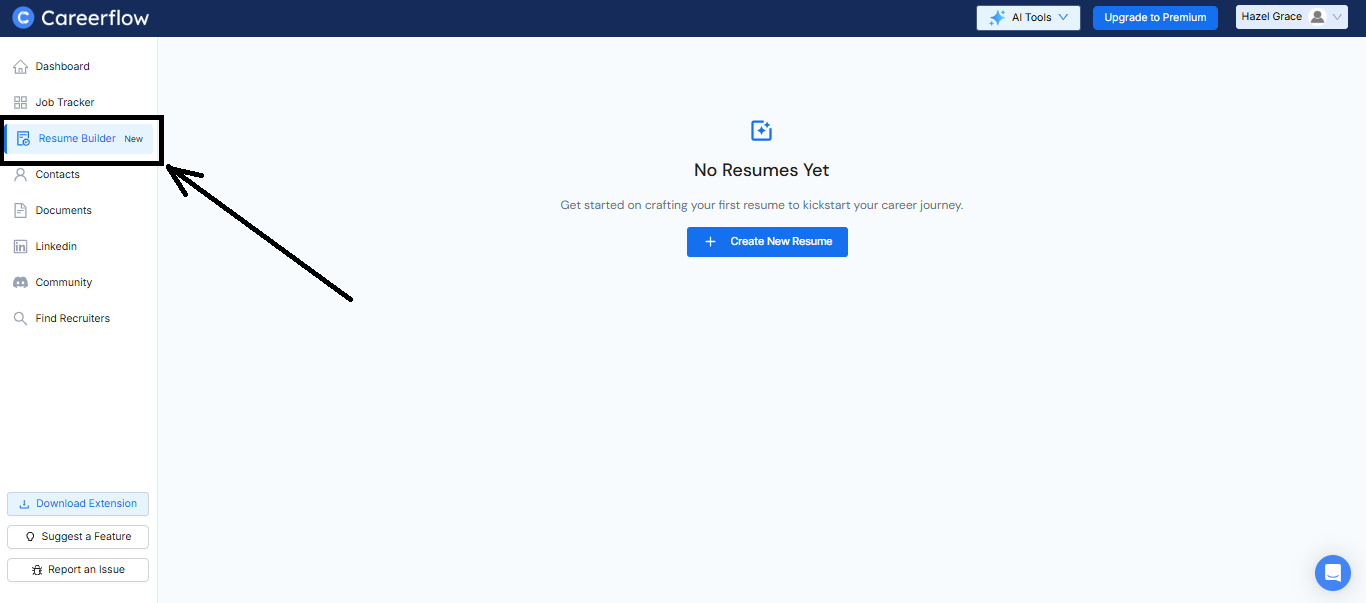
The obvious Careerflow product is an AI resume builder. It imports a LinkedIn profile or an existing document, rewrites bullets, checks keywords and compares a resume against a job description. That puts it in a busy neighborhood with Jobscan, Rezi, Teal, Kickresume and every general-purpose chatbot willing to polish a sentence.
The less obvious product is a miniature customer-relationship manager for a single customer: the candidate. A job lead becomes a card. The card moves from saved to applied to interview to offer. Notes, tasks, contacts and follow-up reminders live beside it. A browser extension can capture a posting from LinkedIn, Indeed, Glassdoor or a company careers page. The resume can then be tailored against that job rather than floating in a separate folder called “final_final_3.”
The candidate pipeline
That connectedness is Careerflow’s differentiator. A specialist may be better at one step, but the bundle reduces switching. It also gives the AI context: the job description informs the resume, the resume informs interview practice, and the tracker remembers the process. Careerflow’s newer U.S. Job Portal extends the chain backward. Launched in 2026 with more than two million aggregated listings, it lets users discover and save roles in Careerflow, although the final application still happens on the original site.
A business built for urgency
Careerflow has two customers and two clocks. The individual job seeker may need intense help for six weeks and nothing for the next two years. The organization - a university, workforce program, bootcamp, career coach or outplacement provider - needs infrastructure every semester or cohort.
For individuals, the company runs a freemium SaaS model. Its public pricing has offered a basic plan at no charge, Premium from $8.99 a week or $23.99 a month, and a higher Premium Plus tier with mock-interview features. Annual pricing has been listed around $172.92 for Premium. Plans and promotions change, but the shape is deliberate: a candidate can buy a short burst during an active search instead of pretending career software is a lifelong daily habit. Optional human services, such as expert resume reviews advertised from $79, sit above the software.
B2C / the candidate
Free tracking and limited tools create the habit. Paid plans unlock heavier AI use, advanced optimization and interview practice when urgency spikes.
B2B2C / the institution
Universities and workforce groups buy administration, coaching, reporting, branding, SSO, integrations and APIs for many job seekers at once.
The institutional platform is the more durable side of the business. Careerflow advertises student and coach management, organization-specific guardrails, resource hubs, placement reporting, single sign-on and integrations with systems such as Salesforce and Okta. Its API documentation describes 71 tools available through an MCP server, covering student records, resumes, job tracking, AI tasks and reporting. The same consumer workflow becomes career-services infrastructure.
That 2025 GSV Cup profile also reported a $12 million post-money valuation and named Techstars, Ganas Ventures, Oasis Capital, the Greylock Ventures Scout Program, Rise Ventures, angels and family offices among the backers. It described 700,000-plus people served at the time. Careerflow’s current site now uses the larger one-million-plus figure. These are company-reported measures, useful as markers of direction rather than audited operating results.
Distribution wears a human face
Careerflow’s expertise is not simply generating text. It is packaging recruiting customs - ATS formatting, keyword matching, LinkedIn discoverability, outreach etiquette and interview structure - for anxious non-experts. Gupta’s creator presence is central to that packaging. Careerflow’s LinkedIn company page had roughly 192,000 followers in August 2026, while Gupta’s own audience was larger still. Posts about hidden job searches, resume mistakes and recruiter behavior are both instruction and distribution.
This matters because AI career software has a trust problem. A candidate cannot easily tell whether an “82 percent match” reflects real hiring behavior or merely a scoring rubric. A recognizable founder explaining why a bullet point is weak gives the software a human translator. The company’s culture, at least in public, follows the same pattern: a distributed crew of engineers, marketers and writers, presenting itself as a small team with one mission - help people get hired.
In market terms, Careerflow sits between three categories that used to be separate. Resume software sold formatting. Career coaching sold judgment. Applicant trackers sold organization, usually to employers rather than candidates. Careerflow borrows a little from each and points the machinery toward the worker. That makes the suite especially legible for students, early-career professionals, career changers and people running a high-volume search. They have enough applications to create administrative pain, but they may not have an executive coach or a recruiter guiding every move.
The breadth also explains the competitive trade. Jobscan can own the resume-to-description comparison; Rezi can concentrate on document creation; Teal and Huntr can emphasize tracking. A user who loves one specialist may accept the extra tabs. Careerflow is for the person who values continuity more: one profile, one collection of target roles and fewer chances to forget which version of the resume went where. Its claim is not that every feature wins in isolation. The claim is that the handoffs matter.
What to steal - and what not to believe
The copyable lesson is a sequence, not a feature. First, perform the service manually. That reveals the vocabulary customers use and the steps they repeat. Second, productize the bottleneck, not the most glamorous part. Careerflow’s tracker is mundane, but it gives people a reason to return. Third, make that system of record useful for free. Fourth, charge for high-volume creation and analysis when the customer’s urgency rises. Finally, sell the same workflow to institutions that already aggregate the audience.
The Careerflow playbook
- Start with a painful service and do enough of it to see the repeated work.
- Build the free organizing layer before the clever generation layer.
- Connect outputs so each tool makes the next tool more useful.
- Price for bursts of urgency, then add contracts for recurring institutional demand.
There are conditions where this will not work. AI polish cannot rescue weak experience, a nonexistent skill match or an indiscriminate application strategy. ATS scores are directional, not admissions tickets. Generated language can flatten a candidate into the same agreeable corporate voice as everyone else. Job seekers who need deep human coaching, visa strategy, executive positioning or local market knowledge may find a broad toolkit too generic. And a bundle loses its advantage if specialized competitors become meaningfully better at the only step a user cares about.
There is also a structural irony: successful consumer career software removes its own customer. Once someone is hired, the weekly subscription should stop. Careerflow’s institutional product, content audience and broader career-management ambition are answers to that churn, but they do not erase it.
Still, Careerflow has put its finger on the right annoyance. Candidates have been offered endless tools that produce another document. What they lack is a place that remembers the search. The company’s bet is that an application is not a file but a moving relationship among a person, a role, a company and a deadline. The AI can write. The operating system has to remember.