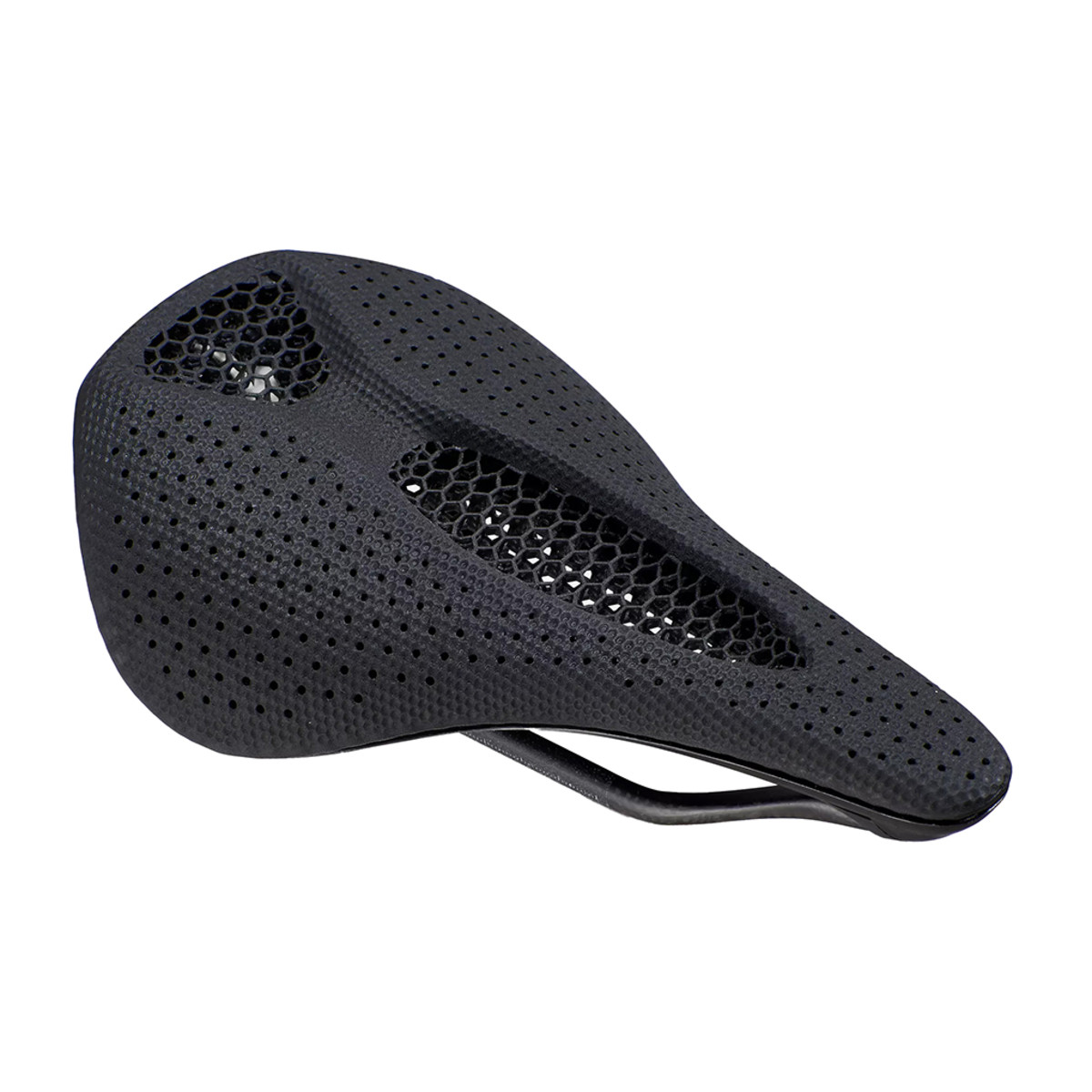
A bicycle saddle is a peculiar place to look for a manufacturing revolution. It is small, familiar and judged by a part of the anatomy that offers unusually frank feedback. Yet the black mesh on Specialized’s Mirror saddles makes a useful introduction to Carbon. The cushioning is a lattice. Its empty spaces are as deliberate as its solid struts. Change the structure, and you can change how it responds to a rider.
Now put that saddle beside an adidas midsole and a dental appliance. The resemblance disappears. The manufacturing logic remains: turn a digital design into a functional polymer part, with enough control to make the next one useful too. Carbon sells the printers, chemistry and software that make this possible. The consumer usually encounters the result wearing somebody else’s name.
- Carbon prints finished polymer parts, as well as prototypes.
- Lattice geometry lets designers tune cushioning and support within a part.
- Subscriptions bundle machines with updates, service and support.
- The buying decision depends on the finished part’s economics, including washing, curing and inspection.
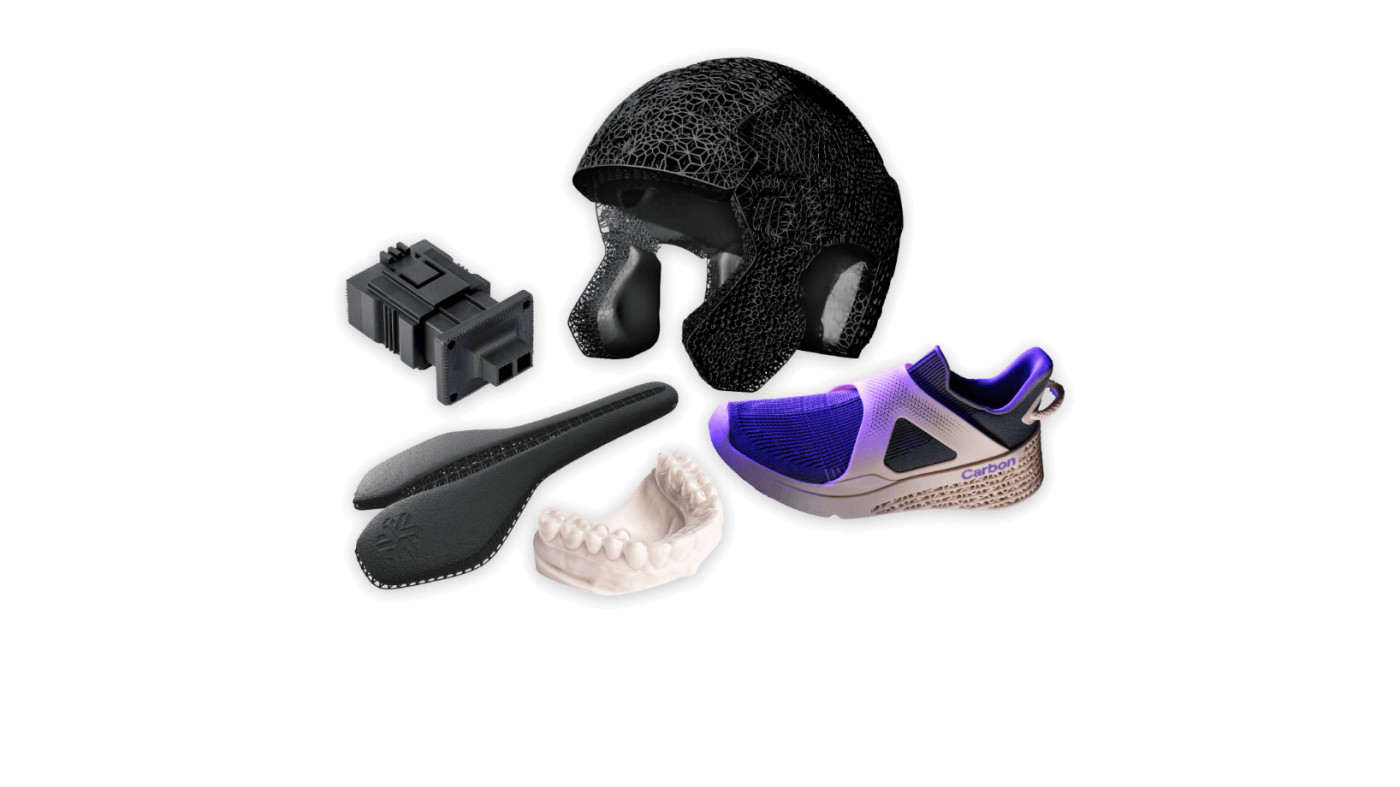
The useful thing about a hole
adidas had a specific difficulty. It wanted a midsole with properties that varied across the part. Conventional molding could not produce that variation in one piece in the way the designers wanted. Assembling multiple pieces was possible, but brought labor and additional potential failure points. Carbon’s case study describes the resulting turn toward directly printed midsoles.
A lattice gives a designer another set of controls. Cell shape, cell size and strut thickness can change the mechanical response. A cushioning zone can behave differently from its neighbor without requiring a seam between two separately manufactured foams. The drawing begins to contain some of the work traditionally assigned to the material.
That is the interesting distinction in Carbon’s consumer products. Printing earns its place by enabling a different structure. The case for it is weaker when the brief merely asks for an ordinary shape through an extraordinary machine. There is something rather expensive about using design freedom to reproduce a constraint.
Oxygen, ordinarily the nuisance, gets a promotion
Carbon’s public arrival came in 2015, when co-founder Joseph DeSimone demonstrated its process at TED. The talk borrowed an image from Terminator 2: a solid object emerging from liquid. Hollywood supplied an excellent visual metaphor. The real machine used polymer resin rather than cinematic liquid metal.
The underlying process is called Continuous Liquid Interface Production, or CLIP. Light projected through an oxygen-permeable window cures resin above it. Oxygen inhibits curing immediately next to the window, preserving a thin liquid interface that Carbon calls the dead zone. The part can rise while fresh resin flows underneath.
Digital Light Synthesis, or DLS, combines that printing process with Carbon’s materials. With dual-cure resins, light establishes the shape and a subsequent thermal reaction develops the final properties. The expertise spans optics, chemistry, mechanical engineering and software. A printer is the visible member of a much larger committee.
- 01DesignTune the geometry
- 02PrintLight + oxygen
- 03WashRemove residual resin
- 04CureFollow material protocol
- 05InspectCheck the finished part
Printing is one stage. The validated material workflow determines what follows.
The printer stops. The work continues.
Carbon’s operating documentation describes a sequence that includes preparation, resin handling, printing, washing and curing. Some parts need thermal treatment; others follow different validated protocols. Its Smart Part Washer brings controlled wash cycles into that workflow. This is manufacturing equipment for an operating environment, with solvents, accessories and procedures to match.
Carbon has also described its own production difficulties. Viscous dual-cure resins can be vulnerable during printing. Washing and thermal curing can contribute to shrinkage and warpage. Small variations between printers, resin batches and processing conditions complicate repeatability.
In 2020, the company began a more concerted effort to improve general print success beyond its established production campaigns. By March 2023, it reported 45 software upgrades since the M1 launch. Temperature control, light-wavelength compensation and automatic orientation were among the fixes. Its chosen measure, “Print Success,” meant meeting the customer’s final requirements. This was a shift in emphasis from recognizable output to acceptable output.
“Building together makes us better.”
Carbon’s stated collaboration value
The culture page gives that collaboration a mundane, credible setting: weekly CarbonTalks, project presentations, new colleague introductions and guest speakers. It also mentions employee fitness groups and dogs in the workplace. The more consequential collaboration happens across specialties. Materials scientists and software engineers have to agree on what a successful part looks like.
The original bill was $130,000
Carbon’s November 2016 M1 price sheet provides a useful historical reality check. The annual subscription was $40,000, with a three-year minimum. Installation and training added $10,000. That implies $130,000 in scheduled subscription and installation charges before ongoing resin, labor, additional equipment and other production expenses.
Historical arithmetic, not a current quote. Ongoing production costs are additional.
The subscription included software updates, service, replacement or upgraded parts and support. Carbon chose to keep a continuing relationship with the operator. That creates an obligation to keep earning the renewal, and gives the buyer access to improvements without treating every software advance as another equipment purchase.
Today, Carbon asks buyers to request region-specific quotes. Its M2 ReFLEX offering adds pay-as-you-print pricing for smaller dental labs. The sensible comparison is the cost of a qualified finished part at the expected utilization, with all downstream work included. A monthly invoice says little by itself.
Teeth make a less theatrical customer
The hardware range includes M2, M3, M3 Max and the larger L1. Design Engine helps create lattices; the 2022 acquisition of ParaMatters expanded topology optimization capabilities. Alongside machines and software sit rigid, elastomeric and dental materials. The product is a set of choices that must work together for a particular application.
Dental laboratories offer a different rhythm from a footwear launch. Models, splints and dentures arrive as recurring production tasks, often with patient-specific geometry. Carbon’s own dental buying guide warns that model-only workflows generally need higher volumes to justify a printer investment than workflows producing end-use appliances. Even the supplier’s advice returns to the mix of work.
Automotive applications are equally particular. Ford has used Carbon for Focus HVAC service parts, Raptor auxiliary plugs and Mustang GT500 electric parking-brake brackets. These examples place the technology among service inventory, niche production and functional components. Nobody needs to argue that every part of a car should emerge from a resin vat.
A million saddles need somewhere to sit
In May 2026, Carbon said its technology had enabled nearly one million printed bicycle saddles. Its partnership with DDK brought saddle printing and final assembly together in Asia. The next capacity question concerned the surrounding supply chain: how to get a printed cushion into a complete product, in a useful geography, at greater scale.
The financial story has a similar change of emphasis. A June 2019 financing brought more than $260 million and a reported valuation around $2.4 billion. In November 2025, Carbon announced another $60 million from investors including Sequoia, Silver Lake and adidas. The company said it was approaching cash-flow-positive operations. An ambition, rather than an announcement that the milestone had been reached.
Subsequent announcements included DB 4000 denture base resin in August 2026 and an EPO appeal outcome for a foundational dual-cure patent in September. Chemistry, industrial capacity and application economics remain the threads. The launch demonstration was memorable; the later work gives customers reasons to stay.

Borrow the question before buying the machine
For a product team, the transferable habit is to name the constraint first. Is the problem a cushion that needs different responses in different zones? A service part whose old tooling is uneconomic? A patient-specific appliance? Those are reasons to investigate the process. “We would like something printed” is a considerably poorer brief.
Carbon’s Production Network offers a practical route: work with a manufacturing partner before installing equipment. Specify the finished part’s requirements, make samples, test them and request a quote that includes post-processing. Qualification belongs at the beginning of the conversation, when changes are still comparatively cheap.
Alternatives deserve that same brief. Formlabs offers professional resin systems; Stratasys Origin Two targets industrial polymer production. Conventional molding can also be the appropriate route. Carbon makes sense when its materials, geometry and workflow solve enough of the actual problem to pay for the commitment. A part requiring metal, an unvalidated medical workflow or an incompatible resin cannot be rescued by a handsome lattice.
Look again at the saddle. The elegant part is the mesh. The valuable part is that someone can design it, produce it, finish it and make another that meets the same requirements. Carbon’s wager is that customers will keep paying for that last sentence.
Explore Carbon’s working world
Company website · Design software · News and product updates · The print-success account
Watch Joseph DeSimone’s TED demonstration · Carbon videos and demos · OECHSLER production webinar