A calendar link is a tidy answer to a narrow question: when are you free? Peer Richelsen had a messier question. His hiring marketplace needed to let its users book one another, and the usual per-seat scheduling model looked odd when thousands of people were involved. The marketplace also needed to know whether meetings happened, moved or vanished. A copied booking link could not tell it much. Richelsen searched for “Calendly open source.” The empty space he found became Calendso, later Cal.com, which he founded with Bailey Pumfleet in 2021.
- The jobTurn availability into a booking flow a business can control.
- The moneyFree individual scheduling; paid team, organization and platform features.
- The turnIn 2026, hosted production code went private; Cal.diy stayed public.
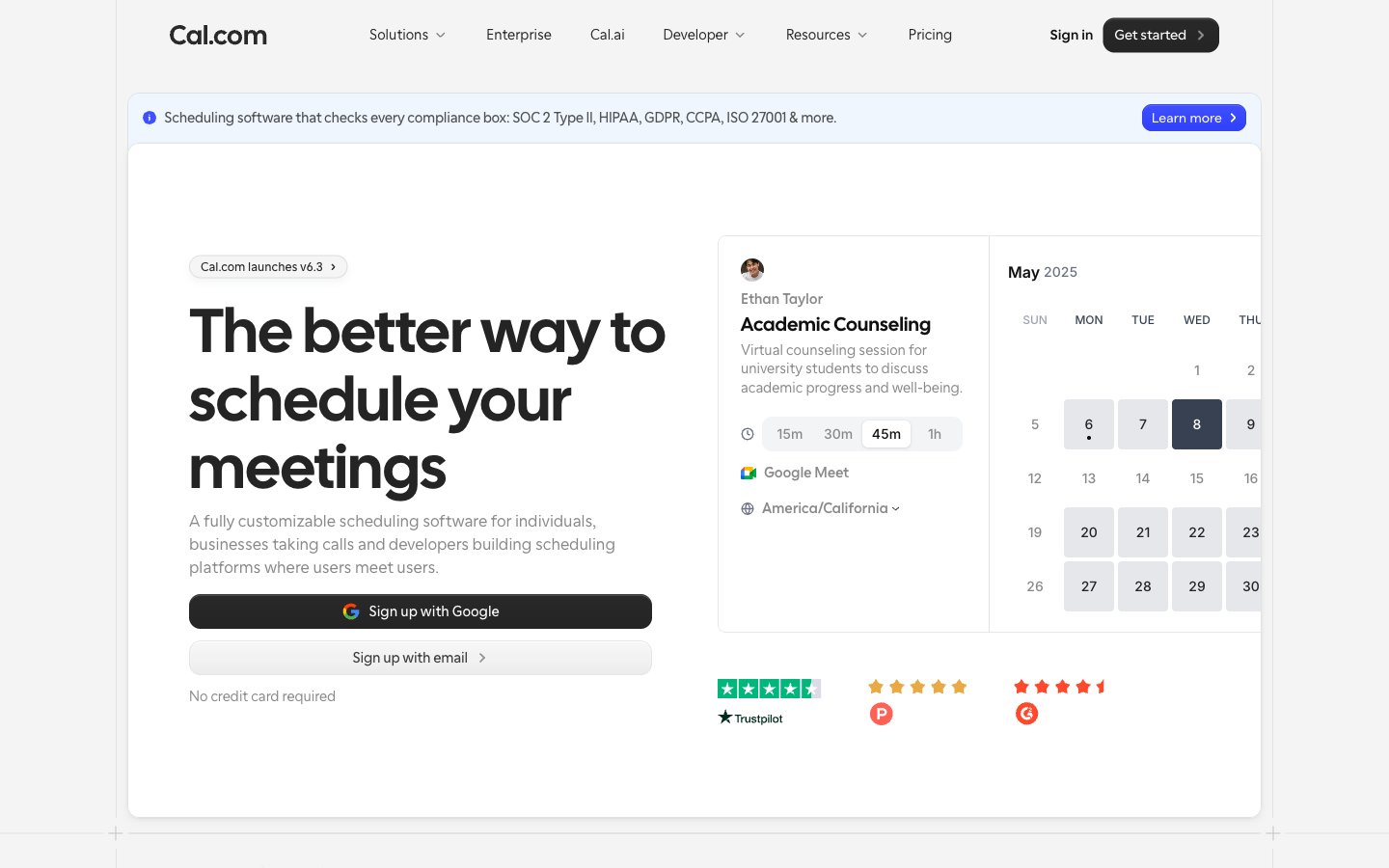
That origin matters because it explains why Cal.com can look like a familiar meeting-link app until you ask it to do something difficult. An individual can publish a page, sync multiple calendars, set a meeting length, take a payment and add a video link. A sales team can route a prospect to the right person, distribute calls by round robin, use CRM ownership, and trigger reminders. A developer can put booking inside a marketplace, telehealth product or service portal through APIs and embeds. It is the same clock, viewed from three very different desks.

The link was never the whole product
Richelsen has described a marketplace with more than 5,000 users. Paying a conventional scheduling subscription for every participant would have made little sense; handing each person an external link made the booking process opaque. If a candidate rescheduled an interview, the hiring product needed to know. If a host became unavailable, it needed a replacement. The distinction is the difference between attaching a calendar to software and making scheduling part of the software itself.
Cal.com first took the obvious route to attention: publish the code and invite people to use, host and extend it. The company rebranded from Calendso in 2021, acquiring a three-letter domain whose virtue it advertised with a wonderfully petty calculation: cal.com/peer required 62.5% less typing than calendso.com/peer. The name was short; the ambition was not. A $7.4 million seed round was announced that December. A $25 million Series A, led by Seven Seven Six, followed in April 2022, alongside an app store and API. Daily.co also backed the round and partnered on Cal Video.
A million users, the number Cal.com now puts on its customer page, are not a million identical customers. A consultant who wants fewer emails and a bank that needs a routed, audited intake flow share an interest in available time, but little else. This is why Cal.com sells both a free individual plan and more expensive team and organization subscriptions, plus custom enterprise arrangements. In September 2026 its published annual-billing prices list Teams at $12 per user per month and Organizations at $28. A platform customer may also buy the ability to make Cal.com disappear behind its own product.
Where a booking becomes a business process
Take a prospective client arriving at a service site. Before a time slot appears, a form may decide which specialist is eligible. The system checks calendars and time zones, reserves a slot, sends an invitation, creates a video room, accepts payment if needed, and starts a reminder sequence. Afterward, it may write to a CRM or report a cancellation. Each handoff is a chance to lose the customer or make two people appear available for the same minute.
A typical managed flow combines routing, calendar sync, a booking page and workflows; each piece can also be used on its own.
The customers show where this distinction has value. Deel wanted one adjustable system for support, operations and sales rather than separate scheduling tools. In a Cal.com case study, Deel says more than 1,000 employees use it and estimates that each saves six hours a week - more than 6,000 hours in total. That is a customer-reported estimate, and it will not transfer automatically to another company. The reusable idea is simpler: measure the coordination work around a meeting, not just the minutes spent choosing a slot.
Pangea.app, a fractional hiring marketplace, says it used Cal.com inside its own product rather than building a booking engine. It reports interview conversion rising from 20% to 85% and revenue increasing 70% after the integration. Those figures are Pangea’s account of its experience, not a controlled experiment. Still, they describe the stakes of making an interview easy to arrange when a small team serves a large marketplace.
The cost of making time look effortless
Cal.com’s January 2026 incident offered a sharp view of the machinery. A new booking search inside its command menu caused a heavy API call on every page load. Database load climbed. Large enterprise event types timed out. The team first tightened a rate limit and rewrote a query, then found the feature interaction and reverted it. Calendar retries later exhausted a Google API quota for some users. By the company’s account, the service stabilized after it removed the coupling, optimized queries and added protections.
A small convenience can make a very large number of expensive requests.Lesson from Cal.com’s January 2026 incident review
The postmortem is unusually useful because it identifies what failed first: not an exotic attack or a flood of customers, but a normal feature issuing costly work too often. The calendar is a polite interface over a system of databases, external APIs, time zones and people who do not enjoy being double-booked. Reliability becomes part of the product the moment scheduling moves into a company’s critical path.
The open door and the locked room
Then came the reversal. In April 2026, Cal.com made its hosted production code private. Pumfleet argued that AI-assisted vulnerability discovery had changed the security risk of exposing the production codebase. That is the company’s reasoning, and security researchers may debate the wider claim. The concrete change is easier to inspect: a separate public project, Cal.diy, remains self-hostable under the MIT license, with the core booking engine, app store framework and API v2. The managed product keeps commercial features including organizations, teams, routing forms, workflows, analytics and enterprise controls.
Team administration, advanced routing, workflows, compliance controls and support live in the paid hosted business.
The self-hostable core retains booking, the app framework and API v2 under an MIT license.
It is a revealing line to draw. The open project gives a developer a scheduling foundation. The hosted product sells the coordination that becomes harder as an organization grows. A solo user may never need the distinction. A marketplace or hospital might have to ask whether it wants to run the machinery itself and which features belong to the paid layer.
Cal.com still publishes an open handbook and describes a remote team with location-independent pay for the same role. Its mission remains connecting a billion people by 2031. But the company is no longer selling quite the same idea it was in 2021. The first wager was that booking software should be open and adaptable. The current wager is that the most valuable scheduling work is operational: fitting a meeting to a business rule, proving it happened, and making the next one easier. The little calendar square turns out to have room for an entire company inside it.