Allan Nørgaard noticed something beyond speed. The Velux PCB designer, describing Cadence’s Allegro X AI, said it produced “placement options that I had not considered.” A circuit board is a crowded neighborhood: every component needs an address, every connection needs a route, and moving one resident changes life for the others. A different arrangement can be worth examining even when an experienced engineer already has a perfectly respectable plan.
That small observation is a useful entrance to Cadence System Design and Analysis. The business sits inside Cadence Design Systems, the Nasdaq-listed engineering software company. It helps people design electronics and investigate what happens when those electronics encounter electricity, heat, physical space and one another.
- Design the board, then test its physical behavior before fabrication.
- Customers range from smaller PCB teams to semiconductor and system manufacturers.
- The appeal is connected design and analysis. The work still depends on sound engineering inputs.
Black Monday changed the route
There is a pleasing historical wrinkle. Cadence’s own account says predecessor SDA Systems was preparing to go public in 1987 when Black Monday shut that route. ECAD, another design-software company, had already reached the public market. Their 1988 merger created Cadence, with Joe Costello as its first chief executive.
SDA had been building a framework that let different IC design tools share an interface and database. Decades later, connecting engineering tasks remains central to the proposition. The original SDA meant SDA Systems; today’s SDA denotes System Design and Analysis. The initials survived a considerable expansion of the problem.
A correct connection can still be a bad connection
A schematic says which components connect. It does not, by itself, settle how a fast electrical signal behaves along a real trace. Neighboring connections can interfere. Power delivery can become unstable. Components can generate heat that the surrounding structure cannot remove effectively. A design can pass one kind of check and remain vulnerable to another.
Cadence’s answer puts analysis closer to the decisions that create those problems. Its PCB tools handle schematics, placement, routing and manufacturing documentation. Its analysis tools examine signal and power integrity, electromagnetic behavior and temperature. The engineering logic is straightforward: a problem discovered while components can still move leaves more options than the same problem discovered on a fabricated board.
Revise while the design is editable.
Then commit to fabrication.
A toolbox with a shared problem
OrCAD X, introduced in 2023, targets individuals and smaller businesses with cloud-enabled collaboration and a redesigned layout environment. Allegro X addresses demanding PCB workflows. PSpice tests circuit behavior. Sigrity X examines signals and power. Clarity provides three-dimensional electromagnetic simulation; Celsius Studio combines electrothermal analysis, cooling and thermal stress.
These products address different questions about the same physical object. The broader portfolio reaches RF and microwave design, advanced packaging, fluid dynamics and data-center digital twins. Expertise in numerical simulation becomes useful across several scales: a package interconnect, a board, an enclosure, an entire cooling arrangement.
Cadence competes with Altium and Siemens in PCB design, and with engineering-simulation portfolios in adjacent disciplines. Altium also offers an integrated design environment. Cadence’s particular pitch is the breadth of its chip, package, board and physics tools. Integration deserves evaluation on an actual workflow; a long product list alone cannot establish its value.
For ECAD Central president Mario Strano, the attraction was concrete. In Cadence’s OrCAD X launch announcement, he attributed his switch from a competing product to usability, performance, functionality and stability. That account offers a more useful buying question than feature counting: can the person doing the work reach a dependable result with less friction?
The interesting part of faster
Allegro X AI launched in April 2023 with automation for small-to-medium PCB designs. It handles placement, metal pouring and critical-net routing, using cloud computation alongside electrical checks. Velux, Schneider Electric and Kioxia supplied launch endorsements. These are named customer perspectives published by the vendor, rather than independent comparative trials.
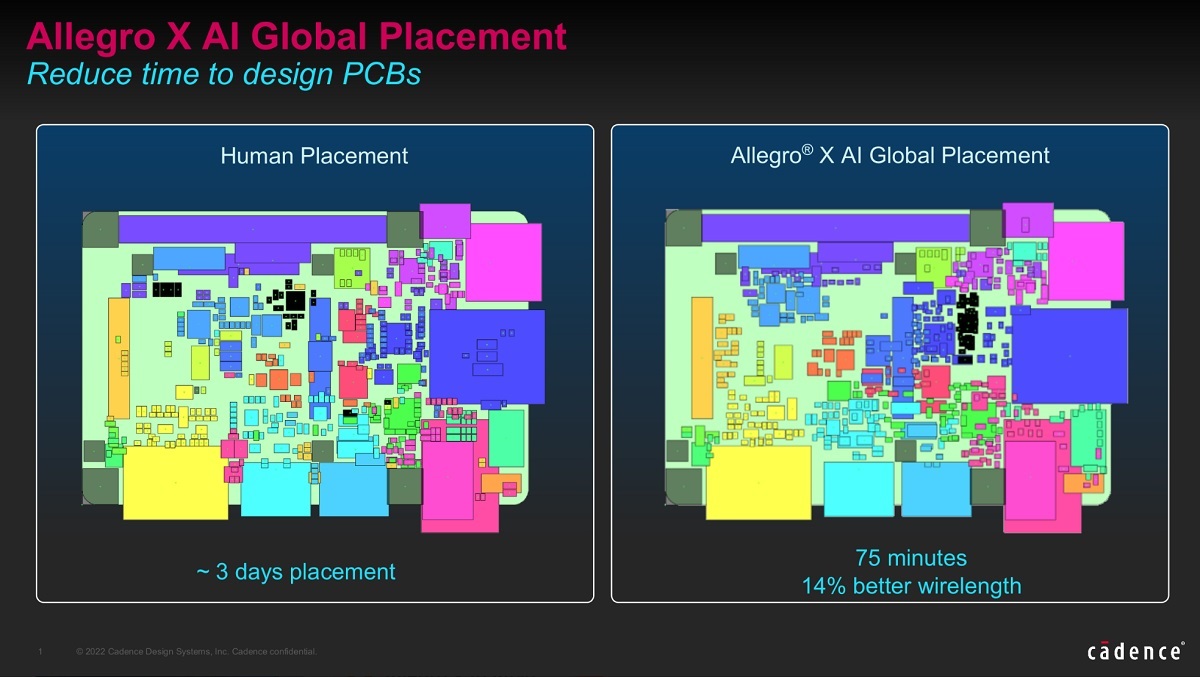
Nørgaard’s observation suggests a second benefit: trying arrangements a human might skip. Faster iteration can make comparison practical. But the goal remains an acceptable board. An attractive layout still needs the right constraints, component information, manufacturing checks and engineering review.
“placement options that I had not considered”
Allan Nørgaard / PCB Design, Velux
The expansion has a price tag
Cadence announced a roughly $1.24 billion transaction for BETA CAE in 2024, extending its structural-analysis capabilities. In February 2026 it completed the acquisition of Hexagon’s Design and Engineering business. That completion announcement put the price at approximately €2.7 billion, including estimated transaction-related taxes.
The addition brought MSC Software capabilities, including Nastran and Adams, into the portfolio. Structures and mechanical motion now sit alongside electronics and fluid simulation. This is a substantial commitment to customers building complete physical systems.

of Cadence’s FY2025 revenue came from its System Design and Analysis product category.Parent-company disclosure; a product category, not a separate listed company.
The business model is familiar enterprise software: licenses, maintenance, services and cloud access. Some OnCloud offerings use consumption tokens. A buyer’s calculation must include configuration, compute, training and workflow adoption alongside the license. The useful comparison is the cost of reaching a validated design with the team’s actual workload.
For a simple board, the additional analysis may offer little benefit relative to its setup effort. For a dense package or a thermally constrained system, the unanswered physical questions can justify much more investigation. The sensible purchase follows the engineering risk and the available expertise. It also depends on whether the team can supply and maintain trustworthy models.
Bring a board, not a wish list
There is a practical lesson here even for a team that never buys Cadence. Write down manufacturing limits before layout. Give electrical and thermal specialists a chance to influence placement. Compare alternatives while revisions remain manageable. Use measurements to check whether the model predicts the hardware you actually built.
That is also how to evaluate these tools. Bring a representative design and a baseline. Check what becomes faster, what still needs intervention, and whether the output satisfies your fabricator. Missing material properties, inaccurate component models or omitted constraints can make a sophisticated simulation misleading. The software earns its place when the earlier answer survives contact with the board.