signal-integrity
(4)
TE Connectivity
It is one of the largest companies most people have never heard of - the connector and sensor maker behind your car, your factory floor, and the AI data centers everyone else is busy hyping.

Stefan Pastine
Stefan Pastine is an American chemist, inventor and deep-tech founder who builds materials most people never think about but every device depends on. After earning a PhD in organic chemistry from Columbia and doing postdoctoral work at UC Berkeley, he founded Connora Technologies to make recyclable epoxy resins, which was acquired by Aditya Birla Chemicals in 2019. That same year he founded Thintronics, a Bay Area startup developing next-generation dielectric insulator films for printed circuit boards and semiconductor packaging. His pitch is deceptively simple: the insulator, long ignored while engineers obsessed over transistors, is the overlooked bottleneck for faster, cooler AI data centers - and Thintronics wants to unseat a Japanese giant that has held 90% of the market for three decades.

Thintronics
Thintronics is a San Francisco-based advanced materials company reinventing the humble insulator - the dielectric films that sit between the copper layers of every chip and circuit board. Founded in 2019 by chemist Stefan Pastine, the company designs new insulating materials from the molecular level up, aiming to deliver faster, lower-loss, lower-power interconnects for AI data centers, high-speed networking, and RF/millimeter-wave systems. Its pitch is pointed: challenge the Japanese incumbent Ajinomoto, which has held more than 90% of the dielectric build-up film market for three decades, with a US-made alternative built for the terabit age.
JITX
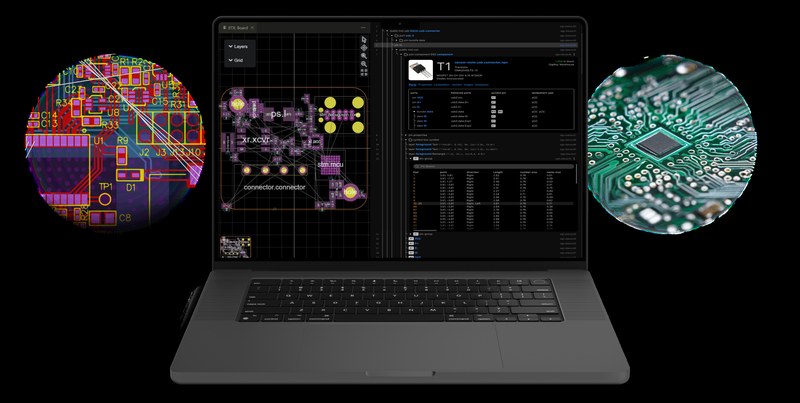
JITX is a Berkeley- and San Jose-based software company building a code-driven, AI-assisted platform for circuit board design. Instead of dragging parts around a canvas by hand, electrical engineers describe what a board must do in code, and JITX selects components, places parts, routes traces, and checks the design against electrical, mechanical, and manufacturing rules. Spun out of UC Berkeley and backed by Y Combinator and Sequoia Capital, the company is used by hardware teams at firms like Honeywell Aerospace, Lockheed Martin, Northrop Grumman, OpenAI, and HP, who report 5-20x productivity gains on complex multi-layer designs.