There are two agents in the story of a famous person endorsing mayonnaise, but only one is obvious. The celebrity's agent sits on one side of the table. On the other is a brand manager holding a brief, a budget, and the uncomfortable knowledge that a beloved actor can still be terribly wrong for a sandwich. Burns Entertainment sits beside that brand manager. It is the agent for the buyer.
That distinction explains a quiet Chicago company better than the usual parade of recognizable names. Burns does not manage Meg Ryan, Billy Crystal, Sydney Sweeney, Eugene Levy, Issa Rae, Juno Temple, Myles Garrett, Snoop Dogg, or Tom Brady. Yet all of them appeared in 2025 Super Bowl campaigns listed in Burns's portfolio. The company helped brands and agencies identify talent, value the package, negotiate the rights, close the contract, and carry the idea into the world.
The glamour is borrowed. The judgment is the product.
Fame is not one price
A celebrity deal is not a jar on a supermarket shelf. Its cost changes when a brand asks for another shoot day, another country, another platform, category exclusivity, permission to cut the footage into new shapes, or the right to keep using a face after the first campaign has run. Music adds publishing and master rights. Movie and television references bring their own owners. An influencer post may also be an ad, an appearance, a content license, and a paid-media asset.
Burns sells professional services around that stack: research, partner identification, valuation, negotiation, contracting, execution, partnership management, and measurement. The client pays for market knowledge and fewer surprises; the talent and rights costs sit inside a package defined by term, territory, media, exclusivity, and deliverables. A public rate card would be almost meaningless because changing one comma can change what the buyer is allowed to do.
The price of a famous face is a bundle
Illustrative, not a Burns pricing model. The point is structural: “How much?” is incomplete until the rights are defined.
This is where repetition becomes leverage. Burns says it negotiates hundreds of partnerships a year. Any one celebrity is unique, but the clauses, market norms, agents, managers, and tradeoffs recur. A brand team may negotiate a major endorsement once every few years. A specialist sees the market continuously.
Celebrities are not the only ones who need an agent's help.Bob Williams, former Burns CEO, explaining the buyer-side premise in 2014
The perfect match is a three-body problem
Marketers often talk about “fit” as though it were chemistry - a mysterious spark detected by the most creative person in the room. Burns treats it more like applied research. The talent must fit the audience, fit the brand, and fit the particular creative idea. Miss any side and the other two do not rescue the deal.
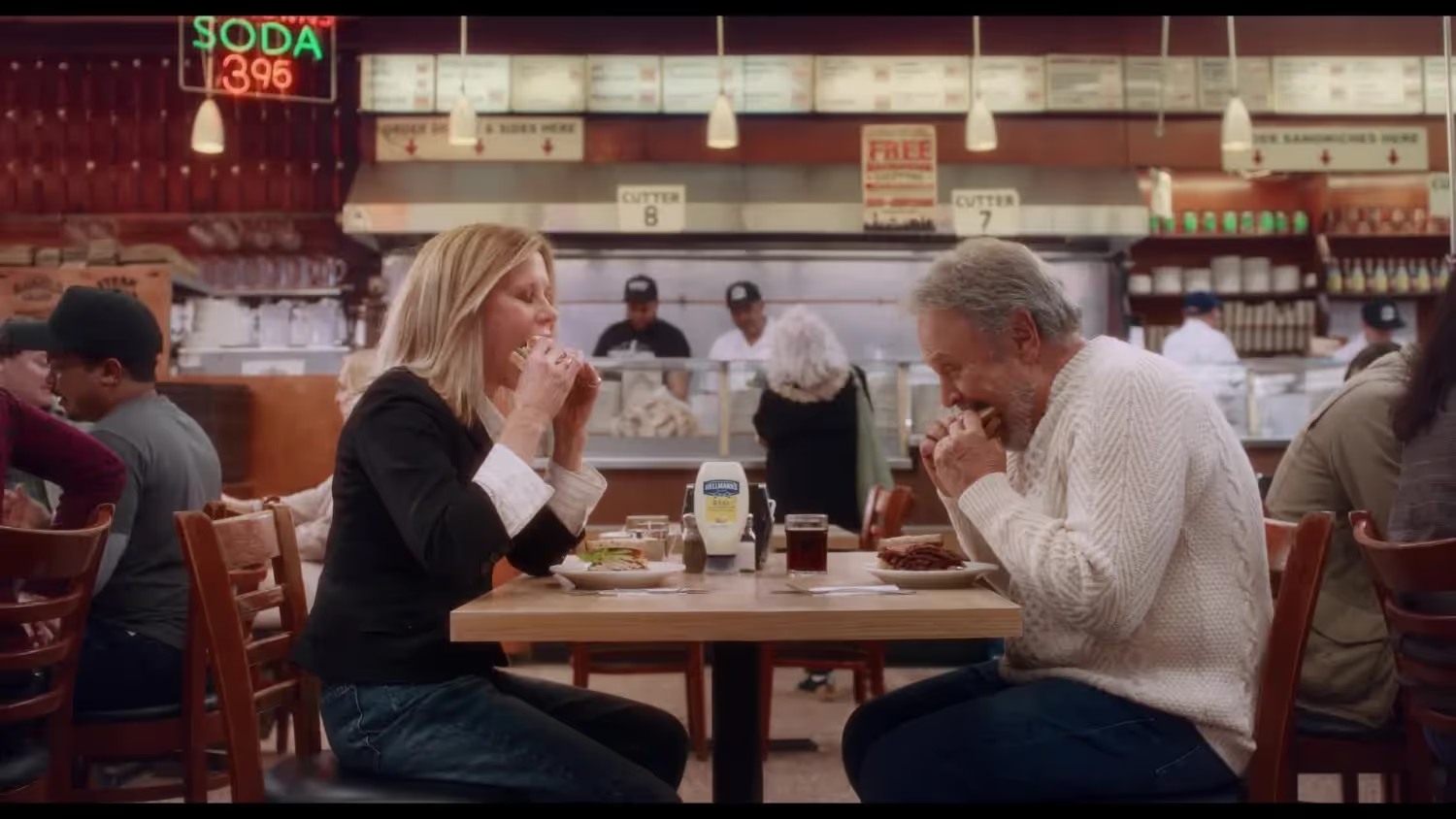
Consider Hellmann's “When Sally Met Hellmann's.” The 2025 spot reunited Meg Ryan and Billy Crystal at Katz's Deli, 35 years after When Harry Met Sally, then gave the film's famous final line to Sydney Sweeney. VML created the commercial; Burns received the talent credit. It worked because the casting was not ornamental. The people were the premise. Change the stars and the joke disappears.
The same portfolio shows the opposite trick. Little Caesars used Eugene Levy's famously animated eyebrows to sell Crazy Puffs. TurboTax put Issa Rae inside a musical tax fantasy. Oikos paired actor Juno Temple with defensive end Myles Garrett. The Foundation to Combat Antisemitism put Snoop Dogg and Tom Brady into an argument that became a call to reject hate. One vendor, five briefs, no single casting formula.
That variety is the competitive point. Talent agencies represent inventory, even when that inventory is exceptionally charming. Burns says it does not. Its obligation is to the brand and agency looking across the market. Alternatives include other entertainment-marketing specialists, an agency's in-house team, or direct negotiation with talent representatives. Burns's argument is that independence, transaction volume, and a combined talent-music-IP-sponsorship practice produce better choices and terms.
A company that kept widening the lens
David Burns founded the business on April 1, 1970. Bob Williams, a former public-relations executive, bought it in 1993. Entertainment attorney Doug Shabelman joined in 1996, followed by Marc Ippolito in 1997. Shabelman is now chief executive; Ippolito is president. The current leadership list includes specialists in growth, brand and agency partnerships, sports, entertainment, and music.
David Burns starts matching corporate buyers with entertainment talent.
Williams buys the company; Shabelman and Ippolito join over the next four years.
The strategic investor gives Burns a route toward a broader corporate and entertainment network. Terms stay private.
Burns lists four Super Bowl campaigns in 2024 and five in 2025.
Aimee Freisthler, Britta Fulton Idrees, Josh Spiegelman, and Lori Nelson enter the partnership group.
The service menu widened too. Celebrity spokesperson work now sits beside athlete deals, creator programs, micro- and regional-influencer events, sponsorship strategy, tour sponsorship, measurement, and licensing for music and screen IP. That change reflects an obvious shift in attention: the famous person on television is no longer the only cultural shortcut available to a marketer. A creator's community, a song, a sports property, or a film reference may do the job better.
In 2014, Azoff MSG Entertainment bought a 50 percent stake for an undisclosed sum. Williams described the deal as a way to take Burns to its next level. It connected a buyer-side procurement firm with a larger entertainment network without changing the core proposition. Four years later, Irving Azoff's company bought Madison Square Garden's share of their joint venture and renamed it The Azoff Company. Burns today describes itself as privately held and operates from Chicago, Los Angeles, and New York, with affiliate offices in Asia, Europe, and South America.
The useful lesson is to start before the name
A company cannot copy Burns's five decades of agent relationships by Friday. It can copy the order of operations. The common mistake is beginning with a famous name and reverse-engineering a reason. The more disciplined move is to specify the audience, behavior, emotion, channels, geography, time period, and measurement first. Only then does the shortlist mean anything.
Define what the partner must make an audience know, feel, or do before discussing names.
Talent fee, content use, media, territory, term, exclusivity, approvals, and cancellation belong in one picture.
A recognizable person who cannot carry the creative premise is expensive decoration.
Decide how earned media, social cuts, appearances, and reusable content extend the initial moment.
It will not work under every condition. Celebrity cannot repair a weak product, a vague offer, or a brand-talent contradiction. A one-off appearance may produce a burst but little durable value. And if a company cannot state what success means beyond impressions, it will struggle to tell borrowed attention from business impact. Burns increasingly emphasizes analytics because fame is visible while causality is not.
The firm's ideal customers are brands and agencies with enough at stake to justify specialist help: national or global campaigns, complicated rights, multiple markets, expensive media, or a partnership expected to live beyond a post. Smaller local promotions can often buy direct. The Burns model matters when a wrong choice is costlier than expert advice.
There is a pleasing modesty to the business. In the finished commercial, nobody applauds the negotiation. They remember Meg Ryan, the eyebrows, the song, the touchdown, or the punch line. Burns disappears behind the effect it helped arrange. For a company that sells access to fame, invisibility may be the most convincing proof of work.