At TowneBank, the interval used to be a week. A borrower asked for a construction draw - a release of money from a loan to cover work on a project - and then waited. In the bank’s account of adopting Built, that interval shrank to a day or two. It is a modest unit of progress, measured in mornings rather than skyscrapers. For someone trying to keep a project moving, mornings are rather useful.
- The job: connect construction money to the evidence needed to release it.
- The customers: lenders, owners, developers and contractors who share a project but often keep separate records.
- The twist: Built learned to accommodate the spreadsheet it once wanted to retire.
- The next bet: free standard payments with linked waivers, plus AI that can review draws under a lender’s rules.
The visible work of construction happens on a site. Its less photogenic counterpart happens in budgets, inspection reports, payment applications and inboxes. A request for money must be matched to a reason for paying it. Built occupies that stretch of administrative ground. Its cloud software brings the participants and their records together so a lender can understand a draw, a developer can track a budget, and a contractor can get through the paperwork attached to being paid.
The week between work and money
Built’s founding team - Chase Gilbert, Andrew Sohr and Scott Sohr - started in 2014 after firsthand frustrations with residential, commercial and land-development construction loans. The platform launched in 2015. Rather than begin with every activity on a building site, they concentrated on the lenders supplying its capital. That put the company at a handoff where information had immediate financial consequences.

A construction loan is administered across a changing project. Built’s construction loan tools gather budgets, draw schedules, inspections and stakeholders into a shared record, with reporting and risk monitoring around them. Its borrower portal gives invited users visibility into deals, documents and draw activity. The practical attraction is being able to see where a request stands without reconstructing the answer from separate messages.
Customer testimonial. A result from one bank, not a promised turnaround for every loan.
TowneBank’s experience is an illustration of the proposition, rather than a universal performance guarantee. At Waltz Construction, the customer account emphasizes time previously spent chasing compliance documents and cutting checks. The useful outcome there was room to examine project finances. Less clerical work matters partly because of the better work that can occupy its place.
The spreadsheet gets a reprieve
There is a revealing piece of company history from December 2017. Andrew Sohr wrote that Built had been known to say “Death to spreadsheets” around the office. After reading the uproar surrounding calls for finance teams to abandon Excel, he reconsidered the enthusiasm. Familiar software has a peculiar advantage: people know exactly how it will disappoint them. New software has yet to earn that intimacy.
“People don’t love being told to change their process.”
Andrew Sohr, Built co-founder / 2017
Sohr’s lesson concerned trust and demonstrating a better process before demanding surrender. It does not establish that an early Built product failed. It does show an assumption meeting resistance: an obviously tidier interface would not, by itself, settle the matter. A person with a working spreadsheet also has habits, knowledge and an investment in how the job gets done.
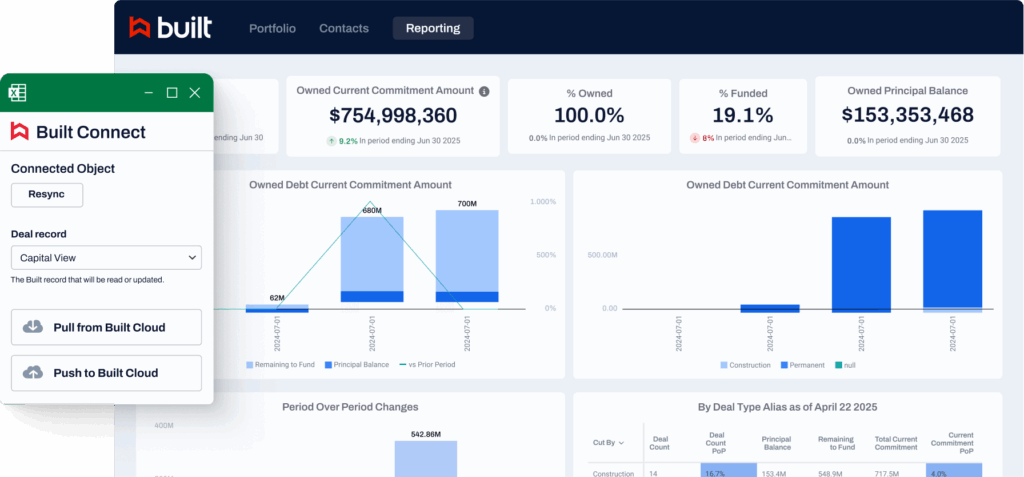
Later products make an interesting companion to that admission. Built’s commercial real estate tools support Excel-based financial models and file integration. The company that once wanted spreadsheets to retire now gives them a connection to shared data. That is a more plausible bargain for an analyst: keep a familiar workspace while making the information around it less isolated.
Follow the customer, then follow the money
In July 2022, Built acquired Nativ, a commercial real estate deal-management platform. Gilbert explained that lenders had begun asking for help beyond administering construction loans: underwriting, asset management and portfolio reporting were also difficult. Nativ supplied capabilities along that route, covering construction, transitional and stabilized properties.
The expansion makes sense because a lender’s information problem does not end when construction ends. A deal moves through underwriting, closing and ongoing management; its data must remain useful along the way. Built’s deal-management offering includes pipeline tools, document management, covenant tracking and portfolio analytics. Its construction financials tools address owners and developers, including budgets, capital requests, invoices and payables.
- 01RequestBudget + payment application
- 02ReviewInspection + documents + policy
- 03ReleaseApproval + payment + record
The financing behind this expansion was substantial. Built announced a $21 million Series A in 2017, a $31 million Series B in 2019 and an $88 million Series C in February 2021. That September, TCV led a $125 million Series D at a $1.5 billion valuation. The valuation belongs to that round and that moment. Citi added a strategic investment in 2023, supporting expansion in commercial real estate asset management.
Built’s current newsroom reports 355 lenders and more than 533,000 projects managed to date. Those are measures of a network and cumulative activity, not a count of paying subscriptions or company revenue. Its place in the market is specialized financial workflow software, with a widening set of connections between institutions and the people building their collateral.
A smaller door into a large platform
The wider platform is sold through business software and service agreements. There is also a more specific invitation. In October 2025, Built launched standard digital payments with linked lien waivers at no cost. Recipients can pay for faster access to funds. Standalone waiver management, without digital payments, was announced at $1,000 a month with unlimited waivers, projects and users.
That pricing belongs to those offers. It should not be mistaken for the price of the full lending or project-finance platform. Its product logic is straightforward: connecting a payment to its required waiver reduces the number of separate tasks someone must remember. The offer also lets a construction business enter through an immediate need rather than a wholesale software replacement.
An agent with a permission slip
Built launched its AI Draw Agent in November 2025, powered by MightyBot. Lenders can choose an audit mode that recommends actions for approval, an assist mode that handles routine steps while people retain final decisions, or an automate mode that executes when policies are satisfied and flags exceptions. The choice of authority is part of the design.
Built reported reviews taking as few as three minutes in early-adopter programs. The company says its results reflect internal analyses and vary by lender, portfolio and configuration. A review lasting three minutes is also a different measure from the whole journey to funded money. The defensible interest is in documented decisions against configured policies, with humans able to keep their place in the approval chain.
The work before the ledger
In February 2026, Built announced its Sage Intacct integration; in March, it became a qualified Yardi ecosystem partner. These connections clarify its role. Teams can manage construction finance activity in Built while their accounting system remains responsible for the corporate books. Approved transactions flow into Yardi with the appropriate general ledger coding, reducing repeat entry.
Competition is real. Land Gorilla offers construction loan management, inspections and risk tools. Rabbet has development and construction-lending products. Built’s distinctive pitch is the span across lender administration, commercial real estate deals and contractor payments. Buyers should compare that span with their actual work. A broad platform is useful when its connections solve recurring problems the team has.
Copy the handoff, not the slogan
Built’s example offers a practical sequence: identify a repeated delay, bring its evidence together, measure the time it takes, and preserve the tools people have good reasons to trust. Its published implementation materials describe data migration, mapping, validation and collaboration with customer teams. Software comes with work, even when the demo looks effortless.
The approach depends on participants using the shared process and supplying dependable information. It cannot make an incomplete inspection report complete or make a project affordable by rearranging its documents. For a team choosing software, a sensible trial is one real draw: trace the request, exceptions, approvals and accounting entry. Count repeated work. Ask where human judgment remains necessary.
Construction makes an unusually good case for this kind of attention. The final object is tangible, but the permission to pay for it travels through records. Built has made a business of shortening that journey. Its spreadsheet lesson supplies the small, humane qualification: progress is easier to sell when it lets people bring some of their old competence with them.
Explore Built
See the platform, follow the company, or hear the people behind the product.