The sticky note that learned to speak developer
Getting client feedback on websites - made ridiculously easy. Clients point and click on a live site, and BugHerd turns every comment into a developer-ready task.
The most expensive sentence in web development is four words long: "the button looks wrong." A client types it into an email. Which button? Wrong how? On which page, which browser, which screen? By the time a developer has chased down the answer, an afternoon is gone and nobody has touched a line of code. BugHerd was built to kill that sentence. Instead of describing the problem, the client walks up to it and points.
The mechanic is almost boringly simple, which is the point. A reviewer opens the live website with BugHerd running on top of it, clicks the offending button, and types a note that sticks to that exact spot like a pin on a map. Behind the scenes, the pin quietly records the browser, the operating system, the screen resolution, and a screenshot of what the reviewer was looking at. That bundle lands on a task board as a ready-to-work ticket. The developer never has to ask "can you reproduce it?" because the answer is already attached.
Point
Client clicks the exact spot on the live site
Comment
They type a note - no login required
Capture
Browser, OS, screen & screenshot auto-attach
Track
It lands on the Kanban board as a task
01 / What it isA tool that lives on the page, not in the inbox
BugHerd is a visual feedback and bug tracking tool. That description undersells the specific trick it pulls off: it turns a webpage into a shared workspace where the feedback sits on top of the thing being discussed. Every comment becomes a card on a built-in Kanban board, sortable by priority and status, so a developer's morning is a queue of "here is the problem, here is where it lives" rather than a scavenger hunt through email threads and Slack messages.
There is a second, quieter feature that reviewers rarely notice and developers never stop appreciating. When someone leaves a pin, BugHerd fingerprints the session automatically - which is why the "works on my machine" argument tends to end quickly. The context that always used to go missing is now stapled to the complaint.

02 / Who uses itThe agency's favourite peacekeeper
The clearest way to understand BugHerd is to picture a web agency the week before launch. A client has been given a staging link and told to "send through any changes." What comes back is a document titled Final_Feedback_v4_ACTUAL.docx containing forty numbered items, half of which reference a page that no longer exists. This is the exact swamp BugHerd was designed to drain, which is why its core users are web development and digital agencies, marketing teams, and the in-house web and QA people who own a site after it ships.
The customer roster referenced across BugHerd's own materials leans on names like Canva, Deloitte, G5, King Kong and Apollo, but the numbers tell the more honest story: more than 10,000 companies and over 350,000 users spread across 172 countries. This is not a handful of whale accounts. It is a long tail of agencies and teams paying every month because the alternative is that Word document.
"We just migrated bug tracking from Asana and halved our testing time." Sam Duncan, BugHerd customer
03 / The problemFeedback that survives the trip to the developer
Website feedback has a translation problem. The person spotting the issue - a client, a marketer, a stakeholder - usually cannot describe it in the terms a developer needs. So the feedback gets lost in transit: vague, un-reproducible, missing the one detail that mattered. BugHerd's whole reason for existing is to make feedback that survives that trip intact. By anchoring the comment to a real element on a real page and grabbing the technical context automatically, it removes the guesswork on the receiving end.
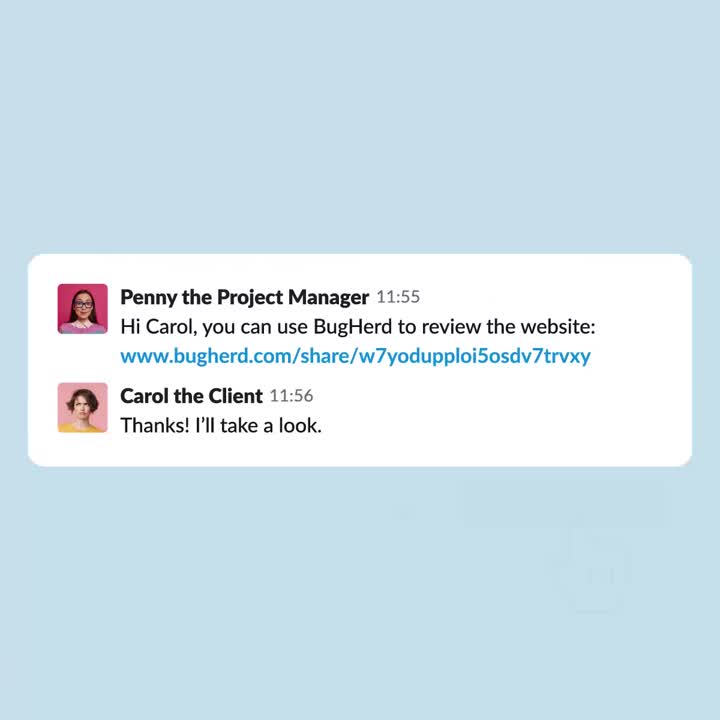
It also removes a friction that sounds trivial but is not: the login. Clients leave feedback through a shared link without creating an account. Anyone who has tried to get a busy client to remember a password for yet another tool understands why that single decision quietly powers the whole business.
04 / The differenceNarrow on purpose
You could track website bugs in Jira, Trello or Asana - plenty of teams tried, and BugHerd's own customers often arrive having escaped exactly those setups. The difference is not features; it is the front door. General project tools start from a blank ticket and ask you to describe the problem. BugHerd starts from the problem itself and builds the ticket around it. In the crowded visual-feedback category - alongside Marker.io, Usersnap, Userback and Pastel - BugHerd's edge is age and focus. It has been sharpening this single workflow since 2010 and, tellingly, was running Kanban boards for feedback before Trello made the format famous.
Rather than fight the tools where the actual coding happens, BugHerd feeds them. It runs two-way integrations with Jira, Asana, Trello, ClickUp, monday.com, Linear and Teamwork, one-way notifications into Slack and Microsoft Teams, a GitHub connection for developers, a WordPress integration, and an API with webhooks for everything else. The pitch to a skeptical engineering lead is not "replace your stack." It is "let the messy human feedback arrive as clean tasks inside the stack you already have."
05 / The productsOne job, sharpened over fifteen years
The product line reads like a series of answers to "what else stops feedback from being actionable?" There is the core web app and its Kanban board; the Chrome and Edge browser extensions that let anyone annotate a page; Share via Link for account-free client review; and Suggest Text Edits, which lets a reviewer highlight copy and propose the exact wording rather than writing "change this bit." In its most recent chapter the company added BugHerd AI and a Model Context Protocol integration, aimed at triaging incoming feedback and routing it toward developer tools with less manual sorting.
"BugHerd speeds up our implementation tenfold." Ashley Groenveld, G5
06 / The businessUn-hyped on purpose
BugHerd is a subscription business, sold in tiers - Standard, Studio, Premium, Deluxe and a custom Enterprise plan - priced by the number of members and projects, with a free trial feeding the funnel. Agencies are ideal customers here: they buy multiple seats, they renew because the workflow is baked into how they ship, and they bring their clients into the tool as guests. A reported retention rate above 90% is the kind of number that makes a bootstrapped-style SaaS quietly durable.
The company's own tone about all this is refreshingly flat. It has publicly described itself as not being "unicorns pooping rainbows on a rocket to the moon" - a line that doubles as a strategy. After raising roughly $1.5 million from Tankstream Ventures and Starfish Ventures between 2012 and 2014, the founders eventually bought out the majority of their investors to reclaim focus. Owning a profitable niche beat renting a hyped one.
07 / The expertiseFounders who build for the people who build the web
BugHerd was founded in 2010 in Melbourne by Alan Downie and Matt Milosavljevic, who had already co-founded UsabilityHub the year before. Their pattern is consistent: they build tools for the people who make websites. BugHerd was one of the first Australian teams into the 500 Startups Batch 1 and the Startmate accelerator - an early sign that a point-and-click bug tracker from Melbourne was worth paying attention to.
The middle years were not smooth. Around 2015 the company lost its focus chasing side products, and by its own account came close to collapse - layoffs, a near-sale, the team asked to walk away. What happened next is the part worth stealing: instead of scaling into the wall, they shrank back to the one job the product did well. In 2018 Stephen Neville stepped in as CEO alongside Downie, the investors were mostly bought out, and the company - operating today under the Splitrock Studio name after years as Macropod - rebuilt around website feedback and nothing else.
"We tried to take on more than we could handle, tackled problems we didn't understand, and lost focus on what makes us 'us'." Alan Downie, co-founder
08 / The marketThe small, sticky middle of the web
BugHerd sits in a specific slice of the market: the handoff between the people who see a website and the people who fix it. That slice is not glamorous and it will never produce a headline valuation, but it is everywhere. Every agency, every marketing team, every product with a public web presence eventually needs someone non-technical to say "this is wrong" in a way a developer can act on. BugHerd found a 350,000-user business hiding inside that single, universally hated step - and then it did the harder thing, which was to resist the temptation to become anything more.
Fifteen years in, the story is less about software than about restraint. The sticky note learned to speak developer, and the company that made it learned to stop trying to be everything else.