Consider the client who comes back for her shoes. At J.M. Weston, a pair might return years after its purchase for care or repair. The visit looks like a service request on a spreadsheet. To an attentive advisor, it is the next chapter of a relationship. BSPK is built for that advisor: the one who needs to know what happened before this moment, and what might matter after it.
The software sits between a luxury brand's scattered systems and its sales floor. It connects purchase history, online behavior, stock information and conversations in a client profile that can travel with the customer. The associate can then send a relevant message, curate a small collection, book an appointment or find an item in another store. The proposition is deceptively modest. Remember people. Then do something useful with what you remember.
- What it sells: mobile clienteling software, unified customer data and AI-assisted outreach for retail teams.
- Who buys it: luxury, premium and specialty brands; store associates and customer teams use it daily.
- What it costs: the Shopify app lists at $399 a month; larger platform plans require a quote.
- The test: an advisor must actually use the information before it becomes a better customer experience.
A personal service business with impersonal plumbing
Luxury retailers have always sold attention along with merchandise. Yet the details that make attention credible are often split between a point-of-sale system, an ecommerce platform, a marketing database and the private memory of an employee. One store knows the size. Another knows the last order. The website knows what was browsed. The person standing in front of the client may know none of it.
BSPK calls the remedy clienteling: gathering those signals, recording the advisor's own knowledge and making the result easy to act on. Its product includes client profiles, messaging by SMS, email and chat apps, visual product curation, inventory lookup, appointment scheduling, team communication and performance reports. The company lists integrations for Shopify, Microsoft Dynamics 365, Salesforce, Cegid and others. It says retailers can add the platform over an existing stack rather than replace each system.
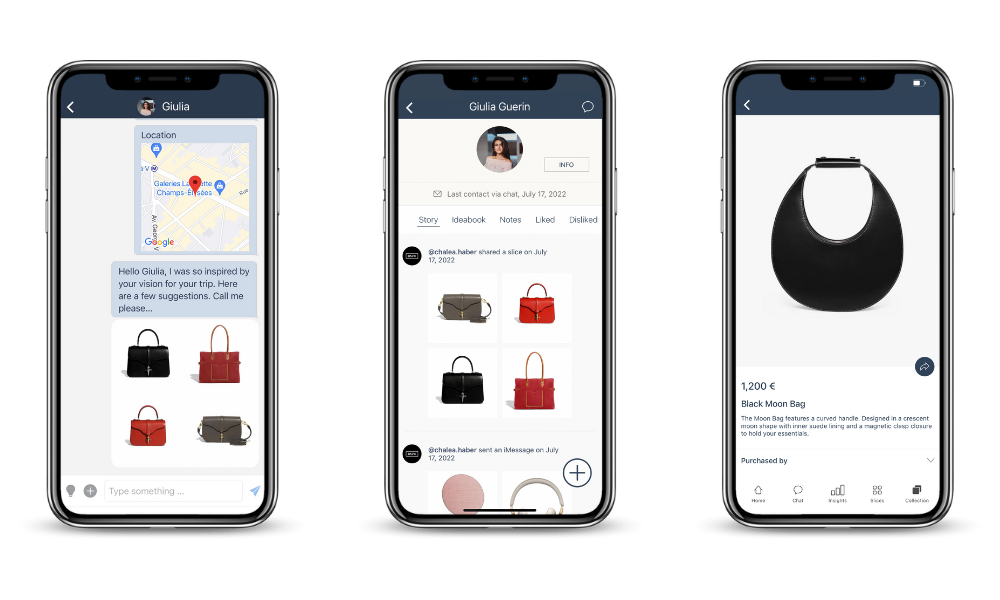
That positioning puts BSPK in a busy market. Retailers can buy broad CRM software, use a clienteling specialist such as Tulip or Salesfloor, or improvise with spreadsheets and personal phones. BSPK's argument is that luxury sales work has its own rhythm. The best action is rarely a mass campaign. It may be a single message about a shoe in stock, sent by someone the customer already trusts.
“Our clients entrust us with shoes that have walked years with them. BSPK lets us treat each visit as a new chapter in the relationship, not a transaction.”
Gilles Aulibé / J.M. Weston, as quoted by BSPKThe pilot that became a habit
Founder and CEO Zornitza Stefanova started BSPK in 2018. The timing mattered. By 2020, when the company raised a $7 million Series A led by Northern Light Venture Capital, boutiques were learning how hard it was to maintain personal service when clients could not always walk through the door. Stefanova described a tool connecting stores and websites to advisors through mobile and video. The round brought reported venture backing to $9 million and was earmarked for expansion and development.
Bonpoint offers a clearer picture of the work than a funding announcement does. The French childrenswear brand began with a New York store pilot and, according to BSPK's case study, extended the platform across its US stores within a year. A Bonpoint review on Shopify later described customer history from Shopify and Cegid Y2 appearing in one place and praised visual Stories that associates could send to clients. Those are customer accounts, not audited proof of return on investment. Their value lies in the sequence: connect records, make them usable, then give staff a reason to return to the app.
Victoire, a group of independent boutiques, began from another familiar place: no centralized clienteling system, no structured CRM and no internal lead to drive the project. BSPK says it provided coaching as well as software while each boutique kept its autonomy. The lesson is transferable. A customer database does not fill itself; someone must decide what to capture, how a follow-up should look and who helps the team establish a habit.
First remember. Then automate.
BSPK's recent language has shifted toward AI and agentic commerce. The sequence it describes is sensible: capture what an advisor learns, unify it with transactions and behavior, then activate that knowledge in outreach. Its agents can find customers worth contacting and draft a message using a unified profile. BSPK says an associate can review and approve before it goes out. The machine does the sorting and drafting; the human remains responsible for the tone and judgment.
The order matters. If the important facts remain in notebooks or leave with an employee, an AI suggestion will be fluent but thin. If the inventory is wrong, a beautifully timed message promises something the brand cannot deliver. BSPK's own writing names the first failure plainly: advisor knowledge has often never been captured in a form the brand owns. That diagnosis is more useful than a claim that AI will somehow know the customer by itself.
The company now sells Boutique, Growth and Enterprise tiers. Its pricing page says charges are based on AI credits rather than user seats, and it quotes onboarding of one to two weeks for most brands, longer for complex stacks. Public prices for those tiers are not posted. Separately, the Shopify App Store lists the BSPK app at $399 per month and says custom plans can start at $299. That is an entry point, not a reliable estimate for a multinational deployment.
What another retailer can steal
The practical idea does not require buying BSPK. Start with a narrow moment: an item returns to stock, a client has been quiet for 90 days, or a repair brings someone back to the boutique. Put the relevant history in front of the person who will respond. Give that person a product worth mentioning and a channel the customer has agreed to use. Measure whether the note was sent and whether the next interaction improved. Only then widen the program.
BSPK's business is to make that sequence repeatable across stores and systems. For a luxury brand, the prize is continuity: a customer should not have to reintroduce herself every time the channel changes. For an advisor, it is a chance to sound less like a campaign and more like the person who remembered the shoes.