Bryan Merica watched The King’s Speech late. By the time he got around to the film on demand, he admitted, the conversation among friends had probably moved on. His response to a movie about royal broadcasting was to write about disruptive communications technology. Some people finish a film and discuss the acting. Merica found a business problem.
That small episode, recounted in 2011, offers an entrance into his working life. A new medium changes what a speaker can do, what an audience expects, and which old habits suddenly become expensive. Radio supplied the historical example. The internet supplied the professional question. Merica was already building businesses around the distance between sending a message and getting somebody to respond.
Today, he is the Sacramento-based co-founder and chief executive of Unearth, a public affairs technology company. The career leading there passes through management consulting, enterprise software, political campaigns, and a California commentary site. Across those settings, his published work keeps returning to a practical concern: how does information become useful to the person making a decision?
A software background, a political destination
Merica studied business administration at the University of the Pacific, graduating summa cum laude. His LinkedIn profile lists his university years as 1992 to 1996. He began his career with Price Waterhouse and Deloitte & Touche, then worked as a senior strategist at PeopleSoft. Before campaign technology became his business, he had experience with the systems large organizations use to operate.
In 2003, he formed ID Media. By 2008, his political consulting firm was being recognized for its emphasis on technology and online strategy. The distinction matters to the shape of his career. Political communication was becoming a software problem as well as a creative one: the message needed an interface, a distribution method, and some way to examine the response.
That same year, Merica co-founded Fox & Hounds Daily with Joel Fox and Tom Ross. Its stated mission brought a business-and-economic-growth perspective to California political debate. Merica’s professional interests now had two outlets: helping organizations communicate and helping maintain a place where arguments about the state could circulate.
Listening to half a million mentions
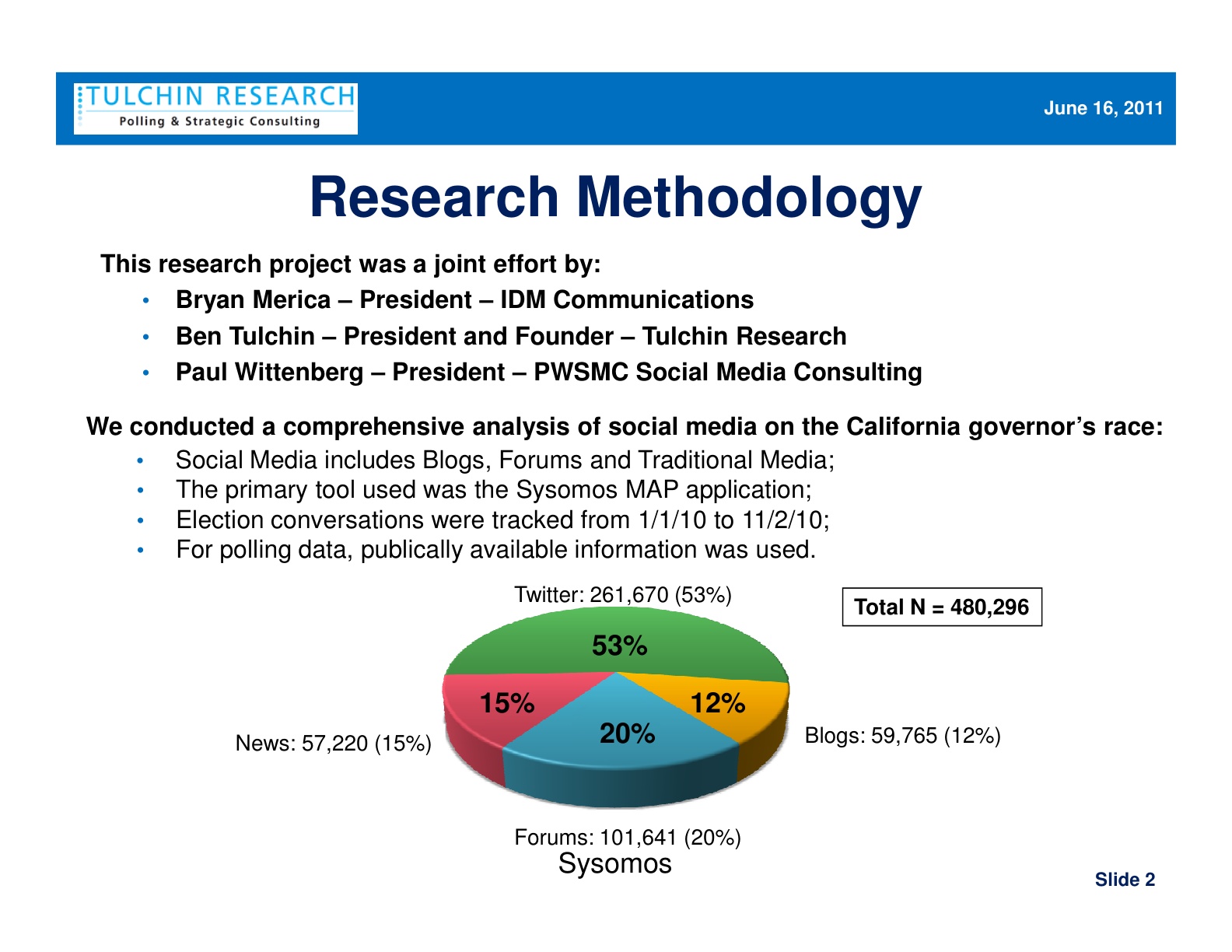
The 2010 California governor’s race provided a concrete opportunity to examine online political conversation. Merica worked with pollster Ben Tulchin and social media consultant Paul Wittenberg on research presented in June 2011. Their dataset covered 480,296 mentions across Twitter, forums, news, and blogs. Twitter accounted for roughly 53 percent of the total.
The team compared online sentiment about Jerry Brown and Meg Whitman with conventional polling. It also examined spikes around campaign events, including Brown’s announcement, the primary election, and controversy involving Whitman’s former housekeeper. A campaign could watch an argument emerge, measure its size, and examine how people described the candidates as it unfolded.
The value was immediacy. The difficulty was interpretation. These were collected mentions, rather than a count of individual voters or a representative survey sample. One person can speak repeatedly; another can vote without posting anything. The study made an argument for listening alongside polling. Its scale alone could not turn online conversation into the electorate.
A dashboard with somewhere to go
Writing after the 2012 election cycle, Merica said companies he co-founded and helped lead had provided digital solutions to more than 300 campaigns across the country and political spectrum. His assessment was hardly a victory lap. He argued that campaigns had yet to use social media fully, and that monitoring tools needed to become easier to use, more predictive, and more accurate.
He described the awkwardness of using enterprise software for political work. A platform could sort yesterday’s mentions into an attractive report while doing less to support a decision that had to be made immediately. His criticism was directed at the fit between the tool and the user’s task. Campaigns needed software designed around the pace of a campaign.
He also singled out sentiment scoring. Finding a mention and correctly judging whether it helps or hurts are separate jobs. The distinction gives his enthusiasm for analytics a useful limit: collecting more material does not remove the need to understand it. A very busy dashboard can still leave its owner with the original question.
The story has to survive the click
For all the attention to measurement, Merica’s writing does not give numbers sole custody of persuasion. In February 2018, he described communication as a combination of art and science, putting the story at its center. The phone mattered because it was close to the audience. The message mattered because the audience could leave.
His proposed sequence began with campaign objectives, followed by choices about digital media, with traditional channels integrated to amplify the message. Measurement then allowed the organization to change course. He treated media buying as an ongoing process, rather than a plan completed once and filed away.
There is something revealing about that combination of storytelling and adjustment. A story needs a coherent point of view. A campaign also needs the humility to see when people are responding differently from what its creators expected. The spreadsheet and the sentence have to share a desk.
“it’s all about the story.”
Bryan Merica, 2018
Platforms lend an audience
In November 2018, Merica examined underdog candidates’ use of Facebook and digital content. He emphasized emotional connection and engagement, discussing politicians from different parties. Beto O’Rourke’s unsuccessful Senate campaign appeared alongside examples of candidates who won. The argument concerned the way campaigns built relationships with voters; spending and attention were not presented as substitutes for an election result.
Two months later, he considered a less comfortable question: what if the platform changed its terms? His January 2019 essay outlined possible futures for Facebook, including restrictions on political advertising and shifts away from its existing advertising model. He used a three-horizon strategy framework to organize those possibilities.
These were forecasts. Their significance here is the habit of looking beyond a currently useful channel. Merica considered alternative ways to deliver messages and asked how campaigns might operate under different business rules. A platform’s popularity could make it valuable while leaving the organizations using it dependent on choices they did not control.
His conclusion supplied the compact version: “What worked yesterday won’t work tomorrow.” Read as a strategist’s warning, it asks the client to keep adapting. The tools are rented rooms in a building whose owner may rearrange the corridors.
Influence comes with scrutiny
That work also carries public consequences. A 2016 independent review of matters involving UC Davis’s then-chancellor described the university’s engagement of IDMLOCO, identifying Merica and Matthew Eagan as its co-founders. The initial 2014 contract called for search engine results management; a subsequent contract concerned an integrated social media program for executive communications.
The episode places reputation work inside Merica’s broader career. Helping an institution shape its online presentation involves choices about what receives attention. For a public institution, the expenditure and purpose of that work also become subjects of public examination. Persuasion does not stop being accountable because its tools are technical.
Make the numbers readable
In a 2017 guide co-authored with Eagan, Merica approached data visualization through three tests: available, accessible, and actionable. Could the team obtain the information? Could someone understand it? Would it help that person act? The order discouraged designing an impressive interface before deciding what it needed to accomplish.
The guide recalled inspiration from Business 2.0 infographics and Edward Tufte, then used Unearth’s work for the California Center for Jobs and Economy to explain the process. It described assembling scattered economic information and organizing it into geographic views. The underlying ambition was plain: let people examining policy get to the evidence without requiring them to excavate it from separate files.
This is a quieter form of persuasion than a campaign advertisement. Presentation changes which comparisons a reader can make and how quickly those comparisons become legible. The authors’ three tests put the user’s ability to do something with the information ahead of the designer’s opportunity to decorate it.
A rehearsal for policy
By September 2022, Merica was writing about digital twins: models of real objects or systems that can be used to test scenarios. His essay considered whether the approach could help policymaking keep pace with technological change. It moved his interest in information beyond observing reactions to exploring consequences before a decision was implemented.
His example was a local sales tax increase to support highway work. A simulation might examine revenue together with effects such as reduced traffic and time saved by commuters. He also proposed comparing models with results after implementation, allowing later versions to improve.
Merica presented digital twinning as an imperfect but promising approach. The appeal was the ability to explore multiple possibilities without first running each experiment in the real world. The proposition extends a recurring theme in his work: make complicated information usable at the moment it can affect a choice.
The people behind the machinery
Unearth’s current tools cover different parts of that process. Scout analyzes online conversations; Optic presents complex data; Portal helps constituents deliver messages; Atlas targets contacts around decision makers; Impact provides digital media buying. These are the company’s stated functions, a picture of its approach rather than proof of any particular campaign outcome.
Merica’s responsibilities include company direction, product vision, and developing leaders. In October 2024, he publicly thanked Jon Korn for leadership and innovation on Korn’s tenth anniversary at Unearth. His LinkedIn profile also records fifteen years of board service at Sacramento nonprofit WEAVE, ending in January 2025. His work has a local institutional dimension as well as a national campaign audience.
Another responsibility surfaced in January 2026. Columnist Joe Mathews recalled speaking with Merica at Joel Fox’s funeral. Merica, who had run the business side of Fox & Hounds, discussed the publication’s future. Mathews reported that he planned to continue it in Fox’s spirit.
The scene belongs beside the software and the strategy essays. A publication, like a campaign, relies on people carrying information to other people. Keeping it alive requires more than an audience metric. Someone has to take responsibility for the next edition, the next argument, and the work that lets the conversation continue.